
Best Time to Take Magnesium: Morning or Night, by Goal and Form
For most people, the best time to take magnesium is a consistent daily time with food; take glycinate 30–60 minutes before bed if your goal is sleep, and split doses above about 200 mg. Spacing matters more than the clock: take tetracycline or quinolone antibiotics 2 hours before or 4–6 hours after magnesium, keep it 2 hours from bisphosphonates, and allow about 4 hours from levothyroxine. Stay at or under 350 mg a day of supplemental magnesium unless a doctor advises more, and ask first if you have kidney disease.
Best Time to Take Magnesium: Morning or Night, by Goal and Form
By the HealthPerk Editorial Team · Last updated: October 2026
Quick Answer
What is the best time to take magnesium?
For most people, the best time to take magnesium is whenever you will take it every day, ideally with a meal. Take it 30–60 minutes before bed if your goal is sleep. Split larger doses into two. Space it from certain antibiotics, osteoporosis drugs, and thyroid medicine; some antibiotics need up to 6 hours, so confirm the gap with a pharmacist.
| Your situation | First step |
|---|---|
| Taking magnesium for sleep | Take glycinate 30–60 minutes before bed, the timing used in a 2025 trial |
| Taking it for constipation | Take citrate or oxide in the evening for a morning effect, starting low |
| Taking it for migraine prevention | Split the daily dose between breakfast and dinner, and ask your doctor about the dose |
| Taking levothyroxine in the morning | Move magnesium to the evening, at least 4 hours after your thyroid pill |
| Taking a tetracycline or quinolone antibiotic | Take the antibiotic 2 hours before or 4–6 hours after magnesium |
| Kidney disease of any stage | Don't start magnesium until your doctor says it's safe |
 For most goals, a consistent daily time matters more than the exact hour, and evening suits sleep.
Search for the best time to take magnesium and you'll find confident answers: morning for energy, night for sleep, malate before the gym, threonate before work. Most of them come from supplement brands. The less exciting truth is that no published trial has compared morning and evening magnesium head to head. What research does show is how your gut absorbs magnesium, how food and dose size change that, and which medicines it blocks.
That evidence is enough to build a sensible schedule. This guide covers timing by goal (sleep, constipation, cramps, migraine, anxiety), by form (glycinate, citrate, oxide, L-threonate, malate), and around common medicines and minerals. If you want to know whether magnesium helps at all, start with our evidence review of magnesium benefits for sleep and anxiety. If you want the right sleep dose, see our magnesium for sleep dosage guide. Here we focus on when.
Table of Contents
- Does the Time of Day Matter for Magnesium?
- How Magnesium Absorption Works and Why Timing Is Secondary
- Best Time to Take Magnesium by Goal
- When to Take Each Form of Magnesium
- Magnesium Forms and Timing Compared
- What Not to Take With Magnesium: Medication and Mineral Spacing
- Which Magnesium Schedule Is Right for You?
- How to Build Your Magnesium Schedule Step by Step
- Common Myths About Magnesium Timing
- When to See a Doctor
- Related Articles on Health Perk
- Frequently Asked Questions
- References
Does the Time of Day Matter for Magnesium?
Mostly, no. Magnesium is not a sleeping pill or a stimulant that acts within an hour and then wears off. Most of its proposed benefits depend on topping up the body's stores over weeks. An adult body holds about 25 grams of magnesium, mostly in bone and soft tissue, and less than 1% of it is in the blood. [1] One capsule at 8 a.m. versus 10 p.m. barely moves that total.
There is an interesting biological rhythm in play. A 2016 study in Nature found that the magnesium concentration inside human cells rises and falls over a 24-hour cycle, helping cells pace their energy use. [18] That was lab work in a human cell line and algae, though. It does not show that supplement timing changes any health outcome, and no clinical trial has tested that question.
So timing matters for three practical reasons, not a biological one:
- Goal-specific effects. If you want help falling asleep, an evening dose lines up with your routine and with how sleep trials were run.
- Side effects. Laxative forms are better timed so their effect arrives when you're near a bathroom.
- Interactions. Magnesium blocks the absorption of several drugs, so the schedule has to work around them.
Beyond that, the best schedule is the one you'll keep. Missing doses costs far more than taking them at a "wrong" hour.
How Magnesium Absorption Works and Why Timing Is Secondary
Most competitor guides stop at "take it with food." The research lets us go one level deeper, and the details explain why dose size and meals matter more than the clock.
Your gut uses two absorption routes. In a classic 1991 study, researchers added 0 to 80 mEq (about 0 to 970 mg) of magnesium to a standard meal and measured how much was absorbed. Total absorption rose with the dose, but the share absorbed fell from about 65% at the lowest dose to 11% at the highest. [2] The authors described a saturable carrier route that fills up quickly plus a passive route that takes in a fixed small fraction. In plain terms, a big single dose wastes more magnesium than two smaller ones.
Splitting the dose helps. A 2011 crossover study gave 12 men the same 126 mg of magnesium in mineral water, either as two large servings or seven small ones across the day. Absorption was 50.7% with small servings versus 32.4% with large ones. [4] That was magnesium in water, not capsules, but it supports splitting doses above roughly 200 mg.
Food helps a little. In a 2002 stable-isotope study in 10 healthy women, magnesium absorption from mineral water was 45.7% on an empty stomach and 52.3% with a meal, a relative increase of about 14%. [3] The authors suggested slower gut transit and digestion products as the reason. Food also reduces nausea and loose stools for many people.
Form matters more than timing. Magnesium forms that dissolve well in liquid are absorbed better. The NIH Office of Dietary Supplements notes that small studies found aspartate, citrate, lactate, and chloride better absorbed than oxide and sulfate. [1] In one study, magnesium oxide was virtually insoluble in water, while citrate was 55% soluble and produced a much larger rise in urinary magnesium. [5] Another study measured the fractional absorption of oxide at just 4%. [6]
Age changes the picture. Gut absorption of magnesium falls and kidney excretion rises as people get older. [1] For older adults, splitting doses and taking them with food are reasonable ways to get more from each capsule.
Best Time to Take Magnesium by Goal
Your reason for taking magnesium is the biggest factor in choosing when to take it. Here is what the evidence supports for each common goal.
When to take magnesium for sleep
Take it 30 to 60 minutes before bed. In a 2025 randomized trial in 155 adults with poor sleep, participants took 250 mg of elemental magnesium as bisglycinate daily, 30 to 60 minutes before bedtime. After four weeks, insomnia scores improved more than with placebo (−3.9 vs −2.3 points), but the effect was small. [7] People with low dietary magnesium seemed to benefit most.
Older trials point the same way, with modest results. A 2021 meta-analysis of three trials in 151 older adults found that magnesium shortened the time to fall asleep by about 17 minutes compared with placebo, but the evidence quality was low to very low. [9] Evening dosing is a sensible routine. Just don't expect it to work like a sleeping pill, and give it at least four weeks.
If you are deciding between supplements, our magnesium vs melatonin comparison explains why melatonin's timing rules are stricter. Magnesium also fits well into broader ways to fall asleep faster without medication.
When to take magnesium for constipation
Laxative-strength magnesium citrate usually works within 30 minutes to 6 hours, so take it when you can stay near a bathroom, and don't use it as a laxative for more than a week without medical advice. Magnesium oxide and citrate work as osmotic laxatives. The unabsorbed magnesium draws water into the intestine and speeds things along. [1] That is why the poorly absorbed forms are the useful ones here.
The 2023 joint guideline from the American Gastroenterological Association and the American College of Gastroenterology gives magnesium oxide a conditional recommendation for chronic constipation. [10] In a 2021 placebo-controlled trial, 68.3% of people taking 1.5 g of magnesium oxide a day reported overall improvement, versus 11.7% on placebo. [12]
Laxative doses are higher than the 350 mg supplement limit, so they belong under a clinician's guidance. A review of magnesium oxide in constipation suggests starting at about 1 g a day, split into two or three doses, and adjusting by symptoms. [11] The same review notes that acid-reducing drugs like proton pump inhibitors (PPIs) and H2 blockers weaken the laxative effect of magnesium oxide, because it needs stomach acid to dissolve. [11]
When to take magnesium for muscle cramps
Timing matters less here because the evidence is weak. A 2020 Cochrane review found that magnesium is unlikely to give meaningful cramp prevention for older adults with nighttime leg cramps. [14] Results for cramps in pregnancy were conflicting, and no trials tested exercise-related cramps.
If you try it anyway, an evening dose is a reasonable choice for night cramps. Stop after about four weeks if nothing changes, and see a doctor if cramps are frequent or new.
When to take magnesium for migraine
Split the dose between morning and evening meals. The American Academy of Neurology and the American Headache Society rated magnesium as "probably effective" for preventing migraine (Level B) in 2012. [13] Trials have used up to 600 mg a day. [1]
Because that is above the 350 mg supplement limit, the NIH says migraine doses should be used only under a healthcare provider's supervision. [1] Splitting the daily amount improves absorption, based on the dose research above, and it tends to reduce diarrhea. Prevention takes regular daily use, so consistency matters more than the hour.
When to take magnesium for anxiety and stress
Any consistent time works. Many people prefer the evening, when stress and sleep problems overlap. A 2017 systematic review found "suggestive" evidence that magnesium helped mild anxiety in vulnerable groups, but the quality of the studies was poor. [15] A 2024 review of 15 trials reached a similar cautious conclusion for both sleep and anxiety. [16]
Magnesium is not a treatment for an anxiety disorder. If anxiety is keeping you awake, our guide to sleeping better with anxiety covers approaches with stronger evidence.
When to Take Each Form of Magnesium
The label on your bottle shows elemental magnesium, the amount of actual magnesium, not the weight of the whole compound. [1] That is the number to compare against the 350 mg limit.
Magnesium glycinate (bisglycinate). This form is bound to the amino acid glycine and is usually gentle on the stomach. It is the best-studied form for sleep in recent trials. [7] Take it in the evening, 30–60 minutes before bed. You can take it with or without a light snack.
Magnesium citrate. Citrate is well absorbed and has a mild laxative effect. [5] Take it with a meal. If loose stools are a problem, take it in the morning so any effect happens during the day. If you're taking it for constipation, an evening dose usually works by morning.
Magnesium oxide. Oxide has a high magnesium content per tablet but poor absorption. [6] It is mainly useful as a laxative or an antacid. Take it with a meal and water. Keep in mind that acid-suppressing drugs can make it less effective. [11]
Magnesium L-threonate. This form was developed to raise brain magnesium. That effect was shown in rats in 2010. [17] In a 2024 trial, 80 adults with sleep complaints took 1 g a day of the compound or a placebo for 21 days. Ring-measured deep and REM sleep scores improved compared with placebo. [8] The study was funded by the company that supplied the product. Brands often market threonate for daytime focus, but the sleep trial is the stronger human data. Evening or split dosing is reasonable. Note that 1 g of the compound supplies much less elemental magnesium than 1 g suggests.
Magnesium malate. Malate is often sold as an "energy" form for morning use. We found no good clinical trials that support the morning-energy claim or show it absorbs differently depending on the time of day. Take it whenever you'll remember, with food.
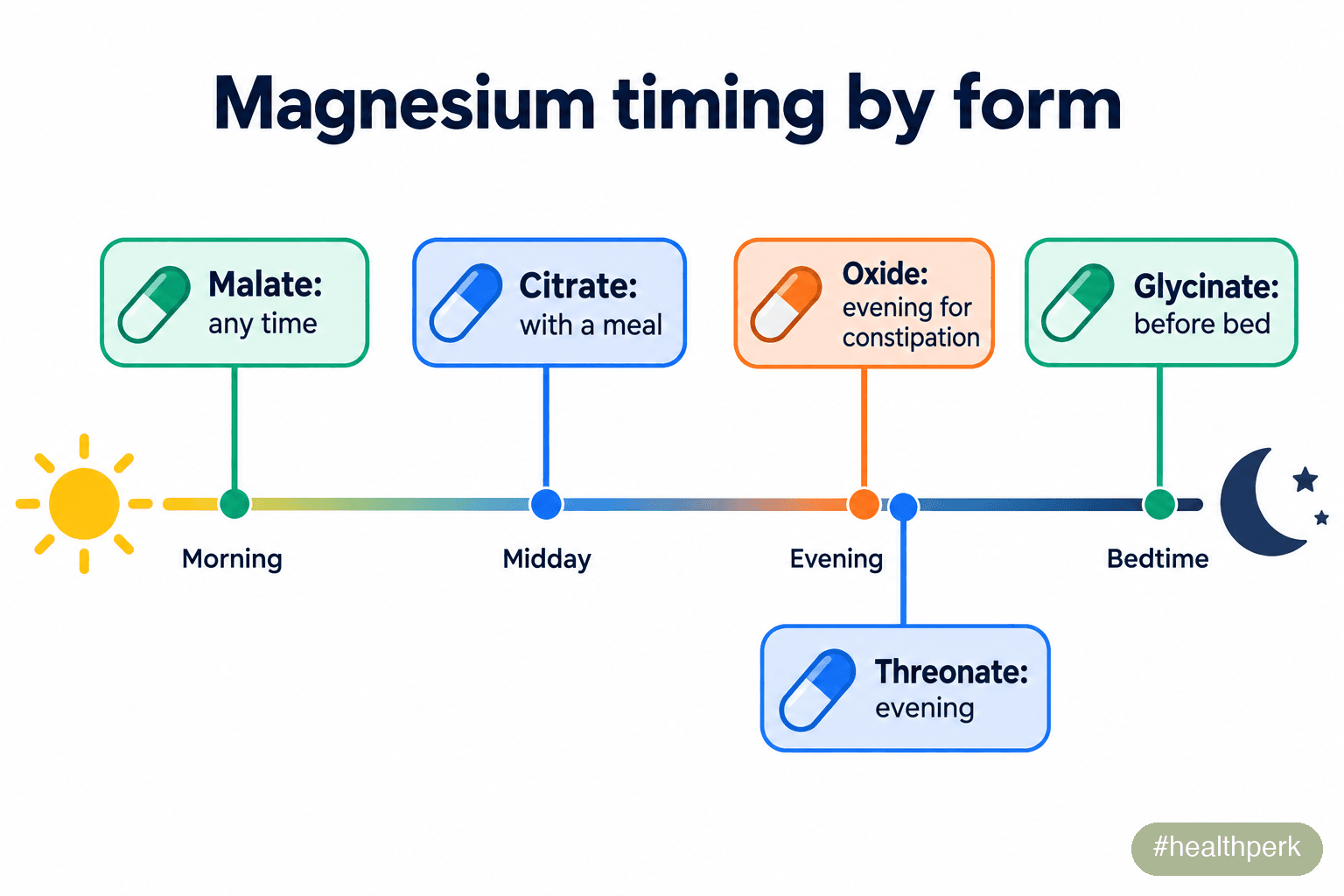 Schematic only: suggested timing by form, based on how each form was studied and how it behaves in the gut, not on head-to-head timing trials.
Magnesium Forms and Timing Compared
| Form | Suggested timing | Take with food? | Main use with evidence | Absorption | Gut side effects | Evidence strength |
|---|---|---|---|---|---|---|
| Glycinate | 30–60 min before bed | Optional | Mild insomnia, low intake | Good | Low | Moderate (one 2025 RCT, small effect) [7] |
| Citrate | With a meal; evening for constipation | Yes | Low intake, mild constipation | Good [5] | Moderate | Moderate |
| Oxide | With a meal; evening for constipation | Yes | Constipation, heartburn | Poor (about 4%) [6] | High | Conditional guideline recommendation for constipation (very low-certainty evidence) [10][12] |
| L-threonate | Evening or split | Optional | Sleep quality, brain-focused use | Not well studied in humans | Low | Limited (one industry-funded RCT) [8] |
| Malate | Any consistent time | Yes | General top-up | Not well studied | Low to moderate | Limited |
Our verdict. For sleep, choose glycinate in the evening. For constipation, choose citrate or oxide, timed so the effect comes when convenient. For a general top-up or migraine prevention, a well-absorbed form like citrate or glycinate split between two meals gives the most absorbed magnesium per milligram. Pay for threonate only if you accept that its evidence is early. The form you'll tolerate and take every day beats a "premium" form you skip.
What Not to Take With Magnesium: Medication and Mineral Spacing
This is where timing truly matters. Magnesium binds some drugs in the gut and stops them from being absorbed. It can also be depleted by other drugs. Here are the intervals from official sources:
- Tetracycline and quinolone antibiotics (doxycycline, ciprofloxacin, levofloxacin). Take the antibiotic at least 2 hours before or 4–6 hours after magnesium. [1] A review also flags azithromycin and some cephalosporins. [11]
- Oral bisphosphonates for osteoporosis (alendronate). Take magnesium at least 2 hours before or after. [1]
- Levothyroxine for hypothyroidism. Labels require at least 4 hours between levothyroxine and calcium carbonate or iron. Labels also list magnesium-containing antacids among products that can reduce its absorption and call for monitoring. [20] A cautious, practical approach is to take levothyroxine in the morning and magnesium in the evening. Confirm the gap with your pharmacist.
- Proton pump inhibitors (omeprazole, esomeprazole, lansoprazole). Long-term use, usually more than a year, can cause low magnesium. In cases reviewed by the FDA, supplements didn't fix it about 25% of the time. [1] Spacing doesn't solve this. Ask your doctor about a blood magnesium test.
- Diuretics. Loop and thiazide diuretics increase magnesium loss in urine. Potassium-sparing diuretics reduce it, which can push levels up. [1] Ask before you supplement.
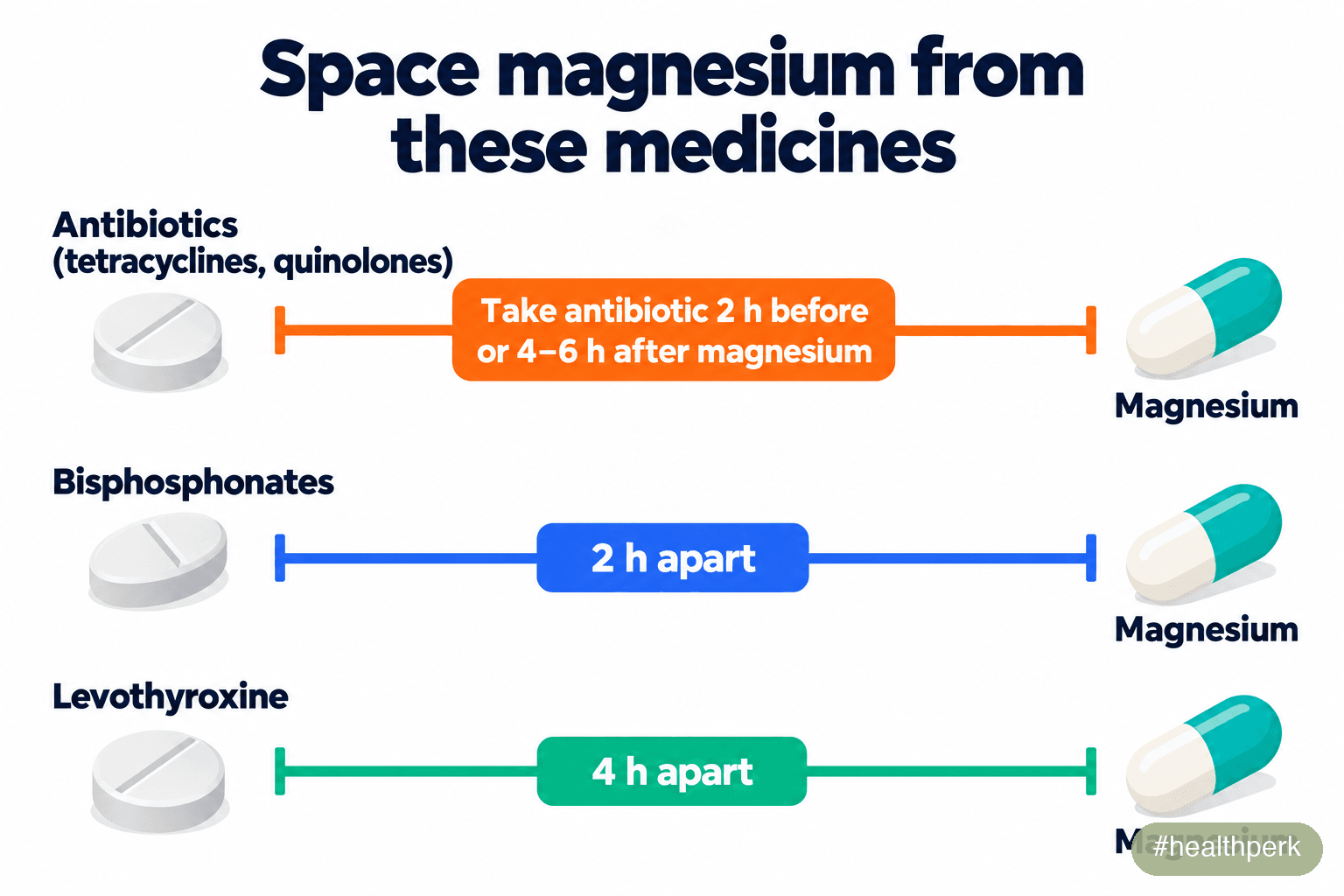 Spacing intervals from NIH and levothyroxine labeling: antibiotics 2 hours before or 4–6 hours after, bisphosphonates 2 hours, levothyroxine 4 hours.
What about zinc, iron, and calcium? High-dose zinc competes with magnesium. In a controlled feeding study, 53 mg of zinc a day lowered magnesium balance in postmenopausal women compared with a low zinc intake. [19] At ordinary multivitamin doses, the effect is likely small. Still, if you take a separate zinc, iron, or calcium supplement, putting it at a different meal than magnesium costs nothing. Our guide to taking multiple supplements together has a full spacing chart, and our zinc benefits guide covers safe zinc doses.
Which Magnesium Schedule Is Right for You?
The light sleeper who takes nothing else. Take 200–250 mg of elemental magnesium as glycinate 30–60 minutes before bed for four weeks. Track how long it takes you to fall asleep. Use our sleep cycle calculator to pick a bedtime that matches your wake-up time.
The office worker with migraines. Ask your doctor about a preventive dose. If they agree, split it between breakfast and dinner with food. Keep a headache diary for at least two to three months before deciding whether it helps.
The person on thyroid medicine. Take levothyroxine on waking as prescribed. Take magnesium with dinner or at bedtime, well over 4 hours later. Keep any iron or calcium supplement in that later window too, apart from your thyroid pill.
The older adult with constipation and heartburn medicine. Talk to your doctor first. PPIs can reduce magnesium oxide's laxative effect and can lower blood magnesium over time. [1][11] Kidney function should be checked before regular magnesium laxatives.
The athlete with night cramps. Magnesium has little evidence for preventing ordinary leg cramps, and no trials have tested it for exercise cramps. [14] If you try it, an evening dose for four weeks is a fair test. Our water intake calculator can help you check your daily fluids.
The shift worker. Anchor the dose to your main meal or your "pre-sleep" routine, whatever the clock says. Consistency with your own sleep period matters more than the time of day.
How to Build Your Magnesium Schedule Step by Step
- Check whether you need it. Look at your diet first. Leafy greens, legumes, nuts, seeds, and whole grains are good sources, and about 30–40% of food magnesium is absorbed. [1]
- Know your ceiling. The adult upper limit is 350 mg a day of supplemental magnesium, not counting food. [1] Higher doses need a doctor's supervision.
- Match the form to your goal. Glycinate for sleep, citrate or oxide for constipation, a well-absorbed form for a general top-up.
- Pick one fixed anchor. Tie the dose to something you do every day, like dinner or brushing your teeth before bed.
- Take it with food, unless it's a pre-bed sleep dose that sits well on an empty stomach.
- Split doses above about 200 mg into two servings, such as dinner and bedtime.
- Map your medicines. List every prescription and set gaps of 2 hours (bisphosphonates), 2 hours before or 4–6 hours after (antibiotics), and 4 hours (levothyroxine). [1][20]
- Give it four weeks, then judge the result honestly. Stop if it isn't helping or if you get diarrhea that doesn't settle with a lower dose.
Common Myths About Magnesium Timing
Myth: You must take magnesium at night to absorb it. No study shows better absorption at night. Absorption depends on dose size, form, and food, not the clock. [2][3]
Myth: Taking it on an empty stomach is better. In the one isotope study on this, absorption was slightly higher with a meal. [3] An empty stomach mainly raises the chance of nausea and loose stools.
Myth: Malate is energizing, so it must be a morning supplement. This is marketing logic. We found no clinical trial that shows a time-of-day energy effect for magnesium malate.
Myth: More magnesium in one dose means more benefit. The share absorbed drops as the dose rises. [2] A large single dose mostly raises the chance of diarrhea, which is the main reason the upper limit exists. [1]
Myth: Magnesium works like a sleeping pill tonight. Trials ran for weeks and found modest effects. [7][9] Any immediate calm is more likely from the bedtime routine itself.
When to See a Doctor
See a doctor before you start magnesium if you have kidney disease of any stage. Healthy kidneys remove extra magnesium, but impaired kidneys can't, and the risk of toxicity rises. [1] Also check first if you take any of the medicines listed above, or if you're pregnant.
Stop magnesium and seek prompt medical care if you notice:
- Muscle weakness, unusual drowsiness, or confusion
- Low blood pressure, dizziness, or facial flushing
- A slow or irregular heartbeat, or trouble breathing
- Nausea and vomiting, or being unable to pass urine
These can be signs of magnesium toxicity, usually from large doses of laxatives or antacids or from poor kidney function. [1] Also see a doctor if constipation lasts more than a few weeks, comes with blood or weight loss, or is new after age 50. Migraines that change pattern, and leg cramps with swelling or weakness, also need a medical check rather than a supplement.
Related Articles on Health Perk
- Magnesium Benefits for Sleep and Anxiety: A 2026 Evidence-Based Guide
- Magnesium for Sleep Dosage in Adults
- Magnesium vs Melatonin for Sleep
- Can You Take Multiple Supplements Together?
- Best Supplements for Sleep Without Melatonin
- How to Adjust Your Sleep to the Clock Change
Frequently Asked Questions
Should I take magnesium in the morning or at night?
Either works for most goals, because magnesium builds up over weeks rather than acting within hours. Choose night if you take it for sleep, since the 2025 glycinate trial used a dose 30–60 minutes before bed. Choose morning if night doses upset your stomach or if that's when you'll remember. Consistency matters more than the hour.
When should I take magnesium glycinate for sleep?
Take magnesium glycinate 30 to 60 minutes before bed. That's how it was taken in a 2025 randomized trial of 250 mg elemental magnesium, which found a small improvement in insomnia scores after four weeks. Take it nightly for at least a month before judging the result, and stay within 350 mg a day unless your doctor advises more.
Can I take magnesium on an empty stomach?
You can, but taking it with food is usually better. A stable-isotope study found absorption was about 14% higher, relatively, when magnesium was taken with a meal. Food also lowers the chance of nausea and diarrhea. A gentle form like glycinate at bedtime is often fine without food if your stomach tolerates it.
What should you not take with magnesium?
Don't take magnesium at the same time as tetracycline or quinolone antibiotics, oral bisphosphonates like alendronate, or levothyroxine. Take antibiotics 2 hours before or 4–6 hours after magnesium, keep bisphosphonates 2 hours apart, and allow about 4 hours for thyroid medicine. High-dose zinc can also lower magnesium balance, so take it at a different meal.
How long before bed should I take magnesium?
About 30 to 60 minutes before bed is a good target. It matches the timing used in recent sleep research and fits into a wind-down routine. If you take a larger dose, consider splitting it between dinner and bedtime. Splitting improves absorption and lowers the chance of a nighttime bathroom trip.
Is it OK to take magnesium every day?
Yes, for most healthy adults, if you stay at or under 350 mg a day of supplemental magnesium. That limit doesn't count magnesium from food. Higher doses, such as those used for migraine or constipation, should be supervised by a doctor. People with kidney disease should not take daily magnesium without medical advice.
When is the best time to take magnesium citrate for constipation?
Laxative-strength magnesium citrate usually works within 30 minutes to 6 hours, so take it when you can stay near a bathroom. Don't use it as a laxative for more than a week without medical advice. Drink a full glass of water with it and start with a low dose. If constipation lasts more than a few weeks or comes with warning signs, see a doctor.
Can I take magnesium with zinc, calcium, or iron?
You can take them on the same day, but it's best to take them at different meals. In one controlled study, a moderately high zinc intake of 53 mg a day lowered magnesium balance. Normal multivitamin amounts are less of a concern. Separating mineral supplements is an easy precaution and may also be easier on your stomach.
Medical disclaimer: This article is for general educational purposes only and is not medical advice. It does not replace diagnosis or treatment by a qualified healthcare professional. Talk to your doctor or pharmacist before starting, stopping, or changing any supplement, especially if you are pregnant, take prescription medicines, or have kidney or heart conditions. Read more about how we review health content.
References
- NIH Office of Dietary Supplements (2022). Magnesium: Fact Sheet for Health Professionals. National Institutes of Health. https://ods.od.nih.gov/factsheets/Magnesium-HealthProfessional/
Supports: 25 g body magnesium, <1% in serum; 30–40% of dietary magnesium absorbed; better absorption of aspartate, citrate, lactate, chloride vs oxide; supplemental UL of 350 mg; migraine trials up to 600 mg under supervision; interaction intervals for antibiotics and bisphosphonates; PPI and diuretic effects; toxicity signs and kidney risk; absorption declines with age.
- Fine, K. D., Santa Ana, C. A., Porter, J. L., & Fordtran, J. S. (1991). Intestinal absorption of magnesium from food and supplements. The Journal of Clinical Investigation, 88(2), 396–402. https://doi.org/10.1172/JCI115317
Supports: Fractional magnesium absorption fell from 65% to 11% as the dose rose from 0 to 80 mEq per meal.
- Sabatier, M., Arnaud, M. J., Kastenmayer, P., Rytz, A., & Barclay, D. V. (2002). Meal effect on magnesium bioavailability from mineral water in healthy women. The American Journal of Clinical Nutrition, 75(1), 65–71. https://doi.org/10.1093/ajcn/75.1.65
Supports: Absorption was 45.7% without a meal vs 52.3% with a meal, a 14.4% relative increase.
- Sabatier, M., Grandvuillemin, A., Kastenmayer, P., Aeschliman, J. M., Bouisset, F., Arnaud, M. J., Dumoulin, G., & Berthelot, A. (2011). Influence of the consumption pattern of magnesium from magnesium-rich mineral water on magnesium bioavailability. British Journal of Nutrition, 106(3), 331–334. https://doi.org/10.1017/S0007114511001139
Supports: Seven small servings gave 50.7% absorption vs 32.4% for two large servings of the same 126 mg.
- Lindberg, J. S., Zobitz, M. M., Poindexter, J. R., & Pak, C. Y. (1990). Magnesium bioavailability from magnesium citrate and magnesium oxide. Journal of the American College of Nutrition, 9(1), 48–55. https://doi.org/10.1080/07315724.1990.10720349
Supports: Oxide was virtually insoluble in water, citrate 55% soluble; citrate produced a larger rise in urinary magnesium.
- Firoz, M., & Graber, M. (2001). Bioavailability of US commercial magnesium preparations. Magnesium Research, 14(4), 257–262. https://pubmed.ncbi.nlm.nih.gov/11794633/
Supports: Fractional absorption of magnesium oxide was about 4%.
- Schuster, J., Cycelskij, I., Lopresti, A., & Hahn, A. (2025). Magnesium Bisglycinate Supplementation in Healthy Adults Reporting Poor Sleep: A Randomized, Placebo-Controlled Trial. Nature and Science of Sleep, 17, 2027–2040. https://doi.org/10.2147/NSS.S524348
Supports: 250 mg elemental magnesium as bisglycinate, taken 30–60 minutes before bed, reduced ISI by 3.9 vs 2.3 points at 4 weeks (small effect, d = 0.2) in 155 adults.
- Hausenblas, H. A., Lynch, T., Hooper, S., Shrestha, A., Rosendale, D., & Gu, J. (2024). Magnesium-L-threonate improves sleep quality and daytime functioning in adults with self-reported sleep problems: A randomized controlled trial. Sleep Medicine: X, 8, 100121. https://doi.org/10.1016/j.sleepx.2024.100121
Supports: 1 g/day magnesium L-threonate for 21 days in 80 adults improved ring-measured deep and REM sleep scores vs placebo.
- Mah, J., & Pitre, T. (2021). Oral magnesium supplementation for insomnia in older adults: a Systematic Review & Meta-Analysis. BMC Complementary Medicine and Therapies, 21(1), 125. https://doi.org/10.1186/s12906-021-03297-z
Supports: Sleep onset latency 17.36 minutes shorter vs placebo across 3 RCTs (151 older adults), low to very low quality evidence.
- Chang, L., Chey, W. D., Imdad, A., Almario, C. V., Bharucha, A. E., Diem, S., Greer, K. B., Hanson, B., Harris, L. A., Ko, C., Murad, M. H., Patel, A., Shah, E. D., Lembo, A. J., & Sultan, S. (2023). American Gastroenterological Association-American College of Gastroenterology Clinical Practice Guideline: Pharmacological Management of Chronic Idiopathic Constipation. The American Journal of Gastroenterology, 118(6), 936–954. https://doi.org/10.14309/ajg.0000000000002227
Supports: Conditional recommendation for magnesium oxide in chronic idiopathic constipation.
- Mori, H., Tack, J., & Suzuki, H. (2021). Magnesium Oxide in Constipation. Nutrients, 13(2), 421. https://doi.org/10.3390/nu13020421
Supports: Starting dose of about 1 g/day in divided doses; PPIs and H2 blockers reduce the laxative effect; caution in renal impairment; chelation with tetracyclines, quinolones, bisphosphonates, azithromycin, and some cephalosporins.
- Morishita, D., Tomita, T., Mori, S., Kimura, T., Oshima, T., Fukui, H., & Miwa, H. (2021). Senna Versus Magnesium Oxide for the Treatment of Chronic Constipation: A Randomized, Placebo-Controlled Trial. The American Journal of Gastroenterology, 116(1), 152–161. https://doi.org/10.14309/ajg.0000000000000942
Supports: Overall improvement in 68.3% with 1.5 g/day magnesium oxide vs 11.7% with placebo.
- Holland, S., Silberstein, S. D., Freitag, F., Dodick, D. W., Argoff, C., & Ashman, E. (2012). Evidence-based guideline update: NSAIDs and other complementary treatments for episodic migraine prevention in adults: report of the Quality Standards Subcommittee of the American Academy of Neurology and the American Headache Society. Neurology, 78(17), 1346–1353. https://doi.org/10.1212/WNL.0b013e3182535d0c
Supports: Magnesium rated "probably effective" (Level B) for migraine prevention.
- Garrison, S. R., Korownyk, C. S., Kolber, M. R., Allan, G. M., Musini, V. M., Sekhon, R. K., & Dugré, N. (2020). Magnesium for skeletal muscle cramps. Cochrane Database of Systematic Reviews, 9, CD009402. https://doi.org/10.1002/14651858.CD009402.pub3
Supports: Magnesium unlikely to provide meaningful cramp prophylaxis in older adults; pregnancy evidence conflicting; no RCTs for exercise-associated cramps.
- Boyle, N. B., Lawton, C., & Dye, L. (2017). The Effects of Magnesium Supplementation on Subjective Anxiety and Stress—A Systematic Review. Nutrients, 9(5), 429. https://doi.org/10.3390/nu9050429
Supports: Suggestive but poor-quality evidence of benefit for mild anxiety in vulnerable groups.
- Rawji, A., Peltier, M. R., Mourtzanakis, K., Awan, S., Rana, J., Pothen, N. J., & Afzal, S. (2024). Examining the Effects of Supplemental Magnesium on Self-Reported Anxiety and Sleep Quality: A Systematic Review. Cureus, 16(4), e59317. https://doi.org/10.7759/cureus.59317
Supports: 15 trials; most showed improvement in at least one sleep or anxiety measure, with mixed results.
- Slutsky, I., Abumaria, N., Wu, L. J., Huang, C., Zhang, L., Li, B., Zhao, X., Govindarajan, A., Zhao, M. G., Zhuo, M., Tonegawa, S., & Liu, G. (2010). Enhancement of learning and memory by elevating brain magnesium. Neuron, 65(2), 165–177. https://doi.org/10.1016/j.neuron.2009.12.026
Supports: Magnesium L-threonate raised brain magnesium and improved memory in rats.
- Feeney, K. A., Hansen, L. L., Putker, M., Olivares-Yañez, C., Day, J., Eades, L. J., Larrondo, L. F., Hoyle, N. P., O'Neill, J. S., & van Ooijen, G. (2016). Daily magnesium fluxes regulate cellular timekeeping and energy balance. Nature, 532(7599), 375–379. https://doi.org/10.1038/nature17407
Supports: Intracellular magnesium shows circadian rhythms in a human cell line and algae.
- Nielsen, F. H., & Milne, D. B. (2004). A moderately high intake compared to a low intake of zinc depresses magnesium balance and alters indices of bone turnover in postmenopausal women. European Journal of Clinical Nutrition, 58(5), 703–710. https://doi.org/10.1038/sj.ejcn.1601867
Supports: 53 mg/day zinc increased fecal and urinary magnesium loss and lowered magnesium balance.
- Pfizer (2026). LEVOXYL (levothyroxine sodium tablets): Drug Interactions. Pfizer Medical Information. https://www.pfizermedical.com/levoxyl/drug-interactions
Supports: Levothyroxine must be taken at least 4 hours apart from calcium carbonate and ferrous sulfate; magnesium-containing antacids can reduce absorption.
Frequently Asked Questions
Should I take magnesium in the morning or at night?
Either works for most goals, because magnesium builds up over weeks rather than acting within hours. Choose night if you take it for sleep, since the 2025 glycinate trial used a dose 30–60 minutes before bed. Choose morning if night doses upset your stomach or if that's when you'll remember. Consistency matters more than the hour.
When should I take magnesium glycinate for sleep?
Take magnesium glycinate 30 to 60 minutes before bed. That's how it was taken in a 2025 randomized trial of 250 mg elemental magnesium, which found a small improvement in insomnia scores after four weeks. Take it nightly for at least a month before judging the result, and stay within 350 mg a day unless your doctor advises more.
Can I take magnesium on an empty stomach?
You can, but taking it with food is usually better. A stable-isotope study found absorption was about 14% higher, relatively, when magnesium was taken with a meal. Food also lowers the chance of nausea and diarrhea. A gentle form like glycinate at bedtime is often fine without food if your stomach tolerates it.
What should you not take with magnesium?
Don't take magnesium at the same time as tetracycline or quinolone antibiotics, oral bisphosphonates like alendronate, or levothyroxine. Take antibiotics 2 hours before or 4–6 hours after magnesium, keep bisphosphonates 2 hours apart, and allow about 4 hours for thyroid medicine. High-dose zinc can also lower magnesium balance, so take it at a different meal.
How long before bed should I take magnesium?
About 30 to 60 minutes before bed is a good target. It matches the timing used in recent sleep research and fits into a wind-down routine. If you take a larger dose, consider splitting it between dinner and bedtime. Splitting improves absorption and lowers the chance of a nighttime bathroom trip.
Is it OK to take magnesium every day?
Yes, for most healthy adults, if you stay at or under 350 mg a day of supplemental magnesium. That limit doesn't count magnesium from food. Higher doses, such as those used for migraine or constipation, should be supervised by a doctor. People with kidney disease should not take daily magnesium without medical advice.
When is the best time to take magnesium citrate for constipation?
Laxative-strength magnesium citrate usually works within 30 minutes to 6 hours, so take it when you can stay near a bathroom. Don't use it as a laxative for more than a week without medical advice. Drink a full glass of water with it and start with a low dose. If constipation lasts more than a few weeks or comes with warning signs, see a doctor.
Can I take magnesium with zinc, calcium, or iron?
You can take them on the same day, but it's best to take them at different meals. In one controlled study, a moderately high zinc intake of 53 mg a day lowered magnesium balance. Normal multivitamin amounts are less of a concern. Separating mineral supplements is an easy precaution and may also be easier on your stomach.