Daylight Saving Time Sleep: How to Adjust When the Clocks Fall Back
When the clocks fall back, your body clock has to move one hour later, so shift bedtime and wake time 15 minutes later for four days beforehand, keep evenings bright, and keep early mornings dark. Evening melatonin pushes the clock the wrong way in autumn, so most people don't need it. The fall change is gentler than spring for heart and crash risk but is linked to more depressive episodes and is harder for early birds.
Daylight Saving Time Sleep: How to Adjust When the Clocks Fall Back
By the HealthPerk Editorial Team · Last updated: October 2026
Quick Answer
How do I adjust my sleep when daylight saving time ends?
The simplest daylight saving time sleep fix is to start four days early. Move bedtime and wake time 15 minutes later each night, so you're on the new schedule by Sunday. For the first week, keep evenings bright and early mornings dim, and skip evening melatonin, which shifts your clock the wrong way.
| Your situation | First step |
|---|---|
| Healthy adult with a regular schedule | Go to bed and get up 15 minutes later each day from Wednesday to Saturday |
| Early bird or adult over 60 who wakes too early | Get bright light from late afternoon to early evening and use blackout curtains for dawn |
| Parent of a baby or toddler | Push naps, meals, and bedtime 15 minutes later every day or two, starting about a week before |
| Night owl | Change little beforehand and simply keep your usual clock times after the switch |
| Night-shift worker on the change night | Plan for a shift one hour longer, with a nap before and a safe ride home |
| Low mood or winter blues every autumn | Plan daily outdoor light now and talk to your doctor if your mood drops |
 After the clocks fall back, dawn arrives an hour earlier on the clock, which is why early waking is the most common problem.
The clocks go back one hour on Sunday, October 25, 2026, in the UK and the European Union. In most of the United States and Canada, they go back on Sunday, November 1, 2026, at 2 a.m. local time. [1][2] Most people hear that they "get an extra hour of sleep." Research on daylight saving time sleep shows that's mostly a myth: few people actually sleep longer that night, and many lose sleep across the following week because they keep waking up too early. [3]
This guide explains what the time change does to your body clock, and gives you a day-by-day plan for both the October 25 and November 1 changes. It also covers babies, kids, and older adults, what melatonin can and can't do here, and what the research says about health effects. Finally, it explains why the American Academy of Sleep Medicine (AASM) wants the US to stay on standard time all year, even though the House voted in July 2026 for the opposite. [4][5]
Table of Contents
- What Happens to Your Body Clock When the Clocks Fall Back
- Is Falling Back Harder Than Springing Forward?
- Your Options: Gradual Shift, Light Timing, and Melatonin
- Daylight Saving Time Sleep Strategies Compared
- Which Fall Back Sleep Schedule Is Right for You?
- Day-by-Day Plan to Adjust to Daylight Saving Time Ending
- Health Effects of the Clock Change: What the Research Shows
- Permanent Standard Time vs Permanent Daylight Saving Time
- Common Myths About Falling Back
- When to See a Doctor
- Related Articles on Health Perk
- Frequently Asked Questions
- References
What Happens to Your Body Clock When the Clocks Fall Back
Your sleep timing is set by a master clock in the brain called the suprachiasmatic nucleus. It sits just above the point where the optic nerves cross. Special light-sensing cells in the retina tell it when it's light outside. In turn, it sets the evening rise in melatonin, your body temperature rhythm, and the hours you feel sleepy.
That clock doesn't run on exactly 24 hours. In carefully controlled lab conditions, the average intrinsic period of the human circadian clock is about 24.18 hours, in both young and older adults. [6] Daily light exposure nudges it back into step with the 24-hour day.
Why the fall change is a "delay." When the clocks go back, 11 p.m. on the new clock is midnight for your body. To sleep at your usual clock times, your internal clock has to move one hour later. Because most people's clocks naturally run a little longer than 24 hours, moving later is usually easier than moving earlier. That's one reason people tend to adjust faster in autumn than in spring. A German study that tracked 50 people for eight weeks around each change found that sleep and activity readily adjusted to the autumn change, but activity didn't fully adjust to the spring change. [7]
Light timing decides the direction. Light shifts your clock differently depending on when you see it. In a Harvard lab study of 21 healthy adults, bright light before the body's temperature low point, which usually falls in the last hours of sleep, moved the clock later, and light after it moved the clock earlier. [8] This is called the phase response curve. It matters here because the advice you'll often read, "get bright morning light," pushes your clock earlier, which is the opposite of what you need right after the fall change.
The early-waking trap. After the clocks go back, sunrise happens one hour earlier by the clock. If your body still thinks 6 a.m. is 7 a.m., you wake early, see that early light, and it anchors your clock earlier again. That's why a 2013 review concluded there's little evidence of extra sleep on the night of the autumn change, and that five days in a row of earlier rise times can add up to a net sleep loss. [3]
Is Falling Back Harder Than Springing Forward?
For most people, no. The spring change removes an hour and forces your clock earlier, which goes against its natural drift. The fall change adds an hour and asks your clock to move later, which goes with it. [7]
But it depends on your chronotype, meaning whether you're naturally an early bird or a night owl. A Finnish study used wrist activity monitors on nine healthy adults around both changes. It found the fall change was more disturbing for morning types, and the spring change for evening types. People with strong seasonal mood swings struggled with both. [9]
The fall change also starts a season. Sunset jumps an hour earlier on the clock overnight, and that matters for mood, as the research section below shows.
Your Options: Gradual Shift, Light Timing, and Melatonin
There are four main tools. You can combine them, and most people only need the first two.
1. A gradual pre-shift
Move bedtime and wake time 15 minutes later each day for the four days before the change. By Saturday night you're going to bed one hour later on the old clock, which is your normal bedtime on the new clock. Shift meals the same way, since mealtimes also act as timing cues. Pediatric and sleep-center guidance uses the same idea of small daily steps, often 10 to 15 minutes. [10]
2. Light timing
For the first week after the change, use light to push your clock later:
- Evening: get bright light, outdoors if possible, in the late afternoon and early evening. A walk at sunset is ideal.
- Early morning: keep light low before your target wake time. Blackout curtains or an eye mask help, because dawn now arrives an hour earlier on the clock.
- Mid-morning on: daylight is fine and helpful for alertness and mood once you're past your usual wake time.
This follows the phase response curve described above. [8] Older adults with a clock that runs early can benefit most: the AASM's clinical guideline supports evening light therapy for adults with advanced sleep-wake phase disorder, a condition where the clock runs much earlier than normal. [11]
3. Melatonin, and why it's rarely the right tool in autumn
Melatonin is a timing signal as much as a sleep aid. A low dose of 0.5 mg moves the clock earlier when taken in the afternoon or early evening, a few hours before your natural melatonin rise. It moves the clock later only when taken around wake time. [12] An evening dose before the fall change therefore pushes you in the wrong direction. A morning dose is impractical because melatonin can make you drowsy.
So for most people, melatonin isn't needed for the fall change. It's more useful in spring, when you do need to shift earlier. If you already take melatonin every night, keep the dose low and tie it to your bedtime on the new clock. Talk to your doctor or pharmacist if you're unsure.
Two more cautions. Melatonin supplements are often mislabeled: one lab analysis of 31 products found actual content ranged from 83% less to 478% more than the label. [13] And US poison control centers recorded a 530% rise in pediatric melatonin ingestions from 2012 to 2021, mostly young children getting into gummies by accident. [14] For more on choosing between sleep aids, see our magnesium vs melatonin for sleep comparison.
4. Sleep trackers and apps
A tracker can show you how long it takes your sleep timing to settle, and a sleep-cycle calculator can help you plan a realistic new bedtime. Neither shifts your clock. Treat them as feedback, not treatment. You can try our sleep cycle calculator to plan wake times, or compare options in our guide to the best sleep tracking devices.
 Late-afternoon and early-evening daylight helps push your body clock later, which is the direction you need after the clocks fall back.
Daylight Saving Time Sleep Strategies Compared
| Strategy | Best for | Effort | Strength of evidence | How fast it helps | Main downside |
|---|---|---|---|---|---|
| Gradual 15-minute pre-shift | Almost everyone, especially early birds and kids | Low to moderate, over 4 days | Built on circadian lab science and clinical guidance; no trials of this exact plan | Ready on change day | Needs planning, clashes with fixed work or school times |
| Switching on the day | Night owls, flexible schedules | None | Most adults adapt to the autumn change within days to a week | Several days | Early waking and grogginess for early types |
| Light timing (bright evenings, dim early mornings) | Early wakers, older adults | Low | Strong lab evidence on light timing; guideline support for evening light in advanced sleep phase | Days | Hard to get evening daylight once sunset is early |
| Low-dose melatonin (0.5 mg) | Mainly the spring change | Low | Good lab evidence on timing; not suited to delaying the clock in the evening | Days | Wrong direction in autumn, inconsistent label doses |
| Sleep tracker or app | Data-minded people | Low | Tracks timing; doesn't shift the clock | No direct effect | Can increase sleep worry in some people |
Editorial verdict: For the fall change, the gradual pre-shift plus light timing is the best combination. It costs nothing, works with your biology, and avoids the early-waking trap. Melatonin is the least useful tool for this change, and most healthy adults don't need it.
Which Fall Back Sleep Schedule Is Right for You?
Early birds and older adults. You're the group most likely to wake at 4:30 or 5 a.m. after the change. Aging is linked to earlier sleep timing and lighter, more fragmented sleep. [15] Do the full four-day pre-shift, prioritize evening light, and darken your bedroom for dawn. If early waking is a long-standing problem, read our guide on why you wake up at 3am.
Night owls. The fall change works in your favor. You can usually skip the pre-shift and just keep your normal clock times from Sunday on. Avoid sleeping in on Sunday morning, since that pushes your clock even later.
Parents of babies and toddlers. The American Academy of Pediatrics suggests moving naps and bedtime toward the new time by a few minutes each day, starting about a week ahead, and getting outdoor daylight. It notes that most kids adjust within about a week. [10] A practical version is 15 minutes every one or two days, applied to naps, meals, and bedtime. Room-darkening blinds help with the 5 a.m. waking that many parents dread. For very young infants without a set schedule, simply follow their cues.
School-age kids and teens. Most adjust on their own. Keep the bedtime routine the same, put screens away at least an hour before bed, and avoid letting them sleep in on Sunday. [10] Don't give melatonin without talking to your pediatrician.
Night-shift workers. In the US, the hour from 1 to 2 a.m. repeats, so an overnight shift that spans it is an hour longer. [1] Take a nap before the shift, save caffeine for the first half, and arrange a safe way home if you'll be very tired.
People prone to seasonal low mood. The fall change marks the start of shorter evenings. Plan daily outdoor time and consider whether a light box is worth discussing with your doctor. Our guide to light therapy lamps for seasonal depression explains the evidence.
Travelers and remote teams. Between October 25 and November 1, 2026, Europe has changed but the US hasn't. [1][2] For that week, London is four hours ahead of New York instead of five, so check meeting times and flights.
Day-by-Day Plan to Adjust to Daylight Saving Time Ending
Use the dates for your region. UK and EU: the change is Sunday, October 25. US and Canada: Sunday, November 1. [2][1]
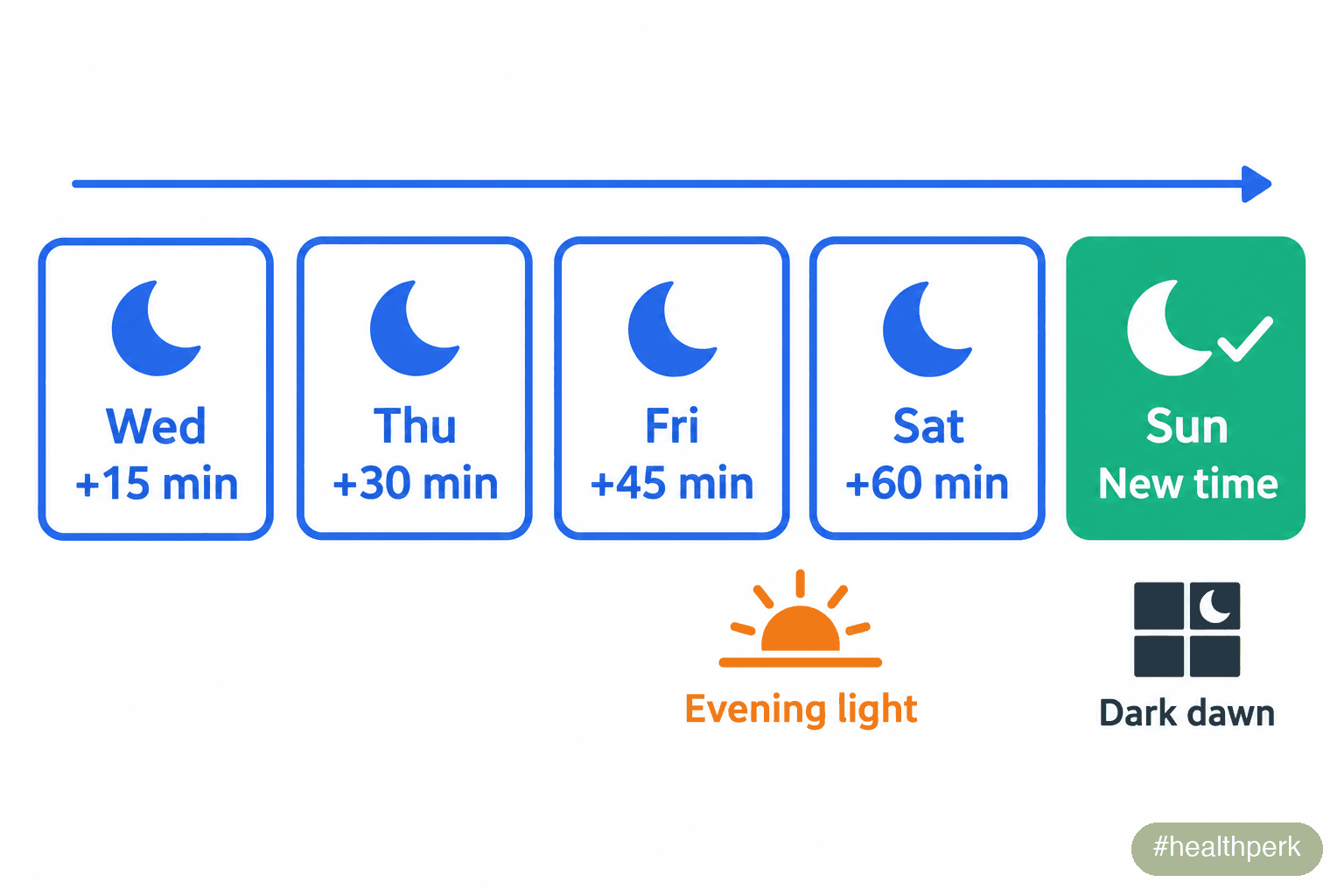 Schematic plan, not study data: a 15-minute shift each day puts you on the new clock by change night.
- Wednesday (Oct 21 in UK/EU, Oct 28 in US): Go to bed and get up 15 minutes later than usual. Move dinner 15 minutes later too.
- Thursday: Shift bedtime, wake time, and meals 30 minutes later than your usual times.
- Friday: Shift them 45 minutes later. Get outdoor light in the late afternoon or early evening.
- Saturday (change night): Go to bed one hour later than usual on the old clock. Before bed, set manual clocks back one hour. Your bedtime now matches your normal time on the new clock. In the US this is Halloween night, so the later bedtime may happen anyway.
- Sunday (change day): Get up at your normal time on the new clock, even if you feel awake earlier. Keep the bedroom dark until then.
- Monday to Friday after the change: Keep fixed bed and wake times on the new clock. Get bright light in the late afternoon and evening, keep early mornings dim, and go outside mid-morning or at lunch.
- Throughout the week: Stop caffeine at least 6 hours before bed, keep alcohol light, and don't nap after mid-afternoon. These help with any sleep change, as explained in our guide on how to fall asleep faster without medication.
- Two weeks later: If you're still waking an hour early most days, extend the evening light and keep pushing bedtime 15 minutes later every few days.
Missed the pre-shift? Start on Sunday. Wake at your usual new-clock time, use the light timing, and expect to settle within about a week.
Health Effects of the Clock Change: What the Research Shows
Most research focuses on the spring change, and its risks are better established. Here's how the two compare.
Heart attacks. A 2019 meta-analysis of seven studies with more than 115,000 people found a modest 5% higher risk of heart attack in the week after the spring change (odds ratio 1.05). There was no increase after the autumn change (odds ratio 1.01). [16] A Michigan hospital study found 24% more heart attacks than expected on the Monday after the spring change, and 21% fewer on the Tuesday after the fall change, with no change in the weekly total. [17] That single-center pattern suggests timing shifts within the week, but the pooled analysis above still found a small rise in heart attacks after the spring change.
Car crashes. Across 732,835 fatal US crashes from 1996 to 2017, the spring change raised fatal crash risk by 6% in the following week. The fall change had no effect on crash risk. [18] Still, earlier darkness in the evening rush hour is a real hazard for pedestrians. Be extra visible if you walk or run after work in November.
Depression. This is where the fall change stands out. A Danish registry study of 185,419 hospital contacts for depression found an 11% increase in new depressive episodes after the change from summer time to standard time. The effect faded over about 10 weeks. The spring change showed no similar rise. [19] The authors suggest the sudden earlier sunset, marking the start of a long dark season, may explain it.
Sleep quality. Both changes increased nighttime restlessness in the Finnish activity-monitor study. [9] The effects are usually short-lived for healthy adults, but they add up for people who are already short on sleep. If your sleep is fragile, our guide on how to improve sleep quality naturally covers the basics.
Permanent Standard Time vs Permanent Daylight Saving Time
The debate is no longer about whether to keep changing clocks. Few people like the current system: in an October 2025 AP-NORC poll of 1,289 US adults, only 12% favored it. Among the two permanent options, 56% preferred daylight saving time and 42% preferred standard time. [20]
What sleep scientists say. The AASM first called for permanent standard time in 2020 and repeated it in 2024. Its position is that the US should end seasonal changes in favor of permanent standard time, which "aligns best with human circadian biology." [21][4] The Society for Research on Biological Rhythms took the same position in 2019. [22] The reasoning is that morning light is the strongest daily signal keeping the body clock on time. Permanent daylight saving time would mean dark winter mornings and later light in the evening, which tends to push body clocks later.
What the modeling shows. A 2025 Stanford study in PNAS modeled light exposure across the continental US. It found that switching twice a year puts more strain on the circadian system than either permanent option, and predicted the largest health benefit with permanent standard time. [23] The authors issued a correction in 2026 for an error in how evening light was calculated, so treat the exact numbers with caution.
The counterpoint. Supporters of permanent daylight saving time point to more evening daylight for activity and road safety. An older US analysis estimated that year-round daylight saving time would cut pedestrian deaths in morning and evening hours by about 13%. [24]
Where things stand in October 2026. On July 14, 2026, the US House passed the Sunshine Protection Act (H.R. 139), which would make daylight saving time permanent. [5] The Senate hasn't passed it, and clocks still fall back on November 1. [1] Under current federal law, states can choose permanent standard time, as Hawaii and most of Arizona do, but not permanent daylight saving time.
Common Myths About Falling Back
Myth: "You get an extra hour of sleep." Few people sleep longer on change night, and earlier waking over the next several days can mean a net loss. [3]
Myth: "Morning sunlight is always the fix." Morning light is great for alertness and mood, but very early light pushes your clock earlier. After the fall change, evening light and a dark bedroom at dawn work better. [8]
Myth: "Melatonin helps with any time change." Taken in the evening, melatonin moves the clock earlier. That helps in spring, not in autumn. [12]
Myth: "The fall change is harmless." It's gentler than spring for heart and crash risk, but it's linked to a rise in depressive episodes. It's also harder for early birds. [19][9]
Myth: "Sleep experts want permanent daylight saving time." The main sleep and circadian science groups back permanent standard time instead. [4][22]
Myth: "Kids adjust overnight." Most children take up to a week. Gradual steps and dark rooms help a lot. [10]
When to See a Doctor
The clock change is a small, temporary shift. See a doctor if you notice any of the following:
- Trouble falling or staying asleep at least three nights a week for more than a few weeks
- Waking two or more hours before you want to, most days, with no other cause
- Low mood, loss of interest, or hopelessness that lasts more than two weeks, especially if it returns every autumn
- Thoughts of harming yourself. Call or text 988 in the US, or contact your local emergency number (112 in the EU) right away
- Loud snoring, gasping, or pauses in breathing during sleep
- Dozing off while driving, or near-misses on the road
- A child whose sleep is still badly disrupted after two weeks, or a baby who seems unwell rather than just tired
Also talk to your doctor before using melatonin or a light box if you have bipolar disorder, an eye condition, take medicines that make you sensitive to light, or are pregnant.
Related Articles on Health Perk
- Magnesium vs melatonin for sleep: which works better
- Light therapy lamps for seasonal depression
- Waking up at 3am every night: causes and fixes
- How to fall asleep faster without medication
- Best sleep tracking devices for light sleepers
- Best supplements for sleep without melatonin
Frequently Asked Questions
When do the clocks fall back in 2026?
In the UK and the EU, clocks go back one hour on Sunday, October 25, 2026. In most of the US and Canada, daylight saving time ends at 2 a.m. local time on Sunday, November 1, 2026. Hawaii and most of Arizona stay on standard time all year. Phones update automatically, but reset manual clocks before bed.
How long does it take to adjust to daylight saving time ending?
Most healthy adults adjust within a few days to a week, and the fall change is usually easier than the spring one. Early birds, older adults, and young children can take longer, sometimes up to two weeks. Starting a 15-minute daily shift four days before the change can put you on the new schedule from day one.
Is falling back harder than springing forward?
For most people, no. Falling back asks your body clock to move later, which matches its natural tendency, while springing forward forces it earlier. However, the fall change is harder for morning types and is linked to an 11% rise in depressive episodes in one large Danish study, so it isn't harmless.
Should I take melatonin for the time change in the fall?
Usually not. Low-dose melatonin taken in the evening moves your body clock earlier, which helps in spring but works against you in autumn. Most healthy adults don't need it for the fall change. If you already take melatonin, keep the dose low, time it to your new bedtime, and ask your doctor or pharmacist if unsure.
How do I adjust my baby's sleep for the fall time change?
Start about a week before and move naps, feeds or meals, and bedtime 15 minutes later every day or two. Use blackout blinds to block the earlier dawn, and get outdoor light during the day. Most babies and toddlers settle within a week. Very young infants without a schedule can simply follow their own cues.
Why do I wake up so early after the clocks go back?
Your body clock is still running on the old time, so 5 a.m. on the new clock feels like 6 a.m. Dawn also arrives an hour earlier by the clock, and that early light keeps your clock early. Keep your bedroom dark until your target wake time and get bright light in the evening.
Is the US getting rid of daylight saving time?
Not yet. The House passed the Sunshine Protection Act on July 14, 2026, which would make daylight saving time permanent, but the Senate hasn't passed it. Clocks still fall back on November 1, 2026. The American Academy of Sleep Medicine favors permanent standard time instead.
Does the end of daylight saving time affect mood?
It can. A Danish study of more than 185,000 hospital contacts found an 11% increase in new depressive episodes after the fall change, fading over about 10 weeks. The earlier sunset may be the trigger. Daily outdoor light helps, and persistent low mood for more than two weeks is a reason to see a doctor.
Medical disclaimer: This article is for general educational purposes only and is not medical advice. It does not replace diagnosis or treatment by a qualified healthcare professional. Talk to your doctor or pharmacist before starting melatonin or any other supplement, especially for children, during pregnancy, or if you take prescription medicines or have a mental health, sleep, or eye condition. Read more about how we review health content.
References
- National Institute of Standards and Technology (2026). Daylight Saving Time (DST). NIST Time and Frequency Division. https://www.nist.gov/pml/time-and-frequency-division/popular-links/daylight-saving-time-dst
Supports: In 2026, US daylight saving time runs from March 8 to November 1 at 2 a.m. local time; it ends on the first Sunday in November and the 1–2 a.m. hour repeats.
- GOV.UK (2026). When do the clocks change? UK Government. https://www.gov.uk/when-do-the-clocks-change
Supports: UK clocks go back one hour on October 25, 2026, the last Sunday in October.
- Harrison, Y. (2013). The impact of daylight saving time on sleep and related behaviours. Sleep Medicine Reviews, 17(4), 285–292. https://doi.org/10.1016/j.smrv.2012.10.001
Supports: Little evidence of extra sleep on the night of the autumn change; five days of earlier rise times suggest a net sleep loss across the week.
- Rishi, M. A., Cheng, J. Y., Strang, A. R., Sexton-Radek, K., Ganguly, G., Licis, A., et al. (2024). Permanent standard time is the optimal choice for health and safety: an American Academy of Sleep Medicine position statement. Journal of Clinical Sleep Medicine, 20(1), 121–125. https://doi.org/10.5664/jcsm.10898
Supports: Updated AASM position: the US should eliminate seasonal time changes in favor of permanent standard time, which aligns best with human circadian biology.
- House Committee on Energy and Commerce (2026). House Passes Legislation to Make Daylight Saving Time Permanent. energycommerce.house.gov, July 14, 2026. https://energycommerce.house.gov/posts/house-passes-legislation-to-make-daylight-saving-time-permanent
Supports: The House passed H.R. 139, the Sunshine Protection Act, on July 14, 2026; it would make daylight saving time permanent.
- Czeisler, C. A., Duffy, J. F., Shanahan, T. L., Brown, E. N., Mitchell, J. F., Rimmer, D. W., et al. (1999). Stability, precision, and near-24-hour period of the human circadian pacemaker. Science, 284(5423), 2177–2181. https://doi.org/10.1126/science.284.5423.2177
Supports: The intrinsic period of the human circadian clock averages 24.18 hours in young and older adults.
- Kantermann, T., Juda, M., Merrow, M., & Roenneberg, T. (2007). The human circadian clock's seasonal adjustment is disrupted by daylight saving time. Current Biology, 17(22), 1996–2000. https://doi.org/10.1016/j.cub.2007.10.025
Supports: In 50 people tracked for 8 weeks around each change, sleep and activity readily adjusted to the autumn change but activity did not adjust to the spring change.
- Khalsa, S. B. S., Jewett, M. E., Cajochen, C., & Czeisler, C. A. (2003). A phase response curve to single bright light pulses in human subjects. The Journal of Physiology, 549(3), 945–952. https://doi.org/10.1113/jphysiol.2003.040477
Supports: In 21 adults, bright light before the core body temperature minimum delayed the clock and light after it advanced the clock.
- Lahti, T. A., Leppämäki, S., Lönnqvist, J., & Partonen, T. (2008). Transitions into and out of daylight saving time compromise sleep and the rest-activity cycles. BMC Physiology, 8, 3. https://doi.org/10.1186/1472-6793-8-3
Supports: The fall change was more disturbing for morning types and the spring change for evening types; both increased night-time restlessness (n = 9).
- Esparham, A. (2025). Daylight Saving Time: Don't Lose Sleep Over It. HealthyChildren.org, American Academy of Pediatrics, updated October 31, 2025. https://www.healthychildren.org/English/healthy-living/sleep/Pages/Daylight-Saving-Time-Dont-Lose-Sleep-Over-It.aspx
Supports: Shift naps and bedtime a few minutes a day starting about a week ahead, get daytime outdoor light, screens away an hour before bed; most kids adjust within about a week; ask a pediatrician before melatonin.
- Auger, R. R., Burgess, H. J., Emens, J. S., Deriy, L. V., Thomas, S. M., & Sharkey, K. M. (2015). Clinical Practice Guideline for the Treatment of Intrinsic Circadian Rhythm Sleep-Wake Disorders: Advanced Sleep-Wake Phase Disorder (ASWPD), Delayed Sleep-Wake Phase Disorder (DSWPD), Non-24-Hour Sleep-Wake Rhythm Disorder (N24SWD), and Irregular Sleep-Wake Rhythm Disorder (ISWRD). An Update for 2015. Journal of Clinical Sleep Medicine, 11(10), 1199–1236. https://doi.org/10.5664/jcsm.5100
Supports: AASM guideline endorses light therapy for adults with advanced sleep-wake phase disorder (second-tier confidence).
- Burgess, H. J., Revell, V. L., Molina, T. A., & Eastman, C. I. (2010). Human phase response curves to three days of daily melatonin: 0.5 mg versus 3.0 mg. The Journal of Clinical Endocrinology & Metabolism, 95(7), 3325–3331. https://doi.org/10.1210/jc.2009-2590
Supports: 0.5 mg melatonin advanced the clock most when taken in the afternoon, 2–4 h before melatonin onset; delays peaked soon after wake time.
- Erland, L. A. E., & Saxena, P. K. (2017). Melatonin Natural Health Products and Supplements: Presence of Serotonin and Significant Variability of Melatonin Content. Journal of Clinical Sleep Medicine, 13(2), 275–281. https://doi.org/10.5664/jcsm.6462
Supports: Across 31 supplements, melatonin content ranged from −83% to +478% of the label claim.
- Lelak, K., Vohra, V., Neuman, M. I., Toce, M. S., & Sethuraman, U. (2022). Pediatric Melatonin Ingestions — United States, 2012–2021. MMWR Morbidity and Mortality Weekly Report, 71(22), 725–729. https://doi.org/10.15585/mmwr.mm7122a1
Supports: Annual pediatric melatonin ingestions reported to US poison centers rose 530% from 2012 to 2021, mainly unintentional ingestions in children aged 5 and under.
- Duffy, J. F., Zitting, K. M., & Chinoy, E. D. (2015). Aging and Circadian Rhythms. Sleep Medicine Clinics, 10(4), 423–434. https://doi.org/10.1016/j.jsmc.2015.08.002
Supports: Aging is associated with changes in sleep timing, duration, and quality linked to the circadian system.
- Manfredini, R., Fabbian, F., Cappadona, R., De Giorgi, A., Bravi, F., Carradori, T., Flacco, M. E., & Manzoli, L. (2019). Daylight Saving Time and Acute Myocardial Infarction: A Meta-Analysis. Journal of Clinical Medicine, 8(3), 404. https://doi.org/10.3390/jcm8030404
Supports: Seven studies (>115,000 people): AMI risk rose after the spring change (OR 1.05) but not after the autumn change (OR 1.01).
- Sandhu, A., Seth, M., & Gurm, H. S. (2014). Daylight savings time and myocardial infarction. Open Heart, 1(1), e000019. https://doi.org/10.1136/openhrt-2013-000019
Supports: 24% more AMI on the Monday after the spring change and 21% fewer on the Tuesday after the fall change, with no change in weekly totals.
- Fritz, J., VoPham, T., Wright, K. P., Jr., & Vetter, C. (2020). A Chronobiological Evaluation of the Acute Effects of Daylight Saving Time on Traffic Accident Risk. Current Biology, 30(4), 729–735.e2. https://doi.org/10.1016/j.cub.2019.12.045
Supports: Among 732,835 fatal US crashes (1996–2017), spring DST raised fatal crash risk by 6%; the fall-back change had no effect.
- Hansen, B. T., Sønderskov, K. M., Hageman, I., Dinesen, P. T., & Østergaard, S. D. (2017). Daylight Savings Time Transitions and the Incidence Rate of Unipolar Depressive Episodes. Epidemiology, 28(3), 346–353. https://doi.org/10.1097/EDE.0000000000000580
Supports: In 185,419 Danish hospital contacts, the change from summer time to standard time was associated with an 11% rise in depressive episodes, dissipating over about 10 weeks; no rise in spring.
- AP-NORC Center for Public Affairs Research (2025). Few people support the daylight saving time system, and more want year-round light in the evenings. AP-NORC, October 30, 2025. https://apnorc.org/projects/few-people-support-the-daylight-saving-time-system-and-more-want-year-round-light-in-the-evenings/
Supports: Poll of 1,289 US adults (Oct 9–13, 2025): 12% favor the current system; 56% prefer permanent DST and 42% permanent standard time.
- Rishi, M. A., Ahmed, O., Barrantes Perez, J. H., Berneking, M., Dombrowsky, J., Flynn-Evans, E. E., et al. (2020). Daylight saving time: an American Academy of Sleep Medicine position statement. Journal of Clinical Sleep Medicine, 16(10), 1781–1784. https://doi.org/10.5664/jcsm.8780
Supports: The AASM's 2020 call to eliminate seasonal time changes in favor of year-round standard time.
- Roenneberg, T., Wirz-Justice, A., Skene, D. J., Ancoli-Israel, S., Wright, K. P., Dijk, D.-J., Zee, P., Gorman, M. R., Winnebeck, E. C., & Klerman, E. B. (2019). Why Should We Abolish Daylight Saving Time? Journal of Biological Rhythms, 34(3), 227–230. https://doi.org/10.1177/0748730419854197
Supports: SRBR position paper: the advantages of permanent standard time outweigh switching annually or permanent DST.
- Weed, L., & Zeitzer, J. M. (2025). Circadian-informed modeling predicts regional variation in obesity and stroke outcomes under different permanent US time policies. Proceedings of the National Academy of Sciences, 122(38), e2508293122. https://doi.org/10.1073/pnas.2508293122
Supports: Biannual shifting produces a greater circadian burden than either permanent policy, and permanent standard time was modeled to give the largest benefit; a 2026 correction (https://doi.org/10.1073/pnas.2612351123) fixed an evening-light calculation error.
- Coate, D., & Markowitz, S. (2004). The effects of daylight and daylight saving time on US pedestrian fatalities and motor vehicle occupant fatalities. Accident Analysis & Prevention, 36(3), 351–357. https://doi.org/10.1016/S0001-4575(03)00015-0
Supports: Full-year DST was estimated to reduce pedestrian fatalities by 13% in the 5–10 a.m. and 4–9 p.m. periods.
Frequently Asked Questions
When do the clocks fall back in 2026?
In the UK and the EU, clocks go back one hour on Sunday, October 25, 2026. In most of the US and Canada, daylight saving time ends at 2 a.m. local time on Sunday, November 1, 2026. Hawaii and most of Arizona stay on standard time all year. Phones update automatically, but reset manual clocks before bed.
How long does it take to adjust to daylight saving time ending?
Most healthy adults adjust within a few days to a week, and the fall change is usually easier than the spring one. Early birds, older adults, and young children can take longer, sometimes up to two weeks. Starting a 15-minute daily shift four days before the change can put you on the new schedule from day one.
Is falling back harder than springing forward?
For most people, no. Falling back asks your body clock to move later, which matches its natural tendency, while springing forward forces it earlier. However, the fall change is harder for morning types and is linked to an 11% rise in depressive episodes in one large Danish study, so it isn't harmless.
Should I take melatonin for the time change in the fall?
Usually not. Low-dose melatonin taken in the evening moves your body clock earlier, which helps in spring but works against you in autumn. Most healthy adults don't need it for the fall change. If you already take melatonin, keep the dose low, time it to your new bedtime, and ask your doctor or pharmacist if unsure.
How do I adjust my baby's sleep for the fall time change?
Start about a week before and move naps, feeds or meals, and bedtime 15 minutes later every day or two. Use blackout blinds to block the earlier dawn, and get outdoor light during the day. Most babies and toddlers settle within a week. Very young infants without a schedule can simply follow their own cues.
Why do I wake up so early after the clocks go back?
Your body clock is still running on the old time, so 5 a.m. on the new clock feels like 6 a.m. Dawn also arrives an hour earlier by the clock, and that early light keeps your clock early. Keep your bedroom dark until your target wake time and get bright light in the evening.
Is the US getting rid of daylight saving time?
Not yet. The House passed the Sunshine Protection Act on July 14, 2026, which would make daylight saving time permanent, but the Senate hasn't passed it. Clocks still fall back on November 1, 2026. The American Academy of Sleep Medicine favors permanent standard time instead.
Does the end of daylight saving time affect mood?
It can. A Danish study of more than 185,000 hospital contacts found an 11% increase in new depressive episodes after the fall change, fading over about 10 weeks. The earlier sunset may be the trigger. Daily outdoor light helps, and persistent low mood for more than two weeks is a reason to see a doctor.