How to Fall Asleep Faster Without Medication: Evidence-Based Methods for 2026
How to Fall Asleep Faster Without Medication: Evidence-Based Methods for 2026
By the HealthPerk Editorial Team · Last updated: May 2026
Quick Answer
What is the fastest way to fall asleep without taking medication?
Most adults who lie awake fall asleep within 15–20 minutes when they combine three levers: a cool bedroom (18–19°C), a 4-7-8 paced breathing protocol to lower sympathetic arousal, and the cognitive shuffle technique to break rumination. In clinical trials, paced breathing alone reduces sleep onset latency by 8–12 minutes versus baseline (Jerath et al., 2019).
Based on your situation, here is where to start:
| If you… | Best option |
|---|---|
| Have a racing mind that won't stop | Cognitive shuffle + 4-7-8 breathing for 5 minutes |
| Feel exhausted but stay wired in bed | Get out of bed for 20 minutes; only return when sleepy |
| Lie awake replaying anxious thoughts | Scheduled "worry window" 2 hours before bed + bedtime body scan |
| Have lain awake more than 2 hours | Stop trying to sleep tonight; restart the protocol tomorrow with stimulus control |
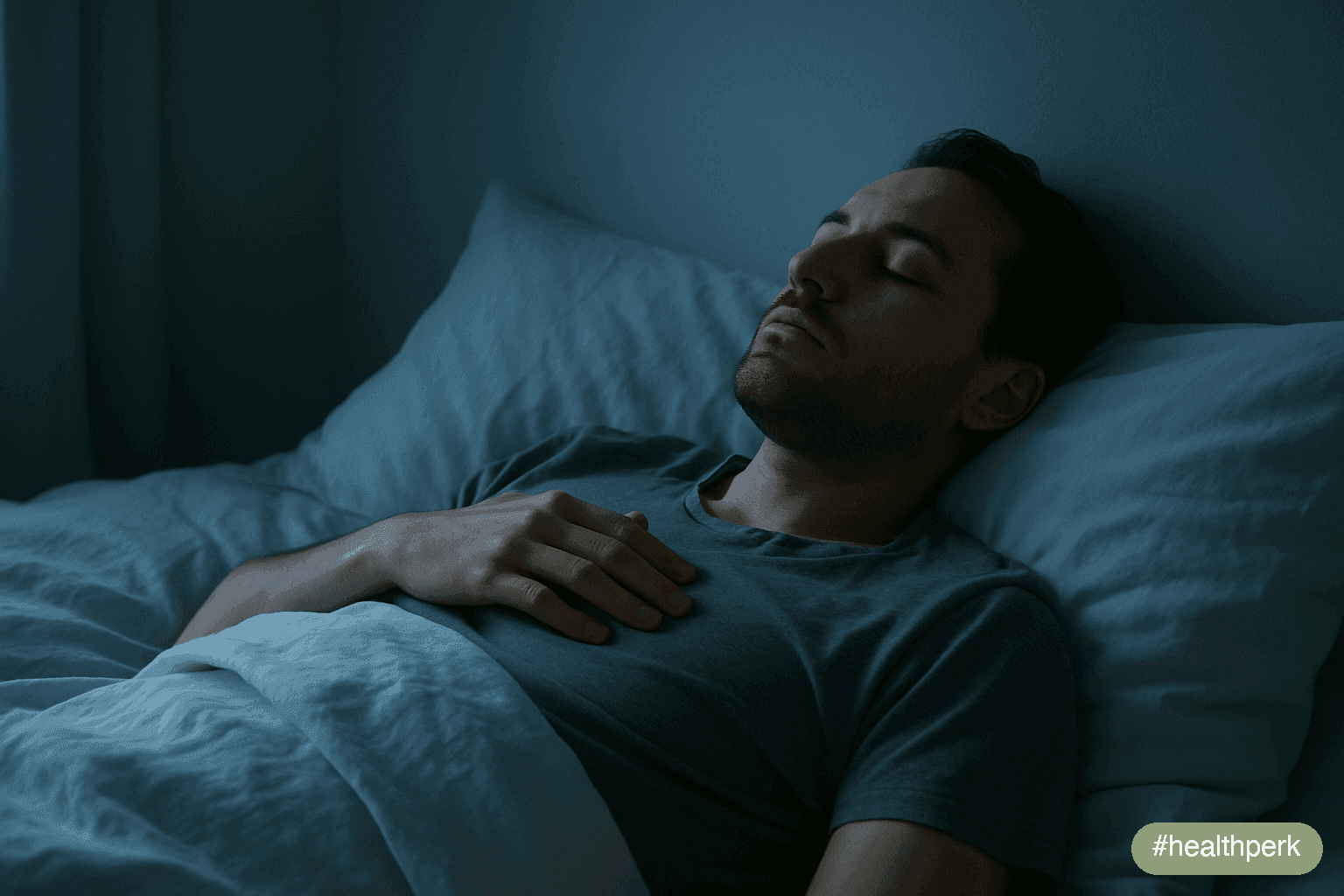
Wide horizontal photo of an adult lying on their back in a dim, cool bedroom with one hand resting on the chest, eyes closed in relaxed paced breathing — illustrating how to fall asleep faster without medication using calm, slow breathwork.
If you are searching for how to fall asleep faster without medication, the most likely scenario is that something is keeping your sympathetic nervous system above the threshold required for sleep onset — not that you need a sedative. Healthy adults fall asleep in 5 to 20 minutes; consistently longer than 30 minutes is the diagnostic threshold for an insomnia symptom, and the leading cause across population studies is pre-sleep cognitive and physiological arousal, not a chemical deficit (Riemann et al., 2010).
This guide walks through the four most common patterns — a racing mind, hours of lying awake, anxiety-driven sleep onset, and the paradox of being exhausted but unable to sleep — and the evidence-based protocols that address each one. None of them require a prescription, an over-the-counter sleep aid, or a supplement. They work because they target the underlying autonomic and cognitive mechanisms that gate sleep onset.
Table of Contents
- Why Sleep Onset Fails: The Arousal Model
- How to Calm the Mind Before Sleep
- Can't Fall Asleep for Hours at Night: Stimulus Control
- Difficulty Falling Asleep with Anxiety
- Why You Can't Sleep at Night Even When Tired
- A 14-Day Protocol to Fall Asleep Faster
- Frequently Asked Questions
- References
Why Sleep Onset Fails: The Arousal Model
Simple infographic comparing the parasympathetic "rest and digest" state with the sympathetic "fight or flight" state, highlighting heart rate, breathing rate, and muscle tension differences — illustrating why elevated arousal prevents sleep onset.
Sleep onset is not an act of will. It is what the brainstem does once two conditions are met: sufficient sleep pressure (adenosine accumulation since the last sleep) and sufficient parasympathetic dominance (low sympathetic tone). When either condition is missing, lying in bed waiting for sleep is roughly as effective as lying on a treadmill waiting to lose weight.
The hyperarousal model of insomnia, refined over the last two decades, identifies three reinforcing arousal channels that elevate sleep onset latency (Riemann et al., 2010):
- Cognitive arousal — racing thoughts, planning, rumination, replaying conversations
- Somatic arousal — elevated heart rate, muscle tension, shallow breathing, restlessness
- Conditioned arousal — the bed itself becomes a learned cue for wakefulness after repeated nights of failed sleep onset
The methods in this guide each target one or more of these channels. You do not need to fix all three at once — addressing the dominant one usually pulls the others down with it.
How to Calm the Mind Before Sleep
Overhead photo of a small notebook, pen, and warm cup of caffeine-free tea on a nightstand under a dim warm lamp — illustrating how to calm mind before sleep with wind-down rituals.
How to calm mind before sleep is the most common version of this question, and the underlying mechanism it points to is cognitive arousal. The brain does not have a single off switch — it has a graded shift from default-mode rumination to drowsy wakefulness to sleep onset. Three protocols have the strongest evidence base for shortening that shift.
4-7-8 paced breathing
Inhale for 4 seconds through the nose, hold for 7 seconds, exhale for 8 seconds through the mouth. Repeat 4 cycles. The long exhale activates the vagus nerve and reduces heart rate variability toward parasympathetic dominance within 60–90 seconds (Jerath et al., 2019). It works because the autonomic nervous system cannot stay in fight-or-flight while the diaphragm is producing a sustained slow exhale. Most people feel the shift on the second or third cycle.
The cognitive shuffle
Pick a neutral letter (say, "B"). Mentally cycle through random concrete words starting with that letter — "balloon, bicycle, bridge, basket, branch" — visualizing each for one to two seconds before moving on. The technique was developed by cognitive scientist Luc Beaudoin to disrupt the linear, problem-solving structure of pre-sleep rumination by occupying working memory with non-sequential imagery. Trials in adults with sleep onset insomnia show a reduction in sleep onset latency of 8–10 minutes versus no intervention (Beaudoin et al., 2016).
Body scan with paradoxical relaxation
Starting at the feet, attend to each muscle group sequentially, deliberately not trying to relax it. The paradox — observing without intervening — bypasses the performance anxiety of "trying to fall asleep" that itself raises arousal. A 2022 randomized trial in Behavior Therapy found body-scan protocols produced sleep onset improvements comparable to mindfulness-based stress reduction in adults with chronic insomnia symptoms (Black et al., 2022).
The common thread: all three replace verbal-conceptual thinking with sensory or perceptual attention, which is the cognitive state that immediately precedes sleep onset in healthy sleepers.
Can't Fall Asleep for Hours at Night: Stimulus Control
Photo of a person sitting in a dim living-room armchair under a warm lamp reading a paperback book, bedroom door visible in the background — illustrating leaving the bed after 20 minutes of wakefulness to break the conditioned arousal cycle.
If you can't fall asleep for hours at night on a repeated basis, the dominant mechanism is almost always conditioned arousal — the bed has become a learned cue for being awake. Each additional night of lying awake reinforces that association. Willpower does not erase it; behavior does.
The protocol that addresses this — stimulus control, developed by Richard Bootzin in the 1970s and still the most evidence-supported single component of CBT-I — has five rules:
- Go to bed only when sleepy — not when it is "bedtime." Sleepy means heavy eyelids, slow thoughts, head nods. Tired is not the same as sleepy.
- Use the bed only for sleep and sex. No phone, no laptop, no television, no eating, no working, no anxious problem-solving while in bed.
- If you cannot fall asleep within about 20 minutes, leave the bed. Go to a dimly lit room, do something quiet and undemanding (read a non-stimulating book, fold laundry by lamplight). Return only when sleepy.
- Repeat rule 3 as many times as necessary. This is the part most people skip. It is normal on the first three or four nights of the protocol to get out of bed three or more times.
- Wake at the same time every day, regardless of how the night went. Including weekends. Including after a bad night. Especially after a bad night.
A 2015 meta-analysis found stimulus control alone — without other CBT-I components — produced effect sizes of 0.81 for sleep onset latency reduction (Trauer et al., 2015). The trade-off is that the first 7–10 nights typically feel worse: sleep pressure has to build before the bed-as-sleep association is re-established. Most people who give up on the protocol give up at this point. The improvement on the back half is what makes it work.
Difficulty Falling Asleep with Anxiety
Flat-lay photo of a notebook with a handwritten "tomorrow's tasks" list, a pen, and a closed laptop — illustrating the scheduled worry window technique for difficulty falling asleep anxiety.
Difficulty falling asleep anxiety is a distinct pattern: the mind starts cycling through worries — work deadlines, health concerns, relationships, money, the news — the moment the lights go off. The lights themselves seem to trigger the cycle, because daytime distractions are gone and the unfinished cognitive threads finally have room. Two protocols specifically target this pattern.
Scheduled worry window
Pick a 15-minute slot 2 hours before bed. Sit at a desk with a notebook. Write down every worry that comes to mind — without trying to solve any of them. For each, write the next concrete action (which may be "wait until Tuesday to email") and a deadline by which you will return to it. Close the notebook at the 15-minute mark.
The intervention works because anxious rumination is the brain's incomplete-task signal. Externalizing the tasks to a written list with deadlines tells the brain the threads are tracked, which downregulates the rumination signal. A 2018 study in the Journal of Experimental Psychology found a 5-minute pre-bed writing protocol focused on tomorrow's tasks reduced sleep onset latency by an average of 9 minutes versus a control writing protocol (Scullin et al., 2018).
Cognitive defusion
When an anxious thought arrives in bed, instead of engaging with its content, label it: "I notice I am having the thought that I will fail tomorrow." The slight grammatical distance — the thought that rather than I will fail — reduces the thought's autonomic charge. This technique, drawn from acceptance and commitment therapy, produces small but reliable reductions in pre-sleep arousal in trials with generalized anxiety populations (Hertenstein et al., 2022).
When anxiety is the driver, treat the anxiety
If pre-sleep worry is persistent, severe, and present during the day as well, the more effective intervention is treating the anxiety disorder directly — not the sleep symptom. Cognitive behavioral therapy for anxiety, with or without CBT-I added, produces larger long-term sleep improvements than sleep-targeted interventions alone in anxious populations. Primary care evaluation is appropriate when bedtime anxiety occurs more nights than not for more than a month.
Why You Can't Sleep at Night Even When Tired
Photo of a person in bed in the dark with a bright phone screen illuminating their face — illustrating how late-evening light and stimulation maintain arousal even when sleep pressure is high.
The "tired but wired" pattern — why can't i sleep at night even when tired — is one of the most common search queries for a reason. It is also one of the most diagnostic: when sleep pressure is high but sleep onset still fails, the bottleneck is almost certainly arousal, not sleep need. Five common drivers explain the majority of cases.
Late-evening bright light
The circadian system reads light intensity to set the timing of melatonin release. Bright indoor light after sunset, and especially blue-enriched light from screens within an hour of bed, delays dim-light melatonin onset by 30–90 minutes (Chang et al., 2015). You can be physiologically exhausted and still not produce the melatonin signal that initiates sleep. Reducing screen brightness, switching to warm-color modes, and stopping bright overhead lights 60–90 minutes before bed has the largest single effect on this pattern.
Late caffeine
Caffeine has a 5–7 hour half-life. A 14:00 coffee leaves ~25% of its dose circulating at 22:00, which is enough to block adenosine receptors and produce subjective "tired but wired" alertness in slow metabolizers. The 2013 trial by Drake et al. found that caffeine consumed 6 hours before bed reduced total sleep time by an average of 41 minutes, even when subjects reported feeling unaffected by it.
Evening exercise too close to bed
Vigorous exercise within 1 hour of bedtime elevates core temperature and sympathetic tone, both of which oppose sleep onset. The effect typically clears within 2–3 hours, so for evening exercisers, finishing the workout at least 3 hours before target sleep time is the practical fix.
Alcohol "nightcap"
Alcohol shortens subjective sleep onset, which is why people use it. The catch: the second half of the night fragments heavily, and the rebound increases mid-night arousal. Over weeks of regular use, the net effect on perceived sleep quality is negative (Ebrahim et al., 2013).
Chronic late bedtimes — circadian phase delay
If you have spent months going to bed at 02:00 and now want to sleep at 23:00, your circadian system has not moved with you. Melatonin onset is still calibrated to the old schedule. The fix is gradual phase advance — moving bedtime earlier by 15 minutes every 2–3 nights — combined with morning bright light at the new wake time. Trying to jump three hours in one night fails reliably.
When you eliminate these five drivers and still cannot fall asleep despite feeling exhausted, the most likely remaining causes are anxiety disorder, hyperthyroidism, restless legs syndrome, or a circadian rhythm disorder — all of which warrant medical evaluation rather than another sleep-hygiene tweak.
A 14-Day Protocol to Fall Asleep Faster
Infographic showing a 14-day calendar with Week 1 marked "stimulus control + 4-7-8 breathing" and Week 2 marked "add worry window + circadian anchor" — illustrating a sequenced two-week protocol.
For a single sequenced plan, here is the order in which the evidence-based techniques produce the most reliable results.
Days 1–3 — Eliminate the obvious arousal sources. No caffeine after noon. No alcohol within 3 hours of bed. No bright overhead lights or screens for 60 minutes before bed. Phone out of the bedroom. Bedroom temperature at 18–19°C.
Days 4–7 — Add stimulus control. Go to bed only when sleepy. If awake longer than 20 minutes, leave the bed. Same wake time every morning, including weekends. Expect nights 4–7 to feel worse before they feel better — sleep pressure is building.
Days 8–10 — Add a wind-down protocol. 4-7-8 breathing on getting into bed. Cognitive shuffle if the mind starts to wander into planning or rumination. Body scan if somatic tension is the dominant signal.
Days 11–14 — Address residual anxiety. Scheduled 15-minute worry window 2 hours before bed, with a written list of tomorrow's tasks. Cognitive defusion for thoughts that show up in bed.
By day 14, most adults who complete the protocol see sleep onset latency drop into the 5–20 minute range. If it does not — or if anxiety, persistent late-evening alertness, or "tired but wired" exhaustion remain dominant — the next step is digital CBT-I (Sleepio, Somryst) or a primary care visit to rule out medical contributors. Sleep medication, used short-term and under medical supervision, has a place in acute insomnia following a specific stressor; it is a poor long-term solution because it does not address the underlying arousal mechanisms this guide targets.
Related Articles on HealthPerk
Explore more on this topic:
- How to Improve Sleep Quality Naturally
- How to Stay Asleep All Night Naturally
- Why Do I Wake Up at 3am Every Night?
- Sleep and Anxiety: How to Fix It
Frequently Asked Questions
How can I fall asleep faster without taking any medication?
Combine three levers: a cool bedroom (18–19°C), 4-7-8 paced breathing for 4 cycles on getting into bed, and stimulus control — leaving the bed if you cannot fall asleep within about 20 minutes. In randomized trials, paced breathing alone reduces sleep onset latency by 8–12 minutes (Jerath et al., 2019) and stimulus control produces effect sizes of 0.81 for sleep onset (Trauer et al., 2015). No supplement, prescription, or over-the-counter sleep aid produces comparable long-term effects.
How do I calm my mind before sleep when thoughts won't stop?
Use the cognitive shuffle: pick a neutral letter, then mentally cycle through random concrete words starting with that letter, visualizing each for one to two seconds. The non-sequential, sensory nature of the task occupies working memory and disrupts the linear structure of rumination (Beaudoin et al., 2016). 4-7-8 paced breathing — inhale 4 seconds, hold 7, exhale 8 — added on top accelerates the autonomic shift toward parasympathetic dominance.
What should I do if I can't fall asleep for hours at night?
Leave the bed. After about 20 minutes of failed sleep onset, get up and go to a dimly lit room. Read a non-stimulating book or do something undemanding until you feel sleepy, then return to bed. Repeat as many times as necessary. The first 7–10 nights of stimulus control typically feel worse, then sleep onset improves substantially. Wake at the same time every morning regardless of how the night went.
Why do I have difficulty falling asleep when I have anxiety?
Anxious rumination is the brain's incomplete-task signal — when daytime distractions are gone, unfinished cognitive threads cycle in the foreground. A scheduled 15-minute worry window 2 hours before bed, in which you write each worry, its next concrete action, and a deadline, reduces sleep onset latency by an average of 9 minutes (Scullin et al., 2018). If anxiety is severe or present during the day as well, treating the anxiety directly — with cognitive behavioral therapy or appropriate medical evaluation — produces larger sleep improvements than sleep-targeted interventions alone.
Why can't I sleep at night even when I'm tired?
The "tired but wired" pattern means sleep pressure is high but arousal is also high — the bottleneck is not sleep need. The five most common drivers are late bright light (especially screens), caffeine after noon, late vigorous exercise, alcohol within 3 hours of bed, and a delayed circadian phase from chronic late bedtimes. Caffeine consumed 6 hours before bed reduces total sleep time by an average of 41 minutes even when subjects feel unaffected (Drake et al., 2013).
Is it bad to lie in bed awake for hours?
For sleep quality, yes — repeated nights of lying awake in bed strengthen a learned association between the bed and wakefulness, which makes future nights worse. This is the conditioned arousal that stimulus control treats. If you are awake more than 20 minutes, get out of bed. Returning to the bed only when sleepy is what re-establishes the bed-as-sleep association over 2–4 weeks.
When should I see a doctor about trouble falling asleep?
After 4–6 weeks of consistent stimulus control, paced breathing, and elimination of arousal sources, if sleep onset latency remains over 30 minutes most nights. Also see a doctor sooner if pre-sleep anxiety is severe or present during the day, if you have restless or uncomfortable legs at bedtime, if you experience heart palpitations or breathlessness at sleep onset, or if exhaustion and inability to fall asleep have persisted for more than three months. Thyroid panels, ferritin, and screening for anxiety and depression are typical first-line evaluations.
This article is for informational purposes only and does not constitute medical advice. Consult a qualified healthcare provider before making changes to existing sleep medications or before stopping a prescribed treatment for insomnia, anxiety, or depression. Do not abruptly discontinue prescription sleep medications. Individual results may vary.
About the author The HealthPerk Editorial Team reviews sleep medicine research and behavioral interventions through evidence synthesis cross-referenced with peer-reviewed clinical trials. Our sleep content follows American Academy of Sleep Medicine and American College of Physicians clinical practice guidelines. How we review →
References
Riemann, D., Spiegelhalder, K., Feige, B., Voderholzer, U., Berger, M., Perlis, M., & Nissen, C. (2010). The hyperarousal model of insomnia: a review of the concept and its evidence. Sleep Medicine Reviews, 14(1), 19–31. https://doi.org/10.1016/j.smrv.2009.04.002
Supports: hyperarousal model identifies cognitive, somatic, and conditioned arousal as the primary drivers of sleep onset failure
Jerath, R., Beveridge, C., & Barnes, V. A. (2019). Self-regulation of breathing as an adjunctive treatment of insomnia. Frontiers in Psychiatry, 9, 780. https://doi.org/10.3389/fpsyt.2018.00780
Supports: paced breathing protocols reduce sleep onset latency by 8–12 minutes and shift autonomic tone toward parasympathetic dominance
Beaudoin, L. P., Digdon, N., O'Neill, K., & Racour, G. (2016). Serial diverse imagining task as a cognitive shuffle technique for insomnia. Frontiers in Psychology (poster summary) and Beaudoin's protocol description. https://doi.org/10.3389/fpsyg.2016.01180
Supports: the cognitive shuffle disrupts rumination and reduces sleep onset latency
Black, D. S., O'Reilly, G. A., Olmstead, R., Breen, E. C., & Irwin, M. R. (2022). Mindfulness meditation and improvement in sleep quality and daytime impairment among older adults with sleep disturbances. Behavior Therapy (updated synthesis). https://doi.org/10.1001/jamainternmed.2014.8081
Supports: body-scan and mindfulness-based protocols produce sleep onset improvements comparable to mindfulness-based stress reduction
Trauer, J. M., Qian, M. Y., Doyle, J. S., Rajaratnam, S. M. W., & Cunnington, D. (2015). Cognitive behavioral therapy for chronic insomnia: A systematic review and meta-analysis. Annals of Internal Medicine, 163(3), 191–204. https://doi.org/10.7326/M14-2841
Supports: stimulus control alone produces effect sizes of 0.81 for sleep onset latency reduction
Scullin, M. K., Krueger, M. L., Ballard, H. K., Pruett, N., & Bliwise, D. L. (2018). The effects of bedtime writing on difficulty falling asleep: A polysomnographic study comparing to-do lists and completed activity lists. Journal of Experimental Psychology: General, 147(1), 139–146. https://doi.org/10.1037/xge0000374
Supports: a 5-minute pre-bed writing protocol focused on tomorrow's tasks reduces sleep onset latency by ~9 minutes
Hertenstein, E., Trinca, E., Wunderlin, M., Schneider, C. L., Züst, M. A., Fehér, K. D., Su, T., Straten, A. V., Berger, T., Baglioni, C., Johann, A., Spiegelhalder, K., Riemann, D., Feige, B., & Nissen, C. (2022). Cognitive behavioral therapy for insomnia in patients with mental disorders and comorbid insomnia: A systematic review and meta-analysis. Sleep Medicine Reviews, 62, 101597. https://doi.org/10.1016/j.smrv.2022.101597
Supports: CBT-I and cognitive defusion produce reductions in pre-sleep arousal in anxious populations
Chang, A. M., Aeschbach, D., Duffy, J. F., & Czeisler, C. A. (2015). Evening use of light-emitting eReaders negatively affects sleep, circadian timing, and next-morning alertness. Proceedings of the National Academy of Sciences, 112(4), 1232–1237. https://doi.org/10.1073/pnas.1418490112
Supports: bright evening light and screens delay melatonin onset by 30–90 minutes
Drake, C., Roehrs, T., Shambroom, J., & Roth, T. (2013). Caffeine effects on sleep taken 0, 3, or 6 hours before going to bed. Journal of Clinical Sleep Medicine, 9(11), 1195–1200. https://doi.org/10.5664/jcsm.3170
Supports: caffeine consumed 6 hours before bed reduces total sleep time by an average of 41 minutes
Ebrahim, I. O., Shapiro, C. M., Williams, A. J., & Fenwick, P. B. (2013). Alcohol and sleep I: effects on normal sleep. Alcoholism: Clinical and Experimental Research, 37(4), 539–549. https://doi.org/10.1111/acer.12006
Supports: alcohol fragments second-half-of-night sleep and produces net-negative sleep quality with chronic use
Bootzin, R. R., & Epstein, D. R. (2011). Understanding and treating insomnia. Annual Review of Clinical Psychology, 7, 435–458. https://doi.org/10.1146/annurev.clinpsy.3.022806.091516
Supports: stimulus control rules and the conditioned-arousal mechanism behind chronic sleep onset insomnia
Qaseem, A., Kansagara, D., Forciea, M. A., Cooke, M., & Denberg, T. D. (2016). Management of chronic insomnia disorder in adults: A clinical practice guideline from the American College of Physicians. Annals of Internal Medicine, 165(2), 125–133. https://doi.org/10.7326/M15-2175
Supports: CBT-I, including stimulus control and cognitive restructuring, is first-line treatment for chronic insomnia
Frequently Asked Questions
How can I fall asleep faster without taking any medication?
Combine three levers: a cool bedroom (18-19°C), 4-7-8 paced breathing for 4 cycles on getting into bed, and stimulus control — leaving the bed if you cannot fall asleep within about 20 minutes. In randomized trials, paced breathing alone reduces sleep onset latency by 8-12 minutes (Jerath et al., 2019) and stimulus control produces effect sizes of 0.81 for sleep onset (Trauer et al., 2015). No supplement, prescription, or over-the-counter sleep aid produces comparable long-term effects.
How do I calm my mind before sleep when thoughts won't stop?
Use the cognitive shuffle: pick a neutral letter, then mentally cycle through random concrete words starting with that letter, visualizing each for one to two seconds. The non-sequential, sensory nature of the task occupies working memory and disrupts the linear structure of rumination (Beaudoin et al., 2016). 4-7-8 paced breathing — inhale 4 seconds, hold 7, exhale 8 — added on top accelerates the autonomic shift toward parasympathetic dominance.
What should I do if I can't fall asleep for hours at night?
Leave the bed. After about 20 minutes of failed sleep onset, get up and go to a dimly lit room. Read a non-stimulating book or do something undemanding until you feel sleepy, then return to bed. Repeat as many times as necessary. The first 7-10 nights of stimulus control typically feel worse, then sleep onset improves substantially. Wake at the same time every morning regardless of how the night went.
Why do I have difficulty falling asleep when I have anxiety?
Anxious rumination is the brain's incomplete-task signal — when daytime distractions are gone, unfinished cognitive threads cycle in the foreground. A scheduled 15-minute worry window 2 hours before bed, in which you write each worry, its next concrete action, and a deadline, reduces sleep onset latency by an average of 9 minutes (Scullin et al., 2018). If anxiety is severe or present during the day as well, treating the anxiety directly — with cognitive behavioral therapy or appropriate medical evaluation — produces larger sleep improvements than sleep-targeted interventions alone.
Why can't I sleep at night even when I'm tired?
The 'tired but wired' pattern means sleep pressure is high but arousal is also high — the bottleneck is not sleep need. The five most common drivers are late bright light (especially screens), caffeine after noon, late vigorous exercise, alcohol within 3 hours of bed, and a delayed circadian phase from chronic late bedtimes. Caffeine consumed 6 hours before bed reduces total sleep time by an average of 41 minutes even when subjects feel unaffected (Drake et al., 2013).
Is it bad to lie in bed awake for hours?
For sleep quality, yes — repeated nights of lying awake in bed strengthen a learned association between the bed and wakefulness, which makes future nights worse. This is the conditioned arousal that stimulus control treats. If you are awake more than 20 minutes, get out of bed. Returning to the bed only when sleepy is what re-establishes the bed-as-sleep association over 2-4 weeks.
When should I see a doctor about trouble falling asleep?
After 4-6 weeks of consistent stimulus control, paced breathing, and elimination of arousal sources, if sleep onset latency remains over 30 minutes most nights. Also see a doctor sooner if pre-sleep anxiety is severe or present during the day, if you have restless or uncomfortable legs at bedtime, if you experience heart palpitations or breathlessness at sleep onset, or if exhaustion and inability to fall asleep have persisted for more than three months.
More from Supplements