
Are Gummy Vitamins Worth It? What the FDA's 2026 Review and Lab Tests Show
Gummy vitamins are a reasonable choice only if you cannot or will not swallow pills. A 2026 FDA review flagged heat, moisture, testing, and overage problems, and August 2026 testing found 12 of 25 vitamin C gummies nearly empty. Most adults get more minerals, steadier doses, less sugar, and lower cost from a third-party-verified tablet.
Are Gummy Vitamins Worth It? What the FDA's 2026 Review and Lab Tests Show
By the HealthPerk Editorial Team · Last updated: October 2026
Quick Answer
Are gummy vitamins worth it?
Sometimes. Gummies make sense if you cannot or will not swallow pills. For most adults, a tested tablet or capsule gives you more minerals, more reliable doses, less sugar, and a lower price per serving.
| Your situation | First step |
|---|---|
| You can swallow pills and want a multivitamin | Choose a third-party-verified tablet or capsule; gummies usually skip iron and calcium |
| You genuinely cannot swallow pills | A gummy is fine. Pick one with a USP or NSF mark and check the sugar line |
| You need iron, calcium, or magnesium | Do not count on a gummy. Ask your clinician about a dedicated tablet, powder, or liquid |
| You buy high-dose gummies (for example, 1,000 mg vitamin C) from unfamiliar brands | Be skeptical. In August 2026 testing, all five of these brands had almost no vitamin C |
| You have young children at home | Store every gummy (especially iron and melatonin) locked up, out of sight and reach |
 Gummies and tablets can carry the same nutrient names on the label, but what ends up in each one can differ a lot.
Gummy supplements are now a multibillion-dollar business. SPINS data reported by NutraIngredients show U.S. gummy supplement sales above $4.88 billion for the 52 weeks ending September 6, 2026, up from $3.88 billion two years earlier [2]. That growth caught the attention of the U.S. Food and Drug Administration. On September 17, 2026, FDA scientists published a review of the specific problems in making and testing gummies, which NutraIngredients brought to wider attention on October 7. An agency spokesperson put it simply: gummies "should not be treated simply as candy" [1][2].
This guide covers what the FDA actually said, what testing shows about gummy label accuracy, why gummies so often leave out iron, calcium, and magnesium, and what poison-control data show about the risk to children. It ends with a framework for deciding when a gummy is a reasonable choice.
Table of Contents
- What Is New: The FDA Weighs In on Gummy Supplements
- Why Gummies Are Harder to Make Than Tablets
- Label Accuracy: What Testing Has Found
- Sugar, Minerals, and What Gummies Leave Out
- The Child Safety Problem: Iron and Melatonin
- Gummies vs Tablets vs Capsules vs Chewables
- Which Format Is Right for You
- How to Choose a Better Gummy
- Common Misconceptions About Gummy Vitamins
- When to See a Doctor
- Related Articles on Health Perk
- Frequently Asked Questions
- References
What Is New: The FDA Weighs In on Gummy Supplements
Three developments from the past two months shape this question.
1. FDA scientists publish a gummy-specific review (September 2026). Scientists from the FDA's Office of Dietary Supplement Programs, led by Haijing Hu, published "Perspective on Gummy Dietary Supplements Manufacturing and Testing" online in the Journal of Dietary Supplements on September 17, 2026 [1]. NutraIngredients reported on it on October 7, 2026 [2]. This is a scientific perspective paper, not a new regulation, ban, warning letter, or recall, and it names no brands. Its goal is to describe practices that line up with existing FDA manufacturing requirements.
The main points, as reported [2]:
- Gummies "should not be treated simply as candy." The format "requires a sophisticated, scientific approach to formulation, manufacturing and testing," according to an FDA spokesperson.
- "There is no single perfect gummy base for all applications." Acidity, temperature, humidity, and moisture content all affect the final product.
- Some ingredients can break down while the gummy mass is heated. Higher water activity (more available moisture) can make gummies more prone to microbial growth.
- The sticky finished product can make standard lab testing harder, so labs may need modified methods.
- Ingredient overages, meaning extra nutrient added to make up for losses during shelf life, "must be constrained by safety considerations" and should not be used to cover poor manufacturing.
2. Industry testing finds many vitamin C gummies nearly empty (August 2026). NOW, a supplement maker, bought 25 vitamin C gummy products from brands sold on Amazon in June 2026. It had them tested by its own lab and by the ISO 17025-accredited Alkemist Labs [4][5]. Only 13 met their label claim. Twelve had almost no detectable vitamin C, and NOW projected that another 16% would likely fall below label before expiration. All five products that claimed 1,000 mg or more of vitamin C per gummy contained less than 2 mg in total. Five long-established comparison brands all passed. Two caveats: NOW sells competing products, and this is company testing, not a peer-reviewed study.
3. A CRN survey shows supplements are mainstream, and cost is the main barrier (October 2026). The Council for Responsible Nutrition (CRN) released its 2026 consumer survey on October 7. Morning Consult surveyed 3,005 U.S. adults from September 11 to 13, 2026 [3]. Key findings:
- 75% of adults use dietary supplements, and 46% use them regularly.
- 31% said cost had discouraged them from taking supplements or made regular use harder. This was the most commonly cited barrier.
- 77% said independent verification of quality standards would increase their confidence.
The cost finding matters here: a 2024 Dutch review by the consumer group Consumentenbond found multivitamin gummies cost about 2.5 times as much as tablets or chewables while containing fewer nutrients [10].
Why Gummies Are Harder to Make Than Tablets
A tablet is mostly dry powder pressed under pressure. A gummy is a cooked, moist gel. That difference explains most of what goes wrong.
Heat. Gummy mass is typically heated so the gelling agent can dissolve and then set. Heat-sensitive vitamins, including vitamin C and some B vitamins, can degrade during this step [1][2].
Moisture and time. Gummies hold more water than tablets. Water speeds up chemical breakdown over the product's shelf life. NOW reports that its own stability studies found vitamin C losses of about 20% per year in some gummy formulas [4]. To stay at label strength until expiration, manufacturers add extra at the start. This "overage" is legitimate when based on stability data and a problem when it covers for sloppy manufacturing.
Space. A gummy usually weighs a few grams, and much of that is sugar or sugar alcohol, gelling agent, flavor, and acid. There is little room left for bulky ingredients. Minerals are the main casualty. An adult needs roughly 1,000 to 1,200 mg of calcium a day and 310 to 420 mg of magnesium [14]. Fitting even a meaningful fraction of that into a pleasant-tasting candy is very hard.
Taste and chemistry. Iron tastes metallic, can discolor products, and reacts with other ingredients. Manufacturers told Consumentenbond that they leave iron and calcium out because these minerals affect taste or color [10].
Testing. Lab methods developed for tablets and capsules do not always transfer cleanly to a sticky gel. The FDA paper notes that gummies need suitable reference standards and sometimes modified methods [1][2].
Label Accuracy: What Testing Has Found
No large peer-reviewed survey covers every gummy category. The evidence comes from a few focused analyses that point in the same direction.
Melatonin gummies (peer-reviewed, 2023). Researchers led by Pieter Cohen analyzed 25 melatonin gummy products bought in the U.S. and published the results in JAMA [6]. Actual melatonin content ranged from 74% to 347% of the labeled amount. Only 3 of 25 products were within 10% of their label. Measured doses per serving ranged from 1.3 mg to 13.1 mg. One product contained no detectable melatonin but 31.3 mg of CBD.
Vitamin C gummies (industry testing, 2026). As described above, 12 of 25 products sold on Amazon had almost no detectable vitamin C [4][5]. The worst results came from products with the most eye-catching claims.
Multivitamin gummies (consumer group, 2024). Consumentenbond reviewed the labels of 49 multivitamin gummies sold in the Netherlands: 22 for adults and 27 for children [10]. On average, they lacked 3 to 4 of the 13 essential vitamins and about 10 of the 11 key minerals. None contained iron or calcium. This was a label review rather than a lab assay, so it shows what was left out by design, not whether listed amounts were accurate.
What this means. Gummies are not always inaccurate. Established brands passed the vitamin C test, and every format can have quality problems. But gummies leave less room for error. That makes the brand and third-party verification matter more for gummies than for a basic tablet.
Sugar, Minerals, and What Gummies Leave Out
Sugar
Most gummies are sweetened with sugar or glucose syrup. Labels in the NIH Dietary Supplement Label Database commonly list about 1 to 3 g of sugar per gummy, and daily servings are often two or more gummies [13]. A few grams a day is small compared with the American Heart Association limit for children of less than 25 g of added sugar a day [11]. Still, it adds up across several gummy products. Gummies also stick to teeth longer than a swallowed tablet. "Sugar-free" versions usually use sugar alcohols, which can cause bloating or loose stools in larger amounts.
Minerals
This is the biggest practical gap.
| Nutrient | Typical adult daily target | Typical gummy multivitamin |
|---|---|---|
| Iron | 8 mg (men, women 51+); 18 mg (women 19–50) | Usually none; none in the 49 Dutch products reviewed [10] |
| Calcium | 1,000–1,200 mg | Usually none or a token amount |
| Magnesium | 310–420 mg | Usually none or a small fraction |
| Zinc | 8–11 mg | Sometimes included |
| Vitamin D | 600–800 IU (15–20 mcg) | Usually included |
Daily targets are U.S. Recommended Dietary Allowances from the NIH Office of Dietary Supplements [14].
A gummy multivitamin may miss exactly the nutrients people most often fall short on, such as iron for menstruating women and calcium or magnesium for those who eat little dairy, greens, or nuts. See our guides to iron deficiency fatigue and magnesium benefits for who is most at risk.
Absorption: not the problem it is often said to be
A common claim is that nutrients in gummies are not absorbed. The limited evidence does not support that for vitamin D. In a randomized crossover study of 31 healthy adults, a single 20,000 IU vitamin D3 dose in gummy form produced higher blood levels than the same dose in tablets, with a peak of 47.3 vs 23.4 ng/mL [9]. The study was funded by a gummy manufacturer and measured a single dose rather than long-term vitamin D status. Even so, it suggests that the main weakness of gummies is what goes into them and how stable it stays, not how the body absorbs it.
The Child Safety Problem: Iron and Melatonin
Gummies look and taste like candy, and toddlers treat them that way.
Melatonin. A CDC analysis of U.S. poison center data found that pediatric melatonin ingestions rose 530% from 2012 to 2021, with 260,435 reported over the decade [7]. Most children had no symptoms, but hospitalizations rose. Five children needed mechanical ventilation, and two died. A follow-up CDC report estimated about 10,930 emergency department visits for unsupervised melatonin ingestion by children aged 5 and under from 2019 to 2022 [8]. Gummies were the most commonly documented form, at 47.3% of visits. In about half the cases, the child had taken an adult or family product. Federal law does not require child-resistant packaging for melatonin. In 2024, CRN asked its member companies to adopt child-deterrent closures and gummy-specific warnings, but these guidelines are voluntary [12]. For safer approaches to sleep, see melatonin vs magnesium for sleep.
Iron. Iron is far more dangerous in overdose than melatonin. Federal regulations require iron-containing supplements in solid oral form to carry this warning: "Accidental overdose of iron-containing products is a leading cause of fatal poisoning in children under 6" [15]. Packaging rules can make a measurable difference. A study of U.S. poison center data found that after unit-dose packaging became mandatory for iron supplements in 1997, iron ingestion calls among young children fell from 2.99 to 1.91 per 1,000 calls. Deaths fell from 29 in the 10 years before the rule to 1 in the 5 years after [16]. That was a before-and-after comparison, so it shows an association rather than proof. Adult and prenatal products carry the highest risk.
The practical rule: treat every gummy as medicine. Store it locked or high up, close the cap fully, and never call it "candy" in front of children.
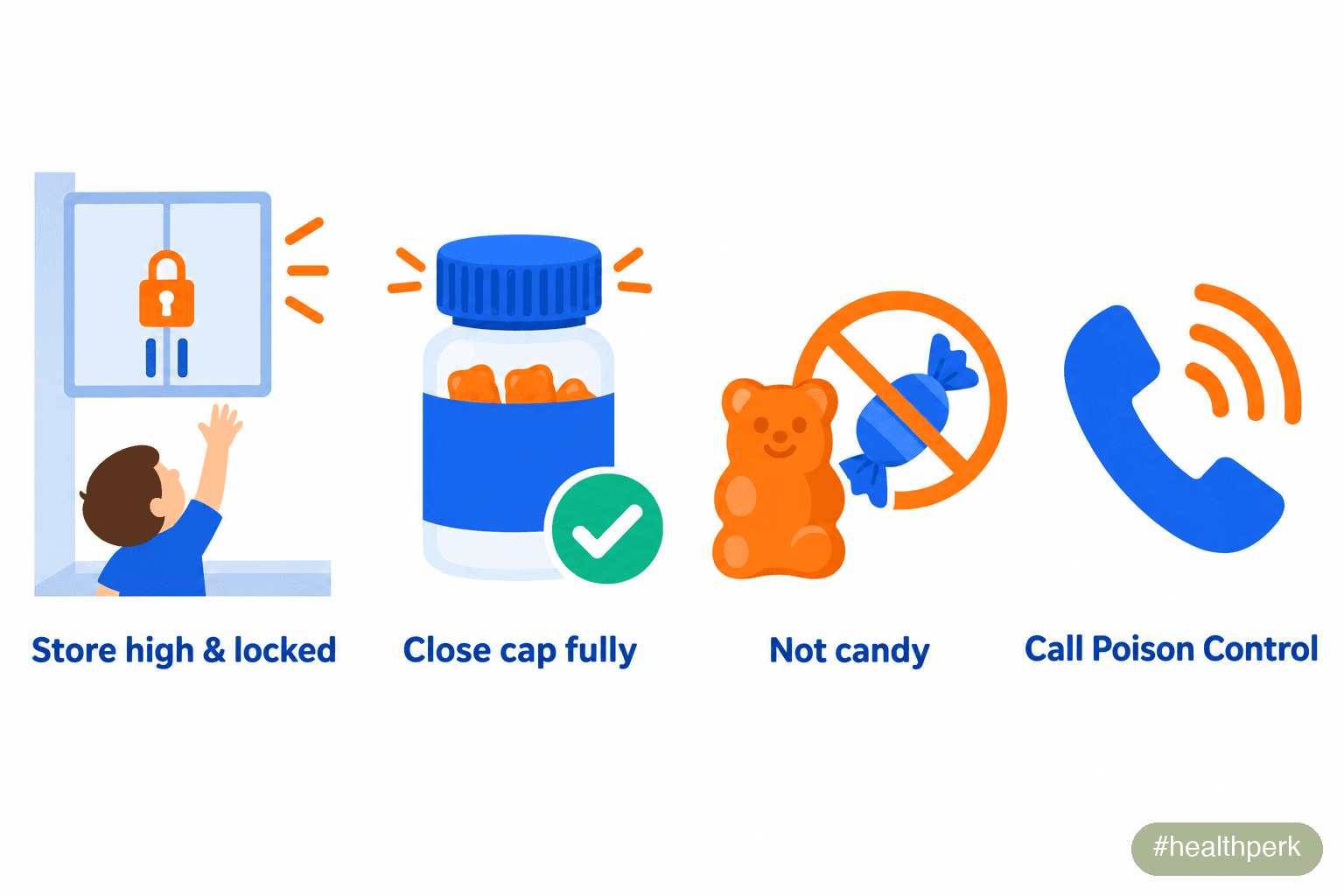 Most pediatric gummy ingestions involve an adult or family bottle left within reach.
Gummies vs Tablets vs Capsules vs Chewables
| Criterion | Gummy | Tablet | Capsule / softgel | Chewable tablet | Liquid or powder |
|---|---|---|---|---|---|
| Ease of taking | Excellent | Fair (can be large) | Good | Very good | Good |
| Mineral content (iron, calcium, magnesium) | Poor | Excellent | Good | Fair to good | Good |
| Dose stability over shelf life | Lower (moisture, heat) | High | High | Moderate to high | Varies; check storage |
| Sugar per serving | Usually 1–3 g per gummy | ~0 g | ~0 g | Small amount | Varies |
| Typical cost per nutrient | Highest (~2.5× tablets for multis [10]) | Lowest | Low to moderate | Moderate | Moderate |
| Appeal to children (overdose risk) | Highest | Low | Low | High | Moderate |
| Best for | Pill aversion, single-nutrient top-ups | Complete multis, minerals | Fat-soluble vitamins, omega-3 | Kids, pill aversion | Precise dosing, iron for infants |
Editorial verdict: For most adults, a third-party-verified tablet or capsule is the best value. It costs less, contains more of what you need, and keeps its labeled dose more reliably. Gummies are a reasonable second choice when the alternative is taking nothing. They work best for nutrients that fit easily in a small chew, such as vitamin D, B12, or folic acid, and from brands with an independent quality mark. Avoid high-dose claims that a gummy cannot physically hold or keep stable, such as 1,000 mg vitamin C per gummy.
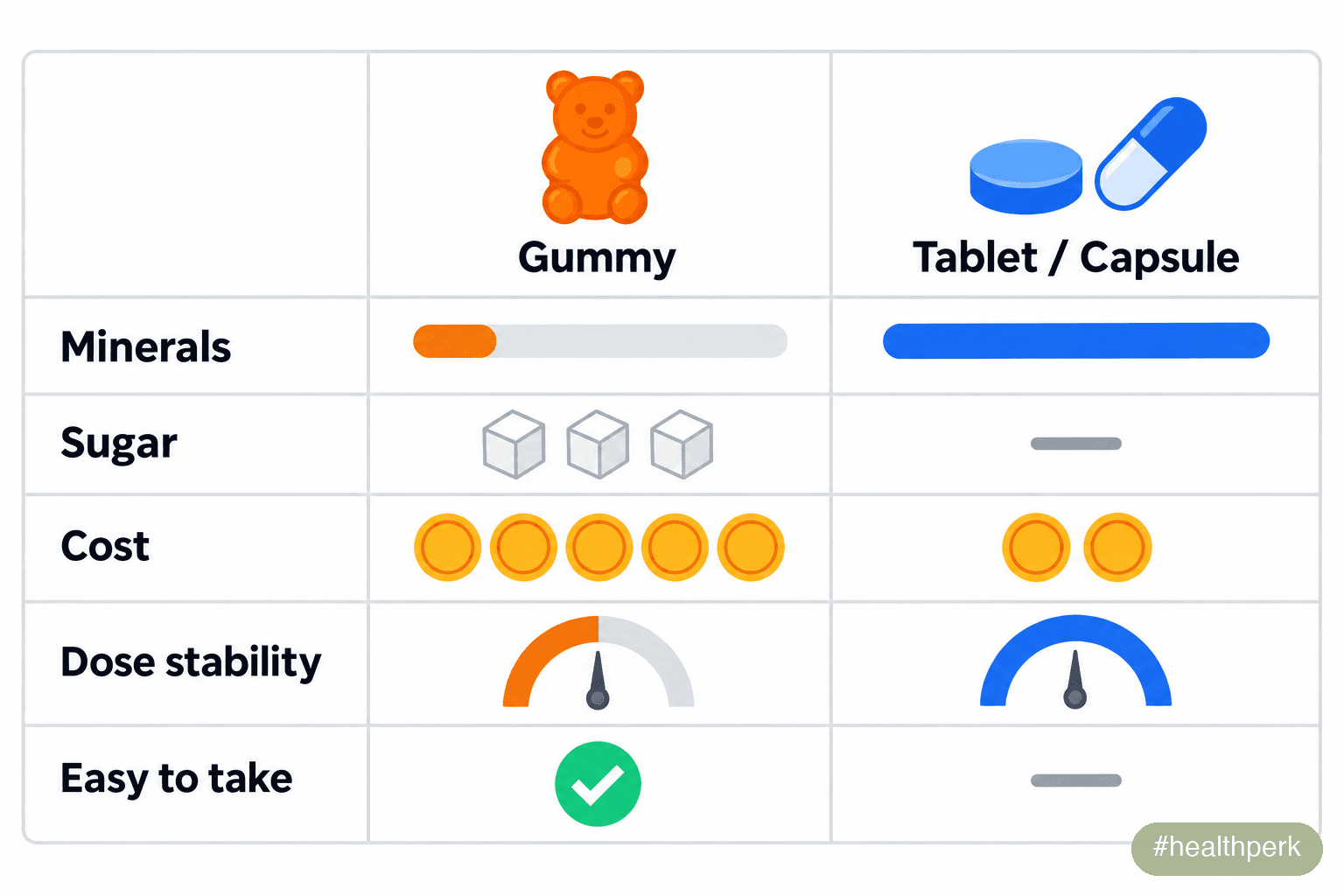 Gummies win on taste and ease of use. Tablets and capsules win on almost everything else.
Which Format Is Right for You
The healthy adult who can swallow pills. Skip the gummy. If you need a multivitamin at all, choose a USP- or NSF-verified tablet. Many adults who eat a varied diet do not need one. See our supplement routine for beginners.
The adult with true pill aversion or trouble swallowing. A gummy is a sensible choice, especially for vitamin D or B12. Cover minerals separately if blood tests show you need them, for example with a liquid iron or a magnesium powder.
The parent of a picky eater. Many children who eat a reasonable diet do not need a multivitamin. If your pediatrician recommends one, a chewable tablet or a verified gummy is fine. The bigger risk is storage, not the format. Keep the daily serving small, keep the bottle locked away, and never let a child have "extra."
The menstruating, pregnant, or vegan adult. You are among the people most likely to need iron, iodine, B12, or calcium, which gummies often leave out. Prenatal gummies in particular often contain no iron. Talk to your clinician and use a product that matches your lab results.
The budget-conscious buyer. Cost was the top barrier in the 2026 CRN survey [3]. Switching from a gummy multivitamin to a verified tablet is one of the easiest ways to save.
The person stacking several gummies. Add up the sugar, vitamin A, and zinc across all your products. Overlapping gummies can push some nutrients higher than you expect. Our guide on taking multiple supplements together shows how to check for overlap.
How to Choose a Better Gummy
- Look for an independent quality mark. The USP Verified Mark means a product passed facility audits, manufacturing document review, and lab testing of what is in the bottle [17]. NSF/ANSI 173 (NSF Contents Certified) checks that a product meets its label claims, is free of specified contaminants, and is made under good manufacturing practices [18]. Neither mark says the supplement will help you. It only says the label is honest.
- Be skeptical of very high single doses. A gram of vitamin C or a large dose of any mineral in one small gummy is a warning sign, not a selling point.
- Read the "Sugars" and "Added Sugars" lines. They are listed per serving, so check the serving size and multiply only by the number of servings you actually take each day.
- Check the minerals. If the product calls itself "complete" but lists no iron, calcium, or magnesium, it is not complete.
- Check the date and storage. Buy fresh stock, keep the lid closed, and avoid hot, humid places such as a bathroom cabinet or a car.
- Buy from the brand or a reputable retailer, not unknown marketplace listings [4].
- Use child-resistant packaging, and close it every time.
For a full checklist, see how to choose supplements safely.
Common Misconceptions About Gummy Vitamins
"Gummies do not get absorbed." Not quite. For vitamin D, a gummy matched or beat a tablet in a single-dose study [9]. The more common problems are missing nutrients and doses that drift over time.
"FDA approves supplements, so the label must be right." The FDA does not approve dietary supplements before they are sold. Its 2026 paper describes good practice. It does not certify any product [1].
"A gummy multivitamin covers everything." Gummy multivitamins usually leave out iron and calcium and often most other minerals [10].
"More is better." Extra fat-soluble vitamins, iron, and zinc can cause side effects.
"Melatonin gummies are harmless." Doses in tested products varied widely, from 74% to 347% of the label [6], and pediatric emergency visits are common [8]. Melatonin works best for occasional use, under guidance, and away from children.
"Immunity gummies prevent colds." The candy format adds nothing. See what has evidence in best vitamins for immunity.
When to See a Doctor
Call Poison Control (1-800-222-1222 in the U.S.) or emergency services right away if:
- A child may have swallowed any iron-containing product, prenatal vitamin, or adult multivitamin, even if they seem fine. Vomiting, diarrhea, belly pain, or drowsiness after an iron ingestion is an emergency.
- A child swallowed melatonin and becomes very drowsy, hard to wake, or has trouble breathing.
- Anyone has taken large amounts of vitamin A, vitamin D, or iron.
Book a regular appointment if:
- You have fatigue, hair shedding, shortness of breath on exertion, or heavy periods. These can point to iron deficiency, which gummies are unlikely to fix.
- You are pregnant, planning pregnancy, or breastfeeding and rely on a gummy prenatal.
- You take blood thinners, thyroid medication, or other prescriptions alongside several supplements.
- You have kidney disease or diabetes and take several gummies a day.
Related Articles on Health Perk
- How to Choose Supplements Safely: A 2026 Evidence-Based Buyer's Guide
- Can You Take Multiple Supplements Together?
- Best Supplements for Immune System: A 2026 Evidence Guide
- Iron Deficiency Fatigue Symptoms
- Vitamin D Deficiency Symptoms
Frequently Asked Questions
Are gummy vitamins as effective as pills?
For the nutrients they actually contain at the stated dose, gummies can work as well as pills. A crossover study found vitamin D from gummies was absorbed at least as well as from tablets. The problems are elsewhere. Gummies often leave out minerals, carry sugar, cost more, and some brands fall below their label claim as the vitamins break down. A verified tablet is usually the more reliable choice if you can swallow it.
Did the FDA ban or warn against gummy vitamins in 2026?
No. In September 2026, FDA scientists published a perspective paper in the Journal of Dietary Supplements on how to make and test gummies properly. A spokesperson said gummies should not be treated simply as candy. The paper highlights heat damage, moisture, testing difficulties, and the need to limit overages. It is guidance on good practice, not a ban, recall, or new rule, and it names no brands.
Why do gummy multivitamins not contain iron?
Iron tastes metallic, can change a gummy's color, and reacts with other ingredients. There is also little room in a small gummy for bulky minerals. A Dutch review of 49 multivitamin gummies found none contained iron or calcium. Iron gummies are also a serious poisoning risk for young children. If you need iron, talk to your clinician about a dedicated iron product sized to your blood test results.
How much sugar is in gummy vitamins?
Many gummies list roughly 1 to 3 grams of sugar per piece, and a daily serving is often two or more pieces. That is modest on its own, but it adds up if you take several gummy products every day. Sugar-free versions usually use sugar alcohols, which can upset the stomach in larger amounts. Always check the Sugars and Added Sugars lines on the Supplement Facts panel.
Are gummy vitamins safe for kids?
They can be, at the labeled dose and if your pediatrician agrees your child needs one. The main danger is overdose when children treat them like candy. Pediatric melatonin ingestions rose 530% from 2012 to 2021, and adult iron products are a leading cause of fatal poisoning in children under six. Store gummies locked away, close caps fully, and never call them candy.
Do USP or NSF marks mean a gummy works?
No. These marks mean an independent organization checked that the product contains what the label says, within limits, and was made under good manufacturing practices. USP also audits facilities, and NSF/ANSI 173 screens for specified contaminants. Neither mark proves that a supplement improves your health. That depends on whether you need the nutrient. Still, for gummies, a quality mark is the best quick check of label accuracy.
Is it worth paying more for gummy vitamins?
Usually not. A Dutch analysis found that gummy multivitamins cost about 2.5 times as much as tablets while containing fewer nutrients. With cost the top barrier to supplement use in the 2026 CRN survey, most people get better value from a verified tablet. Gummies are worth the extra money mainly if they are the only form you will reliably take.
Do gummy vitamins lose potency over time?
Yes, more than most tablets. Gummies contain moisture and are heated during production, which can break down vitamins such as vitamin C. One manufacturer reported losses of about 20% per year in some vitamin C gummy formulas. Buy fresh stock, check the expiration date, keep the lid tightly closed, and store gummies away from heat and humidity, not in a bathroom or car.
Medical Disclaimer: This article is for informational purposes only and is not a substitute for professional medical advice, diagnosis, or treatment. Always consult your physician or another qualified health provider before starting, stopping, or changing any supplement, especially for children, during pregnancy, or if you take prescription medication. If you suspect a poisoning, call Poison Control (1-800-222-1222 in the U.S.) or emergency services immediately. Read more about how we review.
References
- Hu, H., et al. (2026). Perspective on Gummy Dietary Supplements Manufacturing and Testing. Journal of Dietary Supplements. https://doi.org/10.1080/19390211.2026.2727022
Supports: FDA Office of Dietary Supplement Programs scientists reviewed formulation, manufacturing, testing, and overage challenges specific to gummies.
- NutraIngredients (2026). Sticky situation: FDA weighs in on gummy dietary supplements. NutraIngredients, October 7, 2026. https://www.nutraingredients.com/Article/2026/10/07/sticky-situation-fda-weighs-in-on-gummy-dietary-supplements/
Supports: FDA spokesperson statements (gummies "should not be treated simply as candy"), heat and water-activity concerns, and SPINS sales data of over $4.88 billion.
- Council for Responsible Nutrition (2026). New CRN Survey Finds 76% of Americans Say FDA Supplement Listing Would Increase Consumer Confidence. https://crnusa.org/node/7743
Supports: 75% of U.S. adults use supplements (46% regularly), 31% cite cost as a barrier (the most common), 77% say independent verification would raise confidence; Morning Consult, n=3,005, Sept 11–13, 2026.
- NOW (2026). NOW Tests Vitamin C Gummy Supplements Sold on Amazon. https://www.nowfoods.com/healthy-living/articles/now-tests-vitamin-c-gummy-supplements-sold-amazon
Supports: 13 of 25 vitamin C gummies met label claim, 12 had almost no detectable vitamin C, high-claim products had under 2 mg, and vitamin C losses of about 20% per year in some gummy formulas.
- NutraIngredients (2026). NOW's testing of vitamin C gummies on Amazon returns 'deeply disappointing results'. NutraIngredients, August 20, 2026. https://www.nutraingredients.com/Article/2026/08/20/nows-testing-of-vitamin-c-gummies-on-amazon-returns-deeply-disappointing-results/
Supports: Independent reporting of NOW testing methods (Alkemist Labs, ISO 17025, HPLC) and the 48% failure rate among non-legacy brands.
- Cohen, P. A., Avula, B., Wang, Y.-H., Katragunta, K., & Khan, I. (2023). Quantity of Melatonin and CBD in Melatonin Gummies Sold in the US. JAMA, 329(16), 1401–1402. https://doi.org/10.1001/jama.2023.2296
Supports: Melatonin gummies contained 74%–347% of labeled melatonin; only 3 of 25 were within ±10%.
- Lelak, K., Vohra, V., Neuman, M. I., Toce, M. S., & Sethuraman, U. (2022). Pediatric Melatonin Ingestions — United States, 2012–2021. MMWR Morbidity and Mortality Weekly Report, 71(22), 725–729. https://doi.org/10.15585/mmwr.mm7122a1
Supports: 530% increase in pediatric melatonin ingestions, 260,435 total, five children ventilated and two deaths.
- Freeman, D. I., Lind, J. N., Weidle, N. J., Geller, A. I., Stone, N. D., & Lovegrove, M. C. (2024). Notes from the Field: Emergency Department Visits for Unsupervised Pediatric Melatonin Ingestion — United States, 2019–2022. MMWR Morbidity and Mortality Weekly Report, 73(9), 215–217. https://doi.org/10.15585/mmwr.mm7309a5
Supports: About 10,930 ED visits among children aged 5 and under; gummies 47.3% of visits; adult or family products in 47.7%.
- Wagner, C. L., Shary, J. R., Nietert, P. J., Wahlquist, A. E., Ebeling, M. D., & Hollis, B. W. (2019). Bioequivalence Studies of Vitamin D Gummies and Tablets in Healthy Adults: Results of a Cross-Over Study. Nutrients, 11(5), 1023. https://doi.org/10.3390/nu11051023
Supports: Vitamin D3 gummies produced higher peak serum levels than tablets (47.3 vs 23.4 ng/mL) after a single 20,000 IU dose; industry-funded.
- Consumentenbond (2024). Multivitamine-gummies missen belangrijke vitamines en mineralen. https://www.consumentenbond.nl/nieuws/2024/multivitamine-gummies-missen-belangrijke-vitamines-en-mineralen
Supports: Review of 49 multivitamin gummies found none with iron or calcium, most missing about 10 of 11 key minerals, at about 2.5 times the price of tablets.
- Vos, M. B., Kaar, J. L., Welsh, J. A., Van Horn, L. V., Feig, D. I., Anderson, C. A. M., et al. (2017). Added Sugars and Cardiovascular Disease Risk in Children: A Scientific Statement From the American Heart Association. Circulation, 135(19), e1017–e1034. https://doi.org/10.1161/CIR.0000000000000439
Supports: Children should consume less than 25 g of added sugar per day.
- Nutritional Outlook (2024). CRN adopts new voluntary guidelines on melatonin and gummy supplements. April 18, 2024. https://www.nutritionaloutlook.com/view/crn-adopts-new-voluntary-guidelines-on-melatonin-and-gummy-supplements
Supports: CRN voluntary guidelines calling for child-deterrent closures, choking warnings, and data-based melatonin overages.
- NIH Office of Dietary Supplements (2026). Dietary Supplement Label Database (DSLD). https://dsld.od.nih.gov/
Supports: Gummy Supplement Facts panels commonly list about 1–3 g of sugar per gummy.
- NIH Office of Dietary Supplements (2026). Nutrient Recommendations and Databases. https://ods.od.nih.gov/HealthInformation/nutrientrecommendations.aspx
Supports: Recommended Dietary Allowances for iron, calcium, magnesium, zinc, and vitamin D.
- U.S. Code of Federal Regulations (2026). 21 CFR 101.17 - Food labeling warning, notice, and safe handling statements (paragraph e). https://www.law.cornell.edu/cfr/text/21/101.17
Supports: Required warning that accidental overdose of iron-containing products is a leading cause of fatal poisoning in children under 6.
- Tenenbein, M. (2005). Unit-Dose Packaging of Iron Supplements and Reduction of Iron Poisoning in Young Children. Archives of Pediatrics & Adolescent Medicine, 159(6), 557–560. https://doi.org/10.1001/archpedi.159.6.557
Supports: Iron ingestion calls fell from 2.99 to 1.91 per 1,000 and deaths from 29 to 1 after unit-dose packaging was required.
- United States Pharmacopeia (2026). USP Verified Mark. https://www.usp.org/verification-services/verified-mark
Supports: USP Verified Mark requires facility audit, manufacturing documentation review, and product testing.
- NSF (2026). The Importance of NSF/ANSI 173 Certification for Dietary Supplement Products. https://www.nsf.org/gb/en/knowledge-library/importance-nsf-ansi-173-certification-dietary-supplement-products
Supports: NSF/ANSI 173 certification verifies label claims, screens for contaminants, and requires GMP compliance.
Frequently Asked Questions
Are gummy vitamins as effective as pills?
For the nutrients they actually contain at the stated dose, gummies can work as well as pills. A crossover study found vitamin D from gummies was absorbed at least as well as from tablets. The problems are elsewhere. Gummies often leave out minerals, carry sugar, cost more, and some brands fall below their label claim as the vitamins break down. A verified tablet is usually the more reliable choice if you can swallow it.
Did the FDA ban or warn against gummy vitamins in 2026?
No. In September 2026, FDA scientists published a perspective paper in the Journal of Dietary Supplements on how to make and test gummies properly. A spokesperson said gummies should not be treated simply as candy. The paper highlights heat damage, moisture, testing difficulties, and the need to limit overages. It is guidance on good practice, not a ban, recall, or new rule, and it names no brands.
Why do gummy multivitamins not contain iron?
Iron tastes metallic, can change a gummy's color, and reacts with other ingredients. There is also little room in a small gummy for bulky minerals. A Dutch review of 49 multivitamin gummies found none contained iron or calcium. Iron gummies are also a serious poisoning risk for young children. If you need iron, talk to your clinician about a dedicated iron product sized to your blood test results.
How much sugar is in gummy vitamins?
Many gummies list roughly 1 to 3 grams of sugar per piece, and a daily serving is often two or more pieces. That is modest on its own, but it adds up if you take several gummy products every day. Sugar-free versions usually use sugar alcohols, which can upset the stomach in larger amounts. Always check the Sugars and Added Sugars lines on the Supplement Facts panel.
Are gummy vitamins safe for kids?
They can be, at the labeled dose and if your pediatrician agrees your child needs one. The main danger is overdose when children treat them like candy. Pediatric melatonin ingestions rose 530% from 2012 to 2021, and adult iron products are a leading cause of fatal poisoning in children under six. Store gummies locked away, close caps fully, and never call them candy.
Do USP or NSF marks mean a gummy works?
No. These marks mean an independent organization checked that the product contains what the label says, within limits, and was made under good manufacturing practices. USP also audits facilities, and NSF/ANSI 173 screens for specified contaminants. Neither mark proves that a supplement improves your health. That depends on whether you need the nutrient. Still, for gummies, a quality mark is the best quick check of label accuracy.
Is it worth paying more for gummy vitamins?
Usually not. A Dutch analysis found that gummy multivitamins cost about 2.5 times as much as tablets while containing fewer nutrients. With cost the top barrier to supplement use in the 2026 CRN survey, most people get better value from a verified tablet. Gummies are worth the extra money mainly if they are the only form you will reliably take.
Do gummy vitamins lose potency over time?
Yes, more than most tablets. Gummies contain moisture and are heated during production, which can break down vitamins such as vitamin C. One manufacturer reported losses of about 20% per year in some vitamin C gummy formulas. Buy fresh stock, check the expiration date, keep the lid tightly closed, and store gummies away from heat and humidity, not in a bathroom or car.