Calm vs Headspace (2026): Which Meditation App Is Better for You?
Calm is the better pick for falling asleep, with 100+ exclusive Sleep Stories and more languages. Headspace is better for learning to meditate, anxiety, and chronic insomnia, and it adds the Ebb AI companion and optional therapy. Both list a $69.99 annual US plan, and both have small-to-moderate trial evidence, much of it company-linked.
Calm vs Headspace (2026): Which Meditation App Is Better for You?
By the HealthPerk Editorial Team · Last updated: October 2026
Quick Answer
Is Calm or Headspace better?
In the Calm vs Headspace choice, pick Calm if you mainly want help falling asleep. It has the bigger Sleep Stories library and supports more languages. Choose Headspace if you want to learn meditation step by step, or want extra support from its Ebb AI companion or therapy. Both list a $69.99 annual plan in the US.
| Your situation | First step |
|---|---|
| You lie awake with a racing mind | Try Calm's Sleep Stories and wind-down content for two weeks |
| You have had insomnia most nights for 3+ months | Try Headspace's CBT-I-based Sleep Program and talk to a clinician about CBT-I |
| You have never meditated and want structure | Start Headspace's beginner course with 10 minutes a day |
| You want everyday stress relief at work | Either app works; use the 14-day Headspace trial or Calm's free content to compare |
| You are a student on a budget | Look at Headspace's $9.99-a-year student plan or a free app such as Medito |
| You want to pay nothing at all | Start with Insight Timer, Medito, or UCLA Mindful |
Calm leans toward sleep and relaxation, while Headspace leans toward structured meditation training and extra mental health support.
Calm vs Headspace is the most common choice people face when they try a meditation app. Both cost about the same, both have published randomized trials, and both offer sleep content and guided meditations. The real differences are in what each app is built around, how much support you get beyond audio, and what happens to your data.
2026 also changed the picture. Headspace was acquired by Sword Health this fall, and it now leans further into AI support through its Ebb companion [3][4][5]. Calm spun off a standalone sleep app in 2025 [8]. This guide compares content, prices checked in October 2026, the trial evidence for each app, privacy labels, and free alternatives, so you can pick one and test it properly.
Table of Contents
- What Changed in 2025 and 2026
- How Meditation Apps Help With Stress and Sleep
- Calm vs Headspace: Content Compared
- Calm vs Headspace Price in 2026: Plans, Trials, and Free Content
- What the Research Says About Each App
- Privacy and Platforms
- Calm vs Headspace Comparison Table
- Which Is Right for You: Calm or Headspace?
- Free Alternatives to Calm and Headspace
- How to Test a Meditation App in 14 Days
- Common Myths About Meditation Apps
- When to See a Doctor
- Related Articles on Health Perk
- Frequently Asked Questions
- References
What Changed in 2025 and 2026
Headspace now belongs to Sword Health. A regulatory filing reported by Healthcare Dive in August 2026 showed that Sword Health, a digital health company focused on AI care, would acquire Headspace in an all-cash deal [3]. Headspace's own site now says the acquisition "officially closed Fall 2026" [4]. In the filing, Headspace said it expects to keep its therapy, coaching, and on-demand content running "substantially as it currently exists" [3]. As of October 2026, neither company has announced changes to consumer subscription prices.
Ebb, Headspace's AI companion, keeps growing. Headspace launched Ebb in October 2024 as a chat companion that helps members reflect on their emotions and suggests content from the library [5]. In December 2025 it added a voice mode, so you can talk to Ebb out loud [6]. Headspace states that Ebb "is not an AI therapist and does not diagnose, treat, or replace licensed clinical care" [6]. Ebb is included in the standard subscription, not sold separately [10].
Headspace added pay-per-session therapy. In June 2025, Headspace opened Therapy by Headspace to US adults in all 50 states. Most insured members pay $0 to $35 per session, and the self-pay price is $149 per session [7]. Therapy is billed separately from the meditation subscription.
Calm went deeper on sleep, not chatbots. In September 2025, Calm launched Calm Sleep, a standalone iOS app that builds a personalized sleep plan with daily tasks and syncs with Apple Health. It costs $69.99 a year on its own [8]. In October 2025, Calm added Calm Lifestyle, an in-app hub of short collections for busy schedules [9]. As of October 2026 we found no announced conversational AI companion in Calm's consumer app.
How Meditation Apps Help With Stress and Sleep
Most people open these apps for one of two problems: stress that won't switch off, or a mind that races at bedtime. The trials point to a shared mechanism behind both. It is less about deep relaxation and more about breaking repetitive thinking.
Perseverative cognition. Worry and rumination keep the body's stress response running long after the stressful event ends. In a 2025 trial with 138 university employees, people using Headspace reported less subjective stress and less perseverative thinking within two weeks, measured five times a day on their phones. Those gains lasted to week 8, while the waitlist group got worse [22].
Pre-sleep arousal. Insomnia is often driven by being mentally "switched on" at bedtime. In a 2021 trial of adults with sleep disturbance, eight weeks of Calm reduced both cognitive and physical pre-sleep arousal compared with a waitlist, along with daytime fatigue and sleepiness [15].
Structured sleep retraining. Listening to a calming story is not the same as treating chronic insomnia. The first-line treatment for chronic insomnia is cognitive behavioral therapy for insomnia (CBT-I), which uses stimulus control and sleep scheduling [27][28]. Headspace's 18-session Sleep Program borrows CBT-I techniques, which helps explain why it was tested in people with clinical insomnia [23]. For more drug-free strategies, see our guide on how to fall asleep faster without medication.
Calm vs Headspace: Content Compared
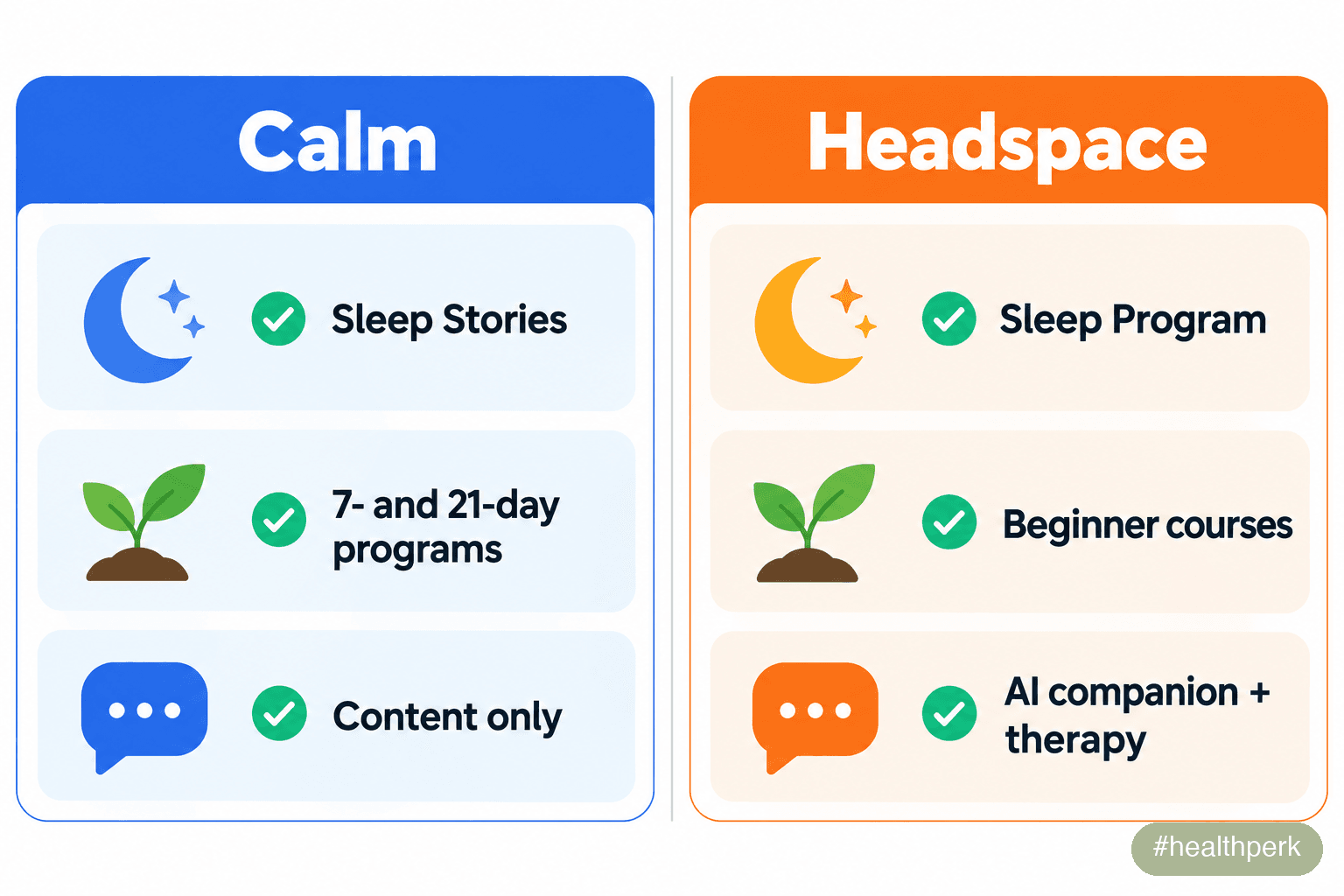
Schematic comparison of each app's main content areas, based on the apps' October 2026 App Store descriptions.
Sleep content: Sleep Stories vs Sleepcasts
Sleep is Calm's signature. Its App Store listing describes more than 100 exclusive Sleep Stories, bedtime stories for adults read by narrators such as Matthew McConaughey and Stephen Fry, with new content added every month [1]. Calm also offers sleep music, soundscapes, and breathing exercises. Calm says its Sleep Stories have been played more than 1 billion times [8].
Headspace's sleep section includes guided sleep meditations, sleep sounds, and sleepcasts, which are long, low-key audio scenes meant to help you drift off [2]. Headspace also has the structured Sleep Program tested in a 2025 trial [23]. If you want a story, Calm has the deeper library. If your problem is a sleep pattern that has gone wrong for months, Headspace's program is closer to a treatment format.
Learning to meditate
Headspace was built around teaching meditation as a skill. Its listing describes more than 500 guided meditations, from 3-minute resets to longer sessions, plus courses on stress, anxiety, and focus [2]. The early sessions are short and highly guided, which suits complete beginners.
Calm offers beginner-to-advanced guided sessions, 7- and 21-day mindfulness programs, and daily sessions such as the Daily Calm with Tamara Levitt and the Daily Trip with Jeff Warren [1]. It also includes breathwork and gentle movement through Daily Move. Calm feels more like a relaxation library you dip into, while Headspace feels more like a course you follow.
Support beyond audio
This is where the apps differ most in 2026. Headspace bundles Ebb into the subscription and offers optional coaching and therapy [2][7]. Calm stays focused on content. Its clinical-style programs live in Calm Health, a separate app you can only get through an employer, insurer, or care team [32].
Calm vs Headspace Price in 2026: Plans, Trials, and Free Content
We checked prices on the official US App Store listings and the companies' own pages on October 16, 2026. All prices are US prices as of October 2026; other countries differ.
Headspace. $12.99 a month or $69.99 a year [2][10]. Headspace's subscription page offers a 14-day free trial [11]. Verified college students pay $9.99 a year [12]. The App Store also lists a "Headspace Plus" purchase at $94.99 without describing it, so check what that tier includes in the app before you buy [2].
Calm. The US App Store lists Calm Premium in-app purchases at $69.99 and $79.99 for annual tiers and $14.99 to $16.99 for monthly tiers [1]. The price you see depends on the offer and where you buy. Calm's help center also describes a one-time lifetime membership; check the current price in the app before buying [13]. The standalone Calm Sleep app is a separate $69.99-a-year purchase [8].
Free content. Calm says it is free to download, has no ads, and keeps "some of the programs and features" free forever [1]. Headspace's free experience is mostly the trial, so plan to test it within that window. Both apps auto-renew, so set a reminder before any trial ends.
Cost of extras. Headspace therapy is $149 per session without insurance, or $0 to $35 for most insured members [7]. It is not part of the $69.99 plan.
What the Research Says About Each App
Both apps have peer-reviewed randomized controlled trials (RCTs). Here is what they found, by app.
Calm trials
- Stressed college students (2019). 109 undergraduates were randomized, and 88 were analyzed. Eight weeks of Calm at 10 minutes a day reduced stress and improved mindfulness and self-compassion versus a waitlist. Effect sizes ranged from moderate (0.59) to large (1.24), and benefits held at 12 weeks [14].
- Adults with sleep disturbance (2021). 263 adults were randomized. Calm reduced daytime fatigue, daytime sleepiness, and pre-sleep arousal over eight weeks compared with a waitlist [15].
- Workplace (2022). In a cluster RCT with 1,029 employees, the Calm group improved on depression, anxiety, and insomnia at week 8. Only 192 people completed every assessment, so the complete-case results carry more uncertainty [16].
- Undergraduates' sleep (2025). A pilot RCT of 80 students using Calm's sleep content reported better sleep quality and lower stress and state anxiety than controls [17].
Headspace trials
- First 10 sessions (2018). In 69 adults new to meditation, 10 days of Headspace reduced irritability and improved mood compared with an audiobook control, with moderate effects (Cohen's d about 0.45) [18].
- University students (2019). 208 students were randomized to Headspace, Smiling Mind, or a note-taking app. After 10 days, both meditation apps improved depressive symptoms versus control [19].
- UK employees (2019). 238 employees used Headspace or joined a waitlist. The app group improved on well-being, distress, and job strain at 8 weeks, and well-being and job strain gains held at 16 weeks [20].
- NHS health care workers (2022). In the largest trial on this list, 2,182 NHS staff used Headspace or an active control for 4.5 months. Headspace reduced stress more, with a small effect (Hedges' g 0.26) [21].
- Clinical insomnia (2025). 132 adults with clinical insomnia used the Headspace Sleep Program or joined a waitlist. Insomnia Severity Index scores fell from 14.8 to 10.7 at follow-up in the app group and didn't change in the waitlist group [23].
- Anxiety and depression (2025). In 168 adults with clinically significant symptoms, a 21-session Headspace program raised combined remission to 21.4%, versus 8.3% on the waitlist [24].
How to read this evidence
Across 34 trials of mindfulness apps, a 2021 meta-analysis found small-to-moderate benefits for stress (g = 0.46), depression (g = 0.33), and anxiety (g = 0.28) [25]. The authors cautioned that the number of studies was small and risk of bias was often unclear.
There is a bigger caveat that competitor reviews skip. Many trials of both apps were run or co-authored by people paid by the company. In the Calm workplace trial, two authors disclosed receiving a salary from Calm and holding company stock [16]. Five authors of the Headspace insomnia trial were Headspace employees [23]. Most trials also used waitlist controls, which tend to make any intervention look better than an active comparison would. The NHS trial is a useful exception because it used an active control [21].
Bottom line: both apps have reasonable evidence for reducing stress in generally healthy adults. No head-to-head trial shows that one app works better than the other.
Privacy and Platforms
Meditation apps collect sensitive information, such as your mood check-ins, sleep habits, and sometimes chat logs. Apple's App Store privacy labels give a quick, standardized view of what each developer says it collects.
Calm declares "Data Used to Track You," covering purchases, identifiers, and usage data. Data linked to you includes health and fitness, contact info, search history, and diagnostics [1].
Headspace doesn't show a "Data Used to Track You" section on its US listing. It does declare data linked to you, including health and fitness, location, contact info, user content, and usage data, some of it used for its own marketing [2]. If you chat with Ebb, those conversations are user content. Read the privacy policy before you share anything you would not want stored.
Platforms. Both apps run on iPhone, iPad, Apple Watch, Mac, Apple Vision Pro, and Android, and both save sessions to Apple Health [1][2]. Calm also lists an Apple TV app and supports English plus nine other languages [1]. Headspace's US listing shows English only [2]. The App Store rates Calm 9+ and Headspace 13+.
Calm vs Headspace Comparison Table
Whichever app you choose, a consistent 10-minute habit matters more than the size of its library.
| Criterion | Calm | Headspace | Insight Timer (free tier) |
|---|---|---|---|
| Best for | Sleep and relaxation | Learning meditation, stress, extra support | Variety at no cost |
| US price (Oct 2026) | $69.99 to $79.99/yr; $14.99 to $16.99/mo | $69.99/yr; $12.99/mo; students $9.99/yr | Free; Premium $59.99/yr or $9.99/mo |
| Free trial or free content | Some content free forever | 14-day free trial | Thousands of free meditations |
| Sleep content | 100+ exclusive Sleep Stories, music, soundscapes | Sleepcasts, sleep meditations, CBT-I-based Sleep Program | Free sleep meditations from independent teachers |
| AI or human support | None in consumer app | Ebb AI companion included; coaching and therapy extra | None |
| Published RCTs of the app | Yes (students, sleep disturbance, workplace) | Yes (students, employees, NHS staff, insomnia, anxiety and depression) | Not reviewed here |
| App Store tracking label | Declares data used to track you | No tracking section shown | No tracking section shown |
| Languages (US listing) | English + 9 | English | Not compared |
Sources: [1][2][10][11][12][29].
Editorial verdict. For most people whose main goal is sleep, Calm is the better first pick, thanks to its story library and wind-down content. For beginners, people with ongoing stress or anxiety, and anyone with long-running insomnia, Headspace has the edge. Its structured programs have been tested in clinical populations, and Ebb, coaching, and therapy are there if you need more help. If the price is the obstacle, start with a free app and upgrade only if you keep using it.
Which Is Right for You: Calm or Headspace?
The bedtime overthinker. You fall asleep fine once your brain quiets, but that takes an hour. Pick Calm. Pair a Sleep Story with a fixed wind-down routine, and use our sleep cycle calculator to set a consistent bedtime.
The complete beginner. You have never meditated and want someone to tell you exactly what to do. Pick Headspace. Its short, guided starter sessions are the same format tested in its 10-day trials [18][19].
The person with chronic insomnia. You have struggled to sleep at least three nights a week for months. Headspace's CBT-I-based Sleep Program is the closer match, but it should complement, not replace, care from a clinician [23][27]. Our guide to sleeping better with anxiety covers related habits.
The stressed professional. You want 10 minutes of relief at lunch. Both apps have workplace trials behind them, so choose based on voice and style during the trial [16][20][21]. If your employer offers Calm Health or Headspace as a benefit, use that first.
The student. Headspace's $9.99-a-year student plan is the cheapest paid option here [12]. Medito and UCLA Mindful cost nothing.
The data-cautious user. If tracking matters to you, compare the App Store privacy labels before you sign up. A nonprofit app such as Medito is another option [30].
Free Alternatives to Calm and Headspace
Insight Timer. Its App Store listing describes thousands of free guided meditations, with more added daily, from many independent teachers. Its Premium tier costs $59.99 a year or $9.99 a month [29]. Quality varies by teacher, so save the voices you like.
Medito. Run by the nonprofit Medito Foundation, it says every meditation, course, and sleep story is free [30]. It's a good fit if you want structure without a subscription.
UCLA Mindful. Created by UCLA Health's mindfulness center, it is free and offers basic guided meditations in several languages [31].
For more options, including mood trackers and therapy apps, see our roundup of the best apps for mental health and our independent guide to the best apps for sleep.
How to Test a Meditation App in 14 Days
- Name one goal. Write down whether you want to fall asleep faster, worry less, or learn to meditate. This decides which app to try first.
- Take a baseline. Rate your stress and sleep from 1 to 10 for three days, or note how long it takes you to fall asleep.
- Start the trial with a reminder. Begin Headspace's 14-day trial or Calm's free content, and set a calendar alert two days before any paid renewal.
- Use it 10 minutes a day. Most trials asked for about 10 minutes daily [14][15][20]. Pick the same time each day, such as after brushing your teeth.
- Follow one program, not random sessions. Use a beginner course or the Sleep Program in order instead of jumping between tracks.
- Re-rate on day 14. Compare your scores with your baseline. A shift of a couple of points, or falling asleep noticeably faster, means it's worth keeping.
- Decide, then commit or cancel. If it helped, consider the annual plan. If not, try the other app or a free one before you pay for anything.
If you track sleep with a wearable, look at trends over two weeks rather than single nights. Our Oura vs Whoop comparison explains what those devices measure.
Common Myths About Meditation Apps
Myth: Meditation apps are a replacement for therapy. They are self-help tools. Headspace itself says Ebb does not diagnose, treat, or replace licensed care [6]. Most trials enrolled healthy or stressed adults, not people with severe illness.
Myth: The bigger the library, the better the results. Benefits in trials came from regular short practice, often 10 minutes a day [14][20]. A large library mostly helps you avoid boredom.
Myth: Sleep stories treat insomnia. Stories can help you stop thinking and drift off. Chronic insomnia usually needs structured CBT-I, which is the recommended first-line treatment [27][28].
Myth: Meditation is always harmless. Most people have no problems. But a 2020 systematic review of 83 studies found that about 8.3% of participants reported an adverse event, most often anxiety or low mood [26]. If a practice makes you feel worse, stop and switch to grounding exercises or talk to a professional.
When to See a Doctor
An app is a reasonable first step for everyday stress and occasional poor sleep. See a doctor or licensed mental health professional if:
- You have trouble sleeping at least three nights a week for three months or more, which may be chronic insomnia that responds to CBT-I [27].
- You snore loudly, gasp or stop breathing during sleep, or feel very sleepy during the day despite enough time in bed. These can be signs of sleep apnea.
- Low mood, loss of interest, or anxiety lasts most days for two weeks or more, or interferes with work or relationships.
- You rely on alcohol or sleeping pills to fall asleep.
- Meditation brings up panic, flashbacks, or feelings of unreality that do not settle.
If you have thoughts of suicide or self-harm, call or text 988 in the US (the Suicide and Crisis Lifeline) or your local emergency number right away.
Related Articles on Health Perk
- Best Apps for Sleep Tracking in 2026: An Independent Guide
- Apps for Mental Health Improvement in 2026
- How to Sleep Better With Anxiety
- How to Adjust Your Sleep to the Clock Change
- Best Apps to Improve Focus and Productivity
- How We Review Health Apps and Products
Frequently Asked Questions
Is Calm or Headspace better for sleep?
Calm is better for most people who want help falling asleep. It has more than 100 exclusive Sleep Stories plus sleep music and soundscapes, and a trial showed it reduced pre-sleep arousal and daytime fatigue. Headspace is the better fit for long-running insomnia, because its CBT-I-based Sleep Program improved insomnia scores in a 2025 trial.
Is Calm or Headspace better for anxiety?
Headspace has the stronger evidence for anxiety. A 2025 trial in adults with clinically significant anxiety or depression found that its 21-session program raised remission rates to 21.4%, versus 8.3% on a waitlist. Calm has trials showing lower stress and anxiety in students and employees. Neither app replaces treatment for an anxiety disorder.
Which is cheaper, Calm or Headspace?
Headspace is usually slightly cheaper. In the US as of October 2026, Headspace costs $69.99 a year or $12.99 a month, and students pay $9.99 a year. Calm's App Store listing shows annual tiers at $69.99 and $79.99 and monthly tiers at $14.99 to $16.99. Calm also offers a one-time lifetime membership.
Is Headspace or Calm better for beginners?
Headspace is better for most beginners. It was built to teach meditation step by step, with short, highly guided starter sessions. Those first sessions were the format tested in Headspace's 10-day trials. Calm also has beginner programs, but it works more like a relaxation library you dip into.
Does Headspace have an AI companion?
Yes. Headspace's AI companion, Ebb, launched in October 2024 and added a voice mode in December 2025. Ebb helps you reflect on your feelings and suggests meditations and exercises. It is included in the standard subscription. Headspace says Ebb is not a therapist and does not diagnose or treat mental health conditions.
Is there a free version of Calm or Headspace?
Calm has a free tier. It is free to download, shows no ads, and keeps some programs and features free forever. Headspace mainly offers a 14-day free trial, plus free content on its YouTube channel. For a fully free app, try Insight Timer, Medito, or UCLA Mindful.
Do meditation apps actually work?
Yes, for many people, though the effects are modest. A 2021 meta-analysis of 34 trials found small-to-moderate improvements in stress, depression, and anxiety from mindfulness apps. Results depend on regular practice, usually about 10 minutes a day. Many trials were funded or run by app companies, so independent research is still needed.
What happened to Headspace in 2026?
Headspace was acquired by Sword Health, a digital health company focused on AI care. The deal was disclosed in August 2026, and Headspace says it closed in fall 2026. Headspace said it expects to keep its therapy, coaching, and meditation content running as before. As of October 2026, no subscription price changes have been announced.
Medical disclaimer: This article is for informational purposes only and is not a substitute for professional medical advice, diagnosis, or treatment. Meditation apps are wellness tools, not treatments for insomnia, anxiety, depression, or other conditions. Talk to a qualified health care provider about any symptoms or before changing a treatment plan. If you are in crisis, call or text 988 in the US or contact your local emergency services.
References
- Calm.com, Inc. (2026). Calm. Apple App Store. https://apps.apple.com/us/app/calm/id571800810
Supports: Calm Premium US in-app purchase prices ($69.99–$79.99, $14.99–$16.99), 100+ exclusive Sleep Stories, free forever content with no ads, 10 languages, platforms, privacy labels including data used to track you.
- Headspace Inc. (2026). Headspace: Sleep & Meditation. Apple App Store. https://apps.apple.com/us/app/headspace-meditation-sleep/id493145008
Supports: $12.99/month and $69.99/year US pricing, Headspace Plus $94.99 listing, 500+ guided meditations, sleepcasts, Ebb, coaching and therapy, privacy labels, English-only listing, platforms.
- Healthcare Dive (2026). Sword Health to acquire Headspace. Healthcare Dive. https://www.healthcaredive.com/news/sword-health-to-acquire-headspace/828873/
Supports: August 2026 filing disclosing Sword Health's all-cash acquisition of Headspace and plan to keep services operating substantially as they are.
- Headspace (2026). Headspace and Sword: A New Era for Mental Health. Headspace. https://www.headspace.com/articles/headspace-and-sword-a-new-era-for-mental-health
Supports: The acquisition officially closed in fall 2026.
- Headspace (2024). Mental Health Company Headspace Launches Empathetic AI Companion. Business Wire. https://www.businesswire.com/news/home/20241010397470/en/Mental-Health-Company-Headspace-Launches-Empathetic-AI-Companion
Supports: Ebb launched October 10, 2024 as an AI companion for reflection that recommends Headspace content.
- OPEN MINDS (2025). Headspace Rolls Out Voice Feature For Empathetic AI Companion. OPEN MINDS. https://openminds.com/market-intelligence/bulletins/headspace-rolls-out-voice-feature-for-empathetic-ai-companion/
Supports: December 2025 voice mode for Ebb; Ebb is not an AI therapist and does not diagnose, treat, or replace licensed clinical care.
- Headspace (2025). Product Announcement: Therapy by Headspace Now Available Nationwide. Headspace. https://www.headspace.com/articles/introducing-therapy-by-headspace
Supports: Therapy for US adults in all 50 states; $0–$35 per session for most insured members; $149 self-pay; Ebb not a substitute for human care.
- Calm (2025). Calm Launches Calm Sleep, New App At the Center of Its Expanded Sleep Ecosystem. Calm Blog. https://www.calm.com/blog/calm-sleep-press-release
Supports: Calm Sleep launched September 16, 2025 on iOS at $69.99/year with personalized sleep plans and HealthKit sync; Sleep Stories played more than 1 billion times.
- Calm (2025). Calm Launches “Calm Lifestyle”. Calm Blog. https://www.calm.com/blog/calm-lifestyle-press-release
Supports: Calm Lifestyle in-app hub launched October 9, 2025.
- Headspace (2026). Meet Ebb. Headspace. https://www.headspace.com/headspace-subscription/ebb
Supports: Ebb is built into the Headspace app; annual subscription is $69.99 USD after the free trial.
- Headspace (2026). Subscribe to Headspace. Headspace. https://www.headspace.com/subscriptions
Supports: 14-day free trial offer.
- Headspace (2026). Headspace Student Plan. Headspace. https://www.headspace.com/studentplan
Supports: $9.99 per year for verified college or university students.
- Calm (2026). Calm Lifetime Membership. Calm Help Center. https://support.calm.com/hc/en-us/articles/30958037515419
Supports: Calm offers a one-time lifetime membership.
- Huberty, J., Green, J., Glissmann, C., Larkey, L., Puzia, M., & Lee, C. (2019). Efficacy of the Mindfulness Meditation Mobile App “Calm” to Reduce Stress Among College Students: Randomized Controlled Trial. JMIR mHealth and uHealth, 7(6), e14273. https://doi.org/10.2196/14273
Supports: Calm reduced stress and improved mindfulness and self-compassion in stressed students; effect sizes 0.59–1.24; 10 minutes/day; benefits maintained at 12 weeks.
- Huberty, J. L., Green, J., Puzia, M. E., Larkey, L., Laird, B., Vranceanu, A.-M., et al. (2021). Testing a mindfulness meditation mobile app for the treatment of sleep-related symptoms in adults with sleep disturbance: A randomized controlled trial. PLOS ONE, 16(1), e0244717. https://doi.org/10.1371/journal.pone.0244717
Supports: In 263 adults with sleep disturbance, Calm reduced daytime fatigue, daytime sleepiness, and cognitive and somatic pre-sleep arousal over eight weeks.
- Huberty, J. L., Espel-Huynh, H. M., Neher, T. L., & Puzia, M. E. (2022). Testing the Pragmatic Effectiveness of a Consumer-Based Mindfulness Mobile App in the Workplace: Randomized Controlled Trial. JMIR mHealth and uHealth, 10(9), e38903. https://doi.org/10.2196/38903
Supports: 1,029 employees; improvements in depression, anxiety, and insomnia at week 8; 192 completers; authors disclosed Calm salary and stock.
- Lew, T., Dubale, N. M., Doose, E., Adenuga, A., Bates, H. E., & West, S. L. (2025). Impacts of the Mindfulness Meditation Mobile App Calm on Undergraduate Students’ Sleep and Emotional State: Pilot Randomized Controlled Trial. JMIR Formative Research, 9, e66131. https://doi.org/10.2196/66131
Supports: Pilot RCT in 80 undergraduates using Calm's sleep content; improved sleep quality, stress, and state anxiety versus controls.
- Economides, M., Martman, J., Bell, M. J., & Sanderson, B. (2018). Improvements in Stress, Affect, and Irritability Following Brief Use of a Mindfulness-based Smartphone App: A Randomized Controlled Trial. Mindfulness, 9(5), 1584–1593. https://doi.org/10.1007/s12671-018-0905-4
Supports: 69 adults; 10 introductory Headspace sessions improved irritability (d = 0.44), affect (d = 0.47), and stress from external pressure (d = 0.45) versus an audiobook control.
- Flett, J. A. M., Hayne, H., Riordan, B. C., Thompson, L. M., & Conner, T. S. (2019). Mobile Mindfulness Meditation: a Randomised Controlled Trial of the Effect of Two Popular Apps on Mental Health. Mindfulness, 10(5), 863–876. https://doi.org/10.1007/s12671-018-1050-9
Supports: 208 students; 10 days of Headspace or Smiling Mind improved depressive symptoms versus an Evernote control.
- Bostock, S., Crosswell, A. D., Prather, A. A., & Steptoe, A. (2019). Mindfulness on-the-go: Effects of a mindfulness meditation app on work stress and well-being. Journal of Occupational Health Psychology, 24(1), 127–138. https://doi.org/10.1037/ocp0000118
Supports: 238 UK employees; Headspace improved well-being, distress, and job strain at 8 weeks, with well-being and job strain effects sustained at 16 weeks.
- Taylor, H., Cavanagh, K., Field, A. P., & Strauss, C. (2022). Health Care Workers’ Need for Headspace: Findings From a Multisite Definitive Randomized Controlled Trial of an Unguided Digital Mindfulness-Based Self-help App to Reduce Healthcare Worker Stress. JMIR mHealth and uHealth, 10(8), e31744. https://doi.org/10.2196/31744
Supports: 2,182 NHS staff; Headspace reduced stress more than an active control (Moodzone) over 4.5 months; Hedges' g 0.26.
- Zawadzki, M. J., Torok, Z. A., Peña, M., & Gavrilova, L. (2025). App-based mindfulness meditation reduces stress in novice meditators: a randomized controlled trial of headspace using ecological momentary assessment. Annals of Behavioral Medicine, 59(1), kaaf025. https://doi.org/10.1093/abm/kaaf025
Supports: 138 employees; Headspace reduced subjective stress and perseverative cognitions by week 2, sustained to week 8, measured by ecological momentary assessment.
- Staiano, W., Callahan, C., Davis, M., Tanner, L., Coe, C., Kunkle, S., & Kirk, U. (2025). Assessment of an App-Based Sleep Program to Improve Sleep Outcomes in a Clinical Insomnia Population: Randomized Controlled Trial. JMIR mHealth and uHealth, 13, e68665. https://doi.org/10.2196/68665
Supports: 132 adults with clinical insomnia; 18-session CBT-I-based Headspace Sleep Program lowered ISI from 14.80 to 10.70 at follow-up versus no change on waitlist; five authors employed by Headspace.
- Staiano, W., Callahan, C. E., Davis, M., Tanner, L., Kunkle, S., Glover, J., et al. (2025). Efficacy of a Self-Guided Transdiagnostic Intervention for Adults With Anxiety and Depression: Randomized Controlled Trial. JMIR mHealth and uHealth, 13, e79759. https://doi.org/10.2196/79759
Supports: 168 adults with clinically significant anxiety or depression; combined remission 21.4% with the 21-session Headspace program versus 8.3% on waitlist.
- Gál, É., Ștefan, S., & Cristea, I. A. (2021). The efficacy of mindfulness meditation apps in enhancing users’ well-being and mental health related outcomes: a meta-analysis of randomized controlled trials. Journal of Affective Disorders, 279, 131–142. https://doi.org/10.1016/j.jad.2020.09.134
Supports: 34 RCTs; pooled effects for perceived stress g = 0.46, depression g = 0.33, anxiety g = 0.28; caution over small study numbers and risk of bias.
- Farias, M., Maraldi, E., Wallenkampf, K. C., & Lucchetti, G. (2020). Adverse events in meditation practices and meditation-based therapies: a systematic review. Acta Psychiatrica Scandinavica, 142(5), 374–393. https://doi.org/10.1111/acps.13225
Supports: 83 studies; overall adverse event prevalence 8.3%, most commonly anxiety and depression.
- Edinger, J. D., Arnedt, J. T., Bertisch, S. M., Carney, C. E., Harrington, J. J., Lichstein, K. L., et al. (2021). Behavioral and psychological treatments for chronic insomnia disorder in adults: an American Academy of Sleep Medicine clinical practice guideline. Journal of Clinical Sleep Medicine, 17(2), 255–262. https://doi.org/10.5664/jcsm.8986
Supports: CBT-I is strongly recommended for chronic insomnia disorder in adults.
- Qaseem, A., Kansagara, D., Forciea, M. A., Cooke, M., Denberg, T. D., et al. (2016). Management of Chronic Insomnia Disorder in Adults: A Clinical Practice Guideline From the American College of Physicians. Annals of Internal Medicine, 165(2), 125–133. https://doi.org/10.7326/M15-2175
Supports: CBT-I recommended as the initial treatment for chronic insomnia in adults.
- Insight Network Inc. (2026). Insight Timer–Meditate & Sleep. Apple App Store. https://apps.apple.com/us/app/-/id337472899
Supports: Thousands of free guided meditations with 100+ new free practices daily; Premium $59.99/year or $9.99/month.
- Medito Foundation (2026). Medito App. Medito Foundation. https://meditofoundation.org/medito-app
Supports: Nonprofit app with all meditations, courses, and sleep stories free.
- UCLA Health (2026). UCLA Mindful App. UCLA Health Mindful Awareness Research Center. https://www.uclahealth.org/marc/ucla-mindful-app
Supports: Free app from UCLA's mindfulness center with guided meditations in multiple languages.
- Calm.com, Inc. (2026). Calm Health. Apple App Store. https://apps.apple.com/us/app/-/id1669369516
Supports: Calm Health is invitation-only through a health plan, care team, or employer, with condition-specific programs.
Frequently Asked Questions
Is Calm or Headspace better for sleep?
Calm is better for most people who want help falling asleep. It has more than 100 exclusive Sleep Stories plus sleep music and soundscapes, and a trial showed it reduced pre-sleep arousal and daytime fatigue. Headspace is the better fit for long-running insomnia, because its CBT-I-based Sleep Program improved insomnia scores in a 2025 trial.
Is Calm or Headspace better for anxiety?
Headspace has the stronger evidence for anxiety. A 2025 trial in adults with clinically significant anxiety or depression found that its 21-session program raised remission rates to 21.4%, versus 8.3% on a waitlist. Calm has trials showing lower stress and anxiety in students and employees. Neither app replaces treatment for an anxiety disorder.
Which is cheaper, Calm or Headspace?
Headspace is usually slightly cheaper. In the US as of October 2026, Headspace costs $69.99 a year or $12.99 a month, and students pay $9.99 a year. Calm's App Store listing shows annual tiers at $69.99 and $79.99 and monthly tiers at $14.99 to $16.99. Calm also offers a one-time lifetime membership.
Is Headspace or Calm better for beginners?
Headspace is better for most beginners. It was built to teach meditation step by step, with short, highly guided starter sessions. Those first sessions were the format tested in Headspace's 10-day trials. Calm also has beginner programs, but it works more like a relaxation library you dip into.
Does Headspace have an AI companion?
Yes. Headspace's AI companion, Ebb, launched in October 2024 and added a voice mode in December 2025. Ebb helps you reflect on your feelings and suggests meditations and exercises. It is included in the standard subscription. Headspace says Ebb is not a therapist and does not diagnose or treat mental health conditions.
Is there a free version of Calm or Headspace?
Calm has a free tier. It is free to download, shows no ads, and keeps some programs and features free forever. Headspace mainly offers a 14-day free trial, plus free content on its YouTube channel. For a fully free app, try Insight Timer, Medito, or UCLA Mindful.
Do meditation apps actually work?
Yes, for many people, though the effects are modest. A 2021 meta-analysis of 34 trials found small-to-moderate improvements in stress, depression, and anxiety from mindfulness apps. Results depend on regular practice, usually about 10 minutes a day. Many trials were funded or run by app companies, so independent research is still needed.
What happened to Headspace in 2026?
Headspace was acquired by Sword Health, a digital health company focused on AI care. The deal was disclosed in August 2026, and Headspace says it closed in fall 2026. Headspace said it expects to keep its therapy, coaching, and meditation content running as before. As of October 2026, no subscription price changes have been announced.