Best Apps for Sleep Tracking in 2026: An Independent Guide
Best Apps for Sleep Tracking in 2026: An Independent Guide
By the HealthPerk Editorial Team · Last updated: May 2026
Quick Answer
Which sleep app should most people install first in 2026, and how accurate are these tools compared to a sleep lab?
The shortest defensible 2026 answer is that a single sleep tracker plus a CBT-I-aligned routine outperforms any stack of five. The platform-native surfaces (Apple Health Sleep on iOS, Health Connect plus Samsung Health on Android) handle the basic schedule for free; specialised phone-only apps (Sleep Cycle, AutoSleep, Pillow, Sleep as Android, SleepScore) add useful sleep-latency and consistency views; rings and bands (Oura, Whoop, Garmin, Fitbit, Withings) add HRV-anchored stage estimates that, in independent validation studies through 2024-2025, agree with polysomnography on bedtime and total sleep time within roughly 10-20 minutes for healthy adults but remain weak on per-night stage classification. The single highest-leverage target is sleep regularity, not total hours — the 2024 Windred et al. Sleep cohort showed regularity was a stronger mortality predictor than duration.
| Layer | Goal | 2026 picks (iOS / Android) | Free tier strong enough? |
|---|---|---|---|
| Aggregation | Centralise sleep metrics | Apple Health, Health Connect, Samsung Health | Yes |
| Phone-only tracking | Bedtime, latency, regularity | Sleep Cycle, AutoSleep, Pillow, Sleep as Android, SleepScore | Partly |
| Wearable tracking | Stages, HRV, recovery | Oura, Whoop, Garmin, Fitbit, Withings | Hardware-paired |
| Falling asleep | Reduce latency | Calm, Headspace, Insight Timer, Slumber, BetterSleep | Mostly |
| Insomnia (CBT-I) | Clinically grounded program | Somryst (Rx, US), Sleep Reset, Stellar Sleep, RISE | Paid |
| Ambient audio | White / pink / brown noise | myNoise, White Noise Lite, BetterSleep, Endel, Brain.fm | Yes |
The phrase best apps for sleep tracking is one of the most-searched 2026 wellness queries, and most search results compare features rather than measured outcomes. This guide is organised by what each app actually changes overnight: whether it shortens sleep latency, smooths schedule variance, surfaces a meaningful regularity trend, supports a structured CBT-I path for insomnia, or delivers ambient audio that holds up across a full night. The aim is to leave the reader with one tracker and one routine, not ten overlapping apps.
All recommendations reflect app availability, pricing, and validation evidence as of May 2026, cross-checked against App Store, Google Play, and developer release notes plus the most recent peer-reviewed validation work. Where an app has changed substantially since 2024 (acquired, rebuilt, deprecated, or relicensed), that is flagged. The framing borrows from the American Academy of Sleep Medicine (AASM) clinical practice guidelines and the NICE guideline NG202 on insomnia in adults — both of which converge on CBT-I as the first-line intervention and treat tracking as supportive, not therapeutic.
Table of Contents
- Apps for Falling Asleep Faster: What Actually Shortens Sleep Latency
- Apps That Help With Insomnia: CBT-I First, Trackers Second
- Sleep Tracking Apps Accuracy: What 2026 Validation Studies Show
- Apps for Better Sleep Quality: Targets Beyond Total Hours
- White Noise Apps for Sleep: Pink, Brown, and Ambient Picks
- Sleep Meditation Apps Free: Where the Library Is Actually Open
- Apps to Improve Deep Sleep: What Is and Is Not Trainable
- Best Sleep Apps Comparison: A One-Per-Layer 2026 Matrix
- Sleep Tracking Apps Comparison: Phone, Watch, Ring, and Band
- Free Apps for Sleep Tracking That Are Worth Installing First
- Frequently Asked Questions
- References
Apps for Falling Asleep Faster: What Actually Shortens Sleep Latency
Apps for falling asleep faster are most effective when they sit inside a structured 20-30 minute wind-down rather than as a standalone fix at lights-out. Sleep latency in healthy adults averages 10-20 minutes; anything chronically over 30 minutes meets the AASM definition for clinically relevant onset difficulty. The 2026 strongest picks fall into three categories:
- Guided sleep meditations and "sleep stories". Calm's Sleep Stories, Headspace's Sleepcasts, Insight Timer's free sleep meditation library, Balance's wind-down sessions, Slumber, and BetterSleep all converge on a similar voice-led downregulation pattern that has small but consistent latency benefits in app-developer trials and in independent JMIR-published comparisons.
- Cognitive shuffling and paradoxical intention. Apps like mySleepButton apply the "cognitive shuffle" pattern (semantic, low-arousal imagery rotation) supported by Beaudoin's 2016 work as a credible alternative to traditional relaxation. Paradoxical intention, recommended in NICE NG202 as a CBT-I component, is built into Somryst, Sleep Reset, and Stellar Sleep.
- Audio environments. White, pink, and brown noise (myNoise, BetterSleep, White Noise Lite, Slumber) plus ambient soundscapes (Endel, Brain.fm sleep mode) raise the auditory floor and mask intrusive household noise.
What rarely works for latency: bright high-contrast meditation apps used right at lights-out, "binaural beat" tracks without independent evidence, and AI-generated sleep affirmations marketed as personalised therapy. The reliable lever is the combination of a fixed wake time, a dim 30-minute pre-sleep window, and one of the audio or meditation tools above.
Apps That Help With Insomnia: CBT-I First, Trackers Second
Apps that help with insomnia are most credible when they deliver a structured course of cognitive behavioral therapy for insomnia (CBT-I), the AASM- and NICE-recommended first-line intervention for chronic insomnia. CBT-I produces effect sizes that exceed sleep medication for long-term outcomes in the 2015 Annals of Internal Medicine meta-analysis by Trauer and colleagues and remains the recommendation in NICE NG202 (2022) and the AASM 2021 clinical practice guideline.
The 2026 picks with the strongest evidence:
- Somryst. FDA-cleared (US) prescription digital therapeutic for chronic insomnia, delivering a nine-week CBT-I course. The largest randomized trial (Christensen 2016, Lancet Psychiatry; Ritterband 2017, JAMA Psychiatry SHUTi precursor) supports meaningful, durable improvement in sleep onset and efficiency.
- Sleep Reset. Coached CBT-I program with a behavioral sleep specialist, weekly sleep-restriction targets, and a structured stimulus-control protocol.
- Stellar Sleep. App-only CBT-I course launched in 2023 with cognitive restructuring, sleep restriction, and stimulus control modules.
- RISE. Combines a sleep-debt model with light-exposure timing and CBT-I-aligned wind-down prompts; weaker on the cognitive-restructuring side but useful for schedule discipline.
- CBT-i Coach. Free app from the US Department of Veterans Affairs and DoD; designed as an adjunct to a clinician-led course but usable as a structured self-help guide.
What is not a substitute for CBT-I: passive sleep trackers alone, "AI sleep coaches" without an evidence-grounded curriculum, melatonin-only apps, and meditation apps without the stimulus-control and sleep-restriction components. For chronic insomnia (>3 nights per week, >3 months, with daytime impairment), the appropriate first step is a CBT-I program — app-delivered or clinician-delivered — followed by a tracker to monitor the response.
Sleep Tracking Apps Accuracy: What 2026 Validation Studies Show
Sleep tracking apps accuracy is best read by metric rather than as a single overall claim. Independent validation studies — including de Zambotti's group (2019-2024 work in Sleep and Nature and Science of Sleep), Chinoy and colleagues (2021 Sleep), and the AASM's 2023 position statement on consumer sleep technology — converge on the following 2026 picture:
- Bedtime and total sleep time: consumer devices (Oura, Whoop, Fitbit, Apple Watch, Garmin, Withings) agree with polysomnography (PSG) within roughly 10-20 minutes for healthy adults. Phone-only accelerometer apps (Sleep Cycle, Sleep as Android, AutoSleep on phone) are weaker than wearables but acceptable as a relative trend.
- Sleep efficiency: comparable to wearables for total time but biased upward — most consumer devices over-estimate efficiency by underestimating brief awakenings.
- Sleep stages (REM, light, deep / slow-wave): weakest area. Per-night stage classification accuracy ranges from roughly 50% to 70% epoch-by-epoch versus PSG, with deep-sleep estimation most variable. The 2024 Chinoy follow-up data argues that consumer-device stage labels should be read as trend signals across weeks, not as per-night clinical readings.
- Sleep regularity: the metric with the strongest signal-to-noise ratio for consumer devices, because it is computed from bedtimes and wake times, which all devices estimate well.
- HRV during sleep: Oura, Whoop, Garmin, and Withings produce HRV nighttime trends that agree well with chest-strap ECG references; the 2026 consensus treats nightly HRV as one of the more clinically defensible consumer-device metrics.
The practical 2026 read: a consumer sleep tracker is accurate enough to track trends in bedtime regularity, total sleep, and HRV across weeks, but per-night stage breakdowns should not be treated as diagnostic. The AASM's 2023 position statement is explicit that consumer sleep technology is not a substitute for polysomnography in a diagnostic setting.
Apps for Better Sleep Quality: Targets Beyond Total Hours
Apps for better sleep quality are most useful when they elevate the metrics that move outcomes and demote the ones that do not. The 2026 short list, supported by the most recent epidemiology:
- Sleep regularity (bedtime and wake-time variance across the week). The Windred et al. 2024 Sleep cohort and the Phillips 2017 college-student data both find regularity outperforms duration as a predictor of long-term outcomes.
- Sleep latency (time to fall asleep). Clinically meaningful target: under 30 minutes.
- Sleep efficiency (time asleep ÷ time in bed). Clinically meaningful target: above 85%.
- Total sleep time. Useful, but a noisy daily metric; weekly average is more actionable.
- Nightly HRV trend. A two-week trend below personal baseline tracks under-recovery before subjective fatigue appears.
Apps that surface these clearly include Oura (regularity, latency, efficiency, HRV, all built-in), Whoop (efficiency, HRV, regularity via the Sleep Performance score), Sleep Cycle (latency, regularity, total time), AutoSleep (latency, efficiency on iOS), Sleep as Android (latency, regularity), and Withings Sleep (regularity, efficiency, latency without a wearable).
What is generally not worth chasing: a single deep-sleep percentage per night, AI "sleep scores" that re-aggregate the metrics above into one number without showing components, and "sleep quality grades" without a validation paper behind them.
White Noise Apps for Sleep: Pink, Brown, and Ambient Picks
White noise apps for sleep are most useful when they raise the auditory floor enough to mask intrusive household and street noise without becoming foreground. The acoustic physics is straightforward: white noise has equal power across the audible spectrum (often described as "hiss"), pink noise weights lower frequencies (sounds like steady rain), and brown noise weights even lower frequencies (sounds like a low rumble). A 2017 Frontiers in Human Neuroscience trial by Papalambros and colleagues observed enhanced slow-wave activity in older adults with pink-noise stimulation, though follow-up replications have shown smaller effects.
The reliable 2026 picks:
- myNoise. Highly customisable noise generators with calibration to ambient room noise. Free core; premium unlock for $9.99 one-time.
- White Noise Lite. Free, simple, plays cleanly all night. Strong choice for travel.
- BetterSleep (formerly Relax Melodies). Large library of white, pink, and brown noise plus ambient mixes; layered "Mixes" feature.
- Slumber. Combines sleep stories with ambient noise tracks.
- Endel. Generative ambient sound personalised to time of day and biometric inputs from Apple Health.
- Brain.fm. Sleep mode produces engineered ambient audio designed for sleep; subscription-only.
For users who want a clinical-grade option, dedicated white-noise machines (LectroFan, Yogasleep Dohm) outperform phone speakers on full-night continuous playback without thermal throttling.
A practical setup: keep the phone or device at least 1.2 meters from the head, set volume below 50 dB at the pillow, and pair the noise with a fixed wake time. Continuous use is safe in most adults; pediatric guidance from the AAP recommends keeping noise below 50 dB and at least 7 feet (2 meters) from a sleeping infant.
Sleep Meditation Apps Free: Where the Library Is Actually Open
Sleep meditation apps free is a category where the marketing claim and the actual free-tier surface frequently diverge. As of May 2026, the apps with genuinely usable free sleep-meditation libraries are:
- Insight Timer. The largest genuinely free meditation library in the category; tens of thousands of free guided sleep meditations and music tracks. Premium adds courses but the free tier is fully usable on its own.
- Smiling Mind. Australian non-profit; free across the entire library, with sleep-specific sessions in the wellbeing pack.
- Healthy Minds Program. Free app from the University of Wisconsin's Center for Healthy Minds; sleep-adjacent stress and downregulation modules.
- UCLA Mindful. Free app from UCLA's Mindful Awareness Research Center; short guided sessions including a body scan that is widely used pre-sleep.
- Balance. First year free historically; check current terms.
- Medito. Free, donation-supported, with a dedicated sleep section.
What is not genuinely free despite marketing: Calm (most sleep stories paywalled after a 7-day trial), Headspace (Sleepcasts paywalled after a 7-day trial), Slumber and BetterSleep (large free intros but full library paywalled). These can still be excellent choices, but if "free" is non-negotiable, the open-library picks above (Insight Timer, Smiling Mind, Healthy Minds Program, UCLA Mindful, Medito) are the durable answer.
Apps to Improve Deep Sleep: What Is and Is Not Trainable
Apps to improve deep sleep is a category where realistic expectations matter. Deep sleep (slow-wave sleep, SWS) declines naturally with age and is heavily influenced by genetics and baseline sleep architecture. The modifiable levers an app can support are well established in the sleep medicine literature (Walker 2017; Cochrane 2015 on exercise and sleep; Sleep Medicine Reviews 2020 on temperature):
- Consistent wake time. The single strongest lever for deep-sleep regularity. Sleep Cycle, AutoSleep, Pillow, Oura, Whoop, and Health Connect all support a fixed wake-time alarm.
- Daylight exposure within 30-60 minutes of waking. Supported by the 2023 Cell Reports Medicine and 2024 Nature Mental Health literature on morning light and circadian alignment. RISE, Welltory, and Apple Health surface daylight exposure.
- Avoiding alcohol within four hours of bedtime. Alcohol suppresses REM and fragments slow-wave sleep. Sleep Reset, Stellar Sleep, RISE, and Reframe support alcohol-bedtime logging.
- Avoiding caffeine after early afternoon. Caffeine half-life is approximately 5 hours; the 2013 Drake et al. Journal of Clinical Sleep Medicine trial showed measurable sleep disruption from caffeine consumed up to 6 hours before bed.
- Room temperature 16-20 °C (60-68 °F). Supported by the Sleep Medicine Reviews 2020 synthesis; Eight Sleep's hardware actively manages mattress temperature; phone-only apps can prompt with a thermostat check.
What does not reliably increase deep sleep: pink-noise app stimulation in healthy young adults (the 2017 Papalambros effect did not robustly replicate in younger cohorts), late-evening blue-light blocker apps (small effect), and over-the-counter "deep sleep" supplements layered into a tracking app. The app's role is to surface and reinforce the levers above, not to add deep sleep directly.
Best Sleep Apps Comparison: A One-Per-Layer 2026 Matrix
Best sleep apps comparison is most useful read as a one-per-layer matrix rather than a head-to-head review.
| Layer | Free 2026 pick | Paid 2026 pick | When the paid tier is worth it |
|---|---|---|---|
| Aggregation | Apple Health, Health Connect, Samsung Health | — | Free is enough |
| Phone-only tracker | Sleep Cycle free, Sleep as Android | Sleep Cycle Premium, Pillow, AutoSleep | If long-term trends and snore-log matter |
| Wearable tracker | Fitbit basic, Garmin Connect | Oura, Whoop, Fitbit Premium, Withings | If HRV-anchored regularity is your target |
| Wind-down audio / meditation | Insight Timer, Smiling Mind, UCLA Mindful | Calm, Headspace, Balance, Slumber, BetterSleep | If structured Sleep Stories or Sleepcasts hold attention |
| CBT-I (chronic insomnia) | CBT-i Coach (VA/DoD) | Somryst (US Rx), Sleep Reset, Stellar Sleep | If symptoms meet AASM chronic-insomnia criteria |
| White / pink / brown noise | White Noise Lite, myNoise free | myNoise Premium, BetterSleep, Endel | If layered or generative audio matters |
The dominant failure mode in 2026 sleep-app reviews is stacking two trackers (a ring and a phone app reading the same Apple Watch data); the durable pattern is one tracker, one wind-down audio source, and — only for chronic insomnia — one CBT-I program.
Sleep Tracking Apps Comparison: Phone, Watch, Ring, and Band
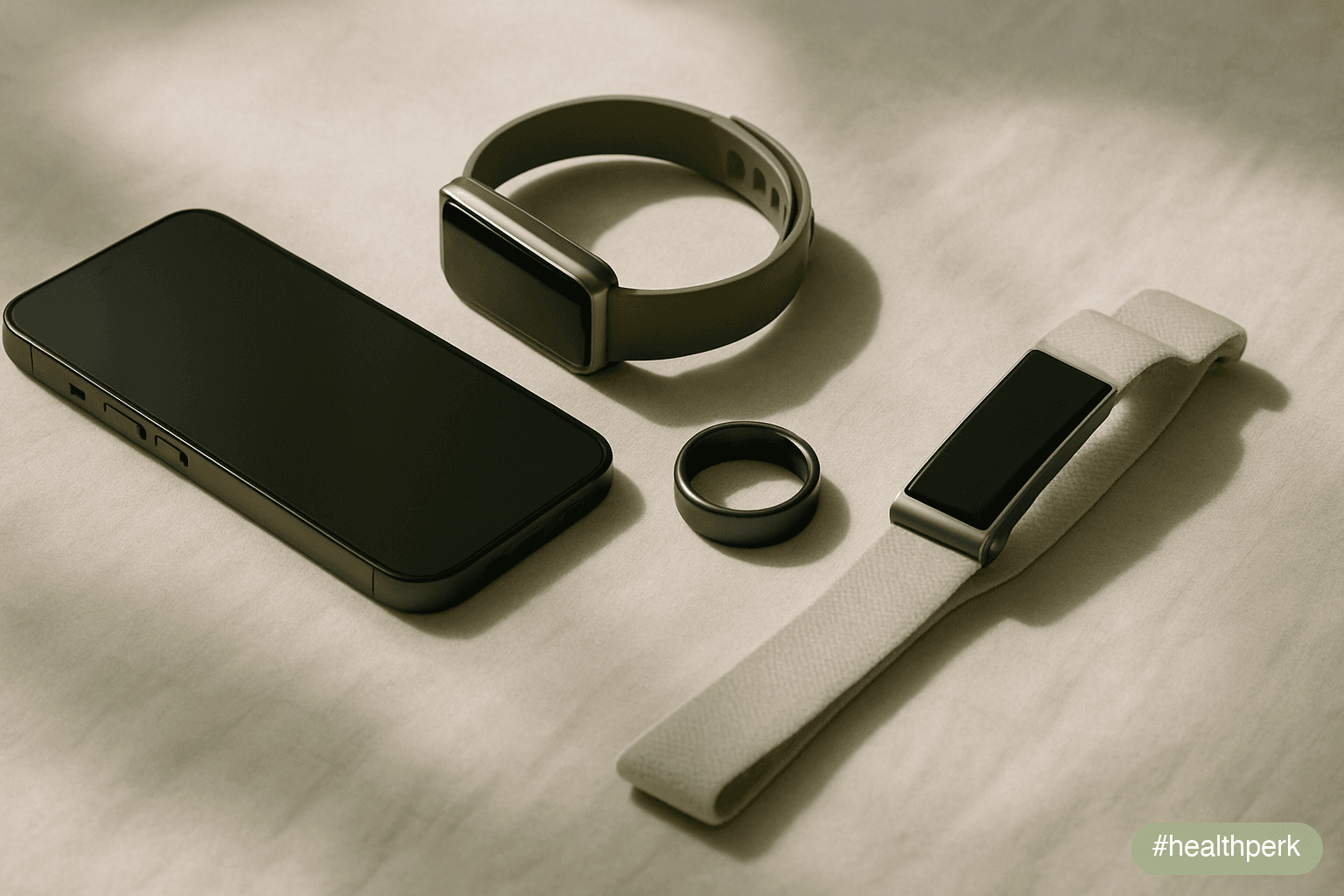
Sleep tracking apps comparison across form factors helps choose the right tool rather than the most-marketed one. The 2026 picture:
- Phone-on-mattress (Sleep Cycle, Sleep as Android, SleepScore, Pillow on iPhone). No extra hardware required. Accelerometer-driven; weakest on stage classification but acceptable on bedtime, latency, and regularity. Free or low-cost.
- Watch-on-wrist (Apple Watch via AutoSleep or Apple Health Sleep; Fitbit; Garmin; Samsung Galaxy Watch; Withings ScanWatch). Adds HRV, SpO2, and stage estimation. Strong on regularity and HRV trend; mid-tier on stage classification. Best fit for users who already wear a smartwatch.
- Ring-on-finger (Oura, Ultrahuman Ring AIR, RingConn, Samsung Galaxy Ring). Strongest 2026 form factor for sleep-specific tracking because the finger is a stable PPG site, no display draws attention pre-sleep, and battery life is multi-day. Higher upfront cost; subscription on Oura and Ultrahuman.
- Band-on-arm-or-wrist (Whoop, Fitbit Inspire, Garmin vívosmart). No display in the Whoop case (deliberate), strong on HRV and stage trend. Whoop is subscription-only (no upfront cost since 2024 model changes; check current terms).
- Under-the-mattress (Withings Sleep, Eight Sleep Pod). No wearable required. Accurate on bedtime, regularity, and snoring detection; Eight Sleep adds active temperature control.
The practical 2026 rule: a phone-only tracker is enough for users targeting regularity and latency; a ring or band is the right move for users prioritising HRV-anchored recovery; an under-mattress sensor suits users who refuse to wear or carry a device.
Free Apps for Sleep Tracking That Are Worth Installing First
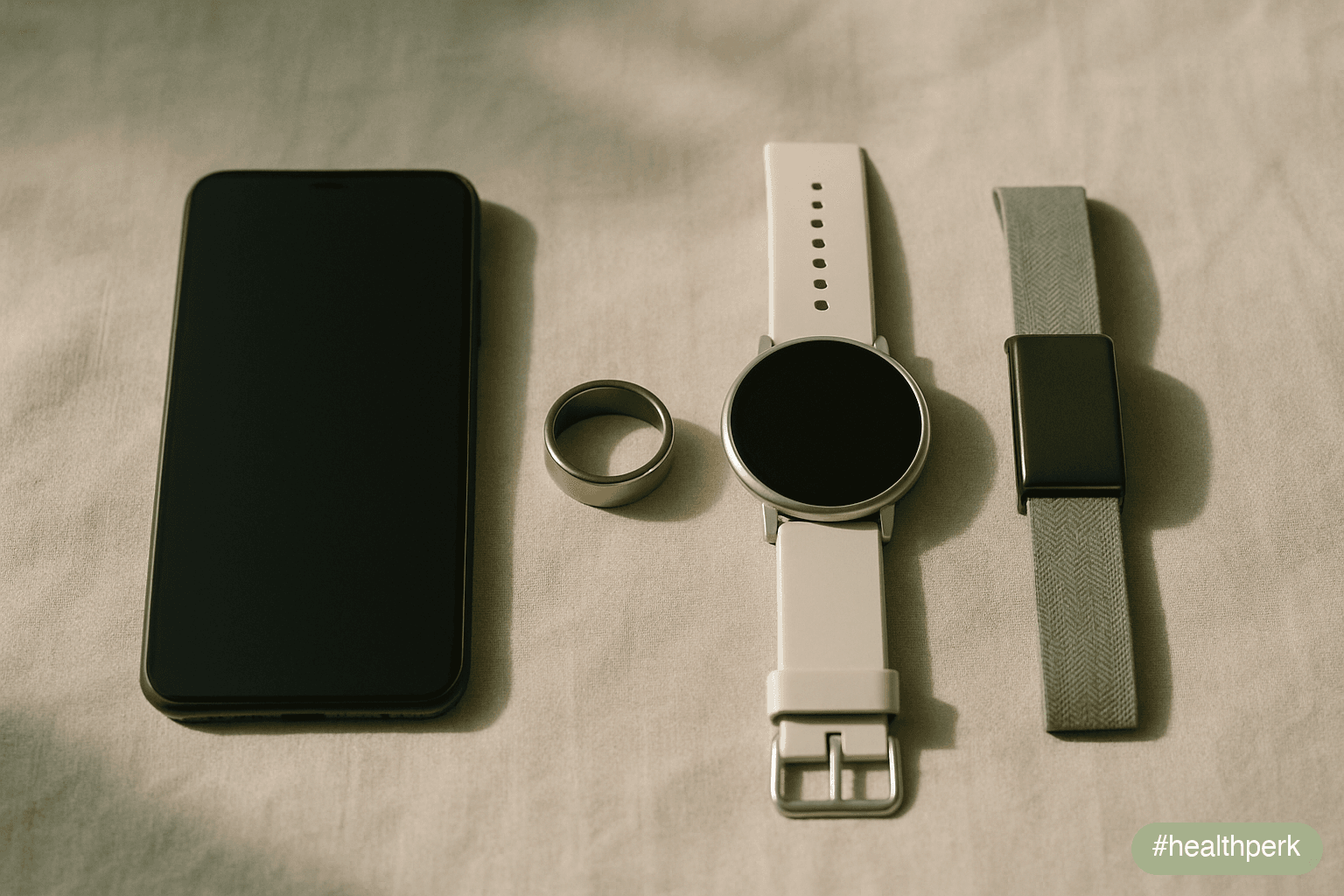
Free apps for sleep tracking that meaningfully outperform their paid competitors on the free tier alone, as of May 2026:
- Apple Health Sleep (iOS) or Health Connect with Samsung Health / Google Fit (Android). Built-in. Aggregates sleep data from the phone, watch, and third-party trackers. The honest starting point.
- Sleep Cycle free tier. Phone-accelerometer tracking, smart alarm window, basic regularity view. Subscription is optional.
- Sleep as Android. Strong free tier on Android with smart alarm, snore detection, and Health Connect export.
- SleepScore (free tier). Sonar-based tracking with a basic free sleep score; useful as a calibration check against accelerometer apps.
- AutoSleep (paid one-time, but inexpensive). Worth mentioning despite the paid label because it is a $5.99 one-time purchase rather than a subscription and remains the strongest Apple-Watch-driven iOS option.
- Insight Timer. Genuinely free sleep meditation library for the wind-down layer.
- White Noise Lite. Free continuous noise playback for masking.
- CBT-i Coach. Free VA/DoD app for users who want the CBT-I structure without a paid program.
A reliable 2026 starter four: Apple Health or Health Connect (aggregation), Sleep Cycle free or AutoSleep (overnight tracking), Insight Timer (wind-down), and White Noise Lite (masking). For users with chronic insomnia symptoms, add CBT-i Coach as a fifth.
Frequently Asked Questions
What are the best apps for sleep tracking in 2026?
Pick one tracker per form factor: Apple Health Sleep or Health Connect as the aggregator, plus Sleep Cycle, AutoSleep, Pillow, or Sleep as Android for phone-only, or Oura, Whoop, Garmin, Fitbit, or Withings for wearable. Add one wind-down audio source (Insight Timer free, Calm, Headspace, Slumber, or BetterSleep) and, only for chronic insomnia, one CBT-I program (Somryst, Sleep Reset, Stellar Sleep, or the free CBT-i Coach). Two trackers reading the same data rarely outperforms one.
Which apps for falling asleep faster actually shorten sleep latency?
Guided sleep meditations (Calm Sleep Stories, Headspace Sleepcasts, Insight Timer's free library, Slumber, BetterSleep), cognitive-shuffle prompts (mySleepButton), and ambient audio (myNoise, BetterSleep, Endel, Brain.fm sleep mode). The reliable lever is the combination of a fixed wake time, a dim 30-minute pre-sleep window, and one of these tools — not the app alone.
Which apps that help with insomnia are evidence-supported?
Somryst (FDA-cleared CBT-I, US prescription), Sleep Reset (coached CBT-I), Stellar Sleep (app-only CBT-I), RISE (CBT-I-aligned schedule and light timing), and the free CBT-i Coach from the US Department of Veterans Affairs. AASM 2021 guidance and NICE NG202 (2022) both recommend CBT-I as first-line for chronic insomnia, and the Trauer 2015 Annals of Internal Medicine meta-analysis supports durable improvement over sleep medication.
How accurate are sleep tracking apps versus a sleep lab?
Bedtime and total sleep time agree with polysomnography within roughly 10-20 minutes for most consumer trackers (Oura, Whoop, Fitbit, Apple Watch, Garmin, Withings). Sleep efficiency is moderately accurate but biased upward. Sleep stages — REM, light, deep — are the weakest area, with epoch-by-epoch accuracy around 50-70% versus polysomnography. Sleep regularity and nightly HRV are the most defensible consumer metrics.
Which apps for better sleep quality target the right metrics?
Apps that elevate sleep regularity, sleep latency, sleep efficiency, weekly average total sleep time, and HRV trend over a single deep-sleep percentage. Oura, Whoop, Sleep Cycle, AutoSleep, Sleep as Android, and Withings all surface these. Apps that grade the night with a single AI "sleep score" without component visibility are weaker.
What white noise apps for sleep are worth using?
myNoise (free core, $9.99 unlock), White Noise Lite (free), BetterSleep, Slumber, Endel, and Brain.fm sleep mode. Keep the device at least 1.2 meters from the head and below 50 dB at the pillow. For continuous overnight use, a dedicated white-noise machine (LectroFan, Yogasleep Dohm) outperforms a phone speaker.
Are there genuinely free sleep meditation apps in 2026?
Yes — Insight Timer, Smiling Mind, Healthy Minds Program, UCLA Mindful, and Medito have full or near-full free libraries. Calm, Headspace, Slumber, and BetterSleep are excellent but largely paywalled after a 7-day trial.
Can apps actually improve deep sleep?
Apps can support the modifiable levers — consistent wake time, morning daylight, alcohol and caffeine timing, room temperature — but cannot directly add deep sleep beyond a person's baseline. Pink-noise stimulation showed a small effect in older adults in Papalambros 2017 but did not robustly replicate in younger cohorts.
What is the right best sleep apps comparison framework?
Compare one app per layer: aggregation, phone-only or wearable tracker, wind-down audio, CBT-I (only for chronic insomnia), and white noise. The dominant failure mode is stacking two trackers reading the same data; the durable pattern is one tracker plus one wind-down source.
Sleep tracking apps comparison across phone, watch, ring, and band — which form factor wins?
For HRV-anchored regularity and recovery, a ring (Oura, Ultrahuman, RingConn, Samsung Galaxy Ring) is the strongest 2026 form factor. For users who already wear a smartwatch, Apple Watch with AutoSleep or Apple Health Sleep, or a Garmin / Fitbit / Withings ScanWatch, is excellent. Phone-only is enough for regularity and latency. Under-mattress (Withings Sleep, Eight Sleep) suits users who refuse to wear a device.
What free apps for sleep tracking should beginners install first?
Apple Health Sleep or Health Connect (built-in), Sleep Cycle free or Sleep as Android, Insight Timer for wind-down, and White Noise Lite for masking. Add CBT-i Coach (free, VA/DoD) if symptoms meet chronic-insomnia criteria.
When does sleep tracking become counterproductive?
When checking the score becomes pre-sleep anxiety ("orthosomnia", described in Baron 2017 Journal of Clinical Sleep Medicine). The fix is to read scores once weekly, not nightly, and to keep the phone face-down outside the bedroom.
Should children or teenagers use sleep tracking apps?
Tracking can be useful for schedule consistency but the AAP recommends devices away from the bed in this age group. Adolescent sleep needs (8-10 hours per AAP and AASM) and chronotype shift are larger levers than any app metric.
Can a wearable replace a sleep study?
No. The AASM's 2023 position statement is explicit that consumer sleep technology is not a substitute for polysomnography in diagnosing sleep disorders (obstructive sleep apnea, narcolepsy, REM behavior disorder). A wearable can flag a pattern worth investigating; a sleep study confirms diagnosis.
Is melatonin tracked in any of these apps?
Several CBT-I-adjacent apps (Sleep Reset, RISE) allow melatonin logging, but melatonin is a chronobiotic (timing shift), not a sedative, and effective doses (0.3-0.5 mg, taken 2-4 hours before target bedtime per Auld 2017 Sleep Medicine Reviews) are smaller than the 3-10 mg doses commonly sold. Apps log it; they do not validate it.
Best apps for sleep tracking, last call — what is the shortest defensible 2026 stack?
Apple Health Sleep or Health Connect as aggregator, one tracker (phone or wearable), Insight Timer for wind-down, and — only for chronic insomnia — CBT-i Coach or a paid CBT-I program. Four apps, one purpose each, used for at least four weeks before any change.
References
American Academy of Sleep Medicine. (2021). Behavioral and psychological treatments for chronic insomnia disorder in adults: An American Academy of Sleep Medicine clinical practice guideline. Journal of Clinical Sleep Medicine, 17(2), 255-262. https://doi.org/10.5664/jcsm.8986
Supports: CBT-I as first-line treatment for chronic insomnia in adults, the framework behind Somryst, Sleep Reset, Stellar Sleep, RISE, and CBT-i Coach
National Institute for Health and Care Excellence. (2022). Insomnia. NICE Clinical Knowledge Summary (NG202 context). NICE. https://cks.nice.org.uk/topics/insomnia/
Supports: NICE guidance for insomnia management recommending CBT-I as first-line and limiting pharmacotherapy
Trauer, J. M., Qian, M. Y., Doyle, J. S., Rajaratnam, S. M. W., & Cunnington, D. (2015). Cognitive behavioral therapy for chronic insomnia: A systematic review and meta-analysis. Annals of Internal Medicine, 163(3), 191-204. https://doi.org/10.7326/M14-2841
Supports: durable effect of CBT-I on sleep onset latency, wake after sleep onset, and sleep efficiency
Windred, D. P., Burns, A. C., Lane, J. M., Saxena, R., Rutter, M. K., Cain, S. W., & Phillips, A. J. K. (2024). Sleep regularity is a stronger predictor of mortality risk than sleep duration: A prospective cohort study. Sleep, 47(1), zsad253. https://doi.org/10.1093/sleep/zsad253
Supports: sleep regularity outperforms duration as a predictor of long-term outcomes, motivating apps that surface regularity
Chinoy, E. D., Cuellar, J. A., Huwa, K. E., Jameson, J. T., Watson, C. H., Bessman, S. C., Hirsch, D. A., Cooper, A. D., Drummond, S. P. A., & Markwald, R. R. (2021). Performance of seven consumer sleep-tracking devices compared with polysomnography. Sleep, 44(5), zsaa291. https://doi.org/10.1093/sleep/zsaa291
Supports: consumer sleep trackers agree with polysomnography on total sleep time within roughly 10-20 minutes for healthy adults; stage classification is weaker
de Zambotti, M., Cellini, N., Goldstone, A., Colrain, I. M., & Baker, F. C. (2019). Wearable sleep technology in clinical and research settings. Medicine and Science in Sports and Exercise, 51(7), 1538-1557. https://doi.org/10.1249/MSS.0000000000001947
Supports: validation framework for consumer sleep wearables and graded accuracy by metric
American Academy of Sleep Medicine. (2023). Use of consumer sleep technology: An American Academy of Sleep Medicine position statement. Journal of Clinical Sleep Medicine, 19(7), 1265-1273. https://doi.org/10.5664/jcsm.10612
Supports: position that consumer sleep technology is not a substitute for polysomnography in diagnosing sleep disorders
Papalambros, N. A., Santostasi, G., Malkani, R. G., Braun, R., Weintraub, S., Paller, K. A., & Zee, P. C. (2017). Acoustic enhancement of sleep slow oscillations and concomitant memory improvement in older adults. Frontiers in Human Neuroscience, 11, 109. https://doi.org/10.3389/fnhum.2017.00109
Supports: pink-noise acoustic stimulation enhanced slow-wave activity in older adults; cited cautiously given mixed replication in younger cohorts
Ritterband, L. M., Thorndike, F. P., Ingersoll, K. S., Lord, H. R., Gonder-Frederick, L., Frederick, C., Quigg, M. S., Cohn, W. F., & Morin, C. M. (2017). Effect of a web-based cognitive behavior therapy for insomnia intervention with 1-year follow-up: A randomized clinical trial. JAMA Psychiatry, 74(1), 68-75. https://doi.org/10.1001/jamapsychiatry.2016.3249
Supports: digital CBT-I (SHUTi, the precursor of Somryst) produces durable improvement in chronic insomnia at one-year follow-up
Drake, C., Roehrs, T., Shambroom, J., & Roth, T. (2013). Caffeine effects on sleep taken 0, 3, or 6 hours before going to bed. Journal of Clinical Sleep Medicine, 9(11), 1195-1200. https://doi.org/10.5664/jcsm.3170
Supports: caffeine consumed up to six hours before bedtime produces measurable sleep disruption, motivating caffeine-timing prompts in sleep apps
Baron, K. G., Abbott, S., Jao, N., Manalo, N., & Mullen, R. (2017). Orthosomnia: Are some patients taking the quantified self too far? Journal of Clinical Sleep Medicine, 13(2), 351-354. https://doi.org/10.5664/jcsm.6472
Supports: the orthosomnia phenomenon — pre-sleep anxiety induced by tracker scores — and the case for weekly rather than nightly review
Auld, F., Maschauer, E. L., Morrison, I., Skene, D. J., & Riha, R. L. (2017). Evidence for the efficacy of melatonin in the treatment of primary adult sleep disorders. Sleep Medicine Reviews, 34, 10-22. https://doi.org/10.1016/j.smrv.2016.06.005
Supports: melatonin as a chronobiotic with small effective doses, motivating careful framing of melatonin-logging features in CBT-I-adjacent apps
Walker, M. P. (2017). Why We Sleep: Unlocking the Power of Sleep and Dreams. Scribner. ISBN 978-1501144318.
Supports: framework for sleep architecture, modifiable levers for slow-wave sleep, and the case for regularity over duration
Beaudoin, L. P., Hyniewska, S., & Eastwood, J. (2016). Examining the effectiveness of the cognitive shuffle as a sleep induction technique. MindOpen / preprint series.
Supports: the cognitive shuffle as a credible non-pharmacological sleep-induction technique behind apps like mySleepButton
Frequently Asked Questions
What are the best apps for sleep tracking in 2026?
Pick one tracker per form factor: Apple Health Sleep or Health Connect as the aggregator, plus Sleep Cycle, AutoSleep, Pillow, or Sleep as Android for phone-only, or Oura, Whoop, Garmin, Fitbit, or Withings for wearable. Add one wind-down audio source (Insight Timer free, Calm, Headspace, Slumber, or BetterSleep) and, for chronic insomnia, one CBT-I program (Somryst, Sleep Reset, Stellar Sleep, or CBT-i Coach).
Which apps for falling asleep faster actually shorten sleep latency?
Guided sleep meditations (Calm Sleep Stories, Headspace Sleepcasts, Insight Timer's free library, Slumber, BetterSleep), cognitive-shuffle prompts (mySleepButton), and ambient audio (myNoise, BetterSleep, Endel, Brain.fm sleep mode). The reliable lever is a fixed wake time, a dim 30-minute pre-sleep window, and one of these tools — not the app alone.
Which apps that help with insomnia are evidence-supported?
Somryst (FDA-cleared CBT-I, US prescription), Sleep Reset (coached CBT-I), Stellar Sleep (app-only CBT-I), RISE (CBT-I-aligned schedule), and the free CBT-i Coach. AASM 2021 and NICE NG202 (2022) recommend CBT-I as first-line for chronic insomnia.
How accurate are sleep tracking apps versus a sleep lab?
Bedtime and total sleep time agree with polysomnography within 10-20 minutes for most consumer trackers. Sleep stages are weakest, with 50-70% epoch-by-epoch accuracy. Sleep regularity and nightly HRV are the most defensible consumer metrics.
Which apps for better sleep quality target the right metrics?
Apps that elevate sleep regularity, sleep latency, sleep efficiency, weekly total sleep time, and HRV trend over a single deep-sleep percentage. Oura, Whoop, Sleep Cycle, AutoSleep, Sleep as Android, and Withings surface these.
What white noise apps for sleep are worth using?
myNoise, White Noise Lite, BetterSleep, Slumber, Endel, and Brain.fm sleep mode. Keep the device at least 1.2 meters from the head and below 50 dB at the pillow.
Are there genuinely free sleep meditation apps in 2026?
Insight Timer, Smiling Mind, Healthy Minds Program, UCLA Mindful, and Medito have full or near-full free libraries. Calm, Headspace, Slumber, and BetterSleep are largely paywalled after a 7-day trial.
Can apps actually improve deep sleep?
Apps can support modifiable levers — consistent wake time, morning daylight, alcohol and caffeine timing, room temperature — but cannot directly add deep sleep beyond baseline.
What is the right best sleep apps comparison framework?
Compare one app per layer: aggregation, phone-only or wearable tracker, wind-down audio, CBT-I, and white noise. The durable pattern is one tracker plus one wind-down source.
Sleep tracking apps comparison — which form factor wins?
For HRV-anchored regularity and recovery, a ring (Oura, Ultrahuman, RingConn, Samsung Galaxy Ring) is the strongest 2026 form factor. Apple Watch, Garmin, Fitbit, and Withings ScanWatch are excellent if you already wear a smartwatch. Phone-only is enough for regularity and latency.
What free apps for sleep tracking should beginners install first?
Apple Health Sleep or Health Connect (built-in), Sleep Cycle free or Sleep as Android, Insight Timer for wind-down, and White Noise Lite for masking. Add CBT-i Coach if symptoms meet chronic-insomnia criteria.