
How Many Steps a Day to Lose Weight? What the 2026 Evidence Shows
Aim for about 8,000–10,000 steps a day, built up gradually, alongside a modest calorie deficit; walking alone typically produces only small weight loss. A 2026 meta-analysis links roughly 8,500 daily steps to keeping lost weight off, and 7,000 steps is tied to 47% lower mortality risk versus 2,000.
How Many Steps a Day to Lose Weight? What the 2026 Evidence Shows
By the HealthPerk Editorial Team · Last updated: October 2026
Quick Answer
How many steps a day to lose weight?
Most adults do best aiming for about 8,000–10,000 steps a day, built up gradually from their current baseline, combined with a modest calorie deficit. Steps alone usually produce small losses (about 1–2 kg over several months), but reaching roughly 8,500 daily steps is linked to keeping lost weight off.
| Your situation | First step |
|---|---|
| Under 5,000 steps a day | Add 1,000 steps a day for one to two weeks, then add another 1,000 |
| 5,000–7,000 steps a day | Aim for 7,000–8,000; this is where most health benefits accrue |
| Dieting to lose weight | Target about 8,500 steps and pair it with a calorie deficit |
| Already lost weight, want to keep it off | Hold 8,500+ steps a day during maintenance |
| Already at 10,000+ steps, no weight change | Look at food intake, not more steps |
| Age 60+ or with a chronic condition | 6,000–8,000 steps is a reasonable target; check with your doctor first |

Daily steps add up, but for weight loss they work best alongside changes to what you eat.
Search for how many steps a day to lose weight and you will see 10,000 again and again. That number has a marketing origin, not a scientific one. The research now gives a more useful answer: steps matter a lot for health and for keeping weight off, but on their own they burn fewer calories than most people expect.
This guide shows the calculation behind calories burned per 1,000 steps for different body weights, what the largest step-count studies found (including the 2025 Lancet Public Health meta-analysis and a 2026 weight-maintenance review), why your body partly offsets the extra calories, and how accurate your phone or watch really is at counting.
Table of Contents
- Why 10,000 Steps? The Origin of the Number
- How Many Calories Do 1,000 Steps Burn?
- What the Research Says About Steps and Weight Loss
- Why Walking More Often Doesn't Cut Weight on Its Own
- Steps for Health: The Mortality Meta-Analyses
- Step Count vs Cadence: Does Walking Pace Matter?
- Which Step Counter Is Most Accurate: Phone, Watch, or Pedometer?
- How Many Steps a Day to Lose Weight: Which Goal Is Right for You?
- A 12-Week Progressive Step Plan for Weight Loss
- Common Myths About Steps and Weight Loss
- When to See a Doctor
- Related Articles on Health Perk
- Frequently Asked Questions
- References
Why 10,000 Steps? The Origin of the Number
The 10,000-step goal goes back to Japan in the 1960s. A pedometer launched in Japan in the mid-1960s, shortly after the 1964 Tokyo Olympics, was marketed as manpo-kei, which roughly means "10,000-step meter." Researchers Catrine Tudor-Locke and David Bassett traced the figure to Japanese walking clubs and "a business slogan" rather than to any trial [5].
The number stuck because it is round, memorable, and roughly matches an active day. Bravata and colleagues found in a 2007 JAMA review that pedometer users who had a step goal, such as 10,000 a day, increased their activity more than those without one [8].
So 10,000 is not wrong. It is just not a threshold where something changes in your body. The studies below show benefits start well before it, and weight loss depends far more on your total energy balance than on hitting any one number.
How Many Calories Do 1,000 Steps Burn?
Calories burned walking depend mostly on body weight, pace, and stride length. To keep the math transparent, here is how we calculated the table below.
Calculation basis:
- Pace: a moderate 3.0 mph (4.8 km/h), which the 2024 Adult Compendium of Physical Activities rates at 3.8 METs for level walking [12].
- Distance: 1,000 steps ≈ 0.75 km (0.47 mi), an average adult stride of about 75 cm. At 3.0 mph that takes about 9.3 minutes.
- Energy: 1 MET ≈ 1 kcal per kg of body weight per hour. Gross calories = 3.8 × kg × 0.155 h.
- Net calories subtract the 1 MET you would burn anyway at rest (2.8 × kg × 0.155 h). Net is the number that matters for weight loss.
| Body weight | Gross kcal per 1,000 steps | Net kcal per 1,000 steps | Net kcal per extra 4,000 steps/day, per week |
|---|---|---|---|
| 55 kg (121 lb) | 32 | 24 | ~670 |
| 70 kg (154 lb) | 41 | 30 | ~850 |
| 85 kg (187 lb) | 50 | 37 | ~1,035 |
| 100 kg (220 lb) | 59 | 43 | ~1,220 |
| 115 kg (254 lb) | 68 | 50 | ~1,400 |
| 130 kg (287 lb) | 77 | 57 | ~1,580 |
These are estimates. Taller people with longer strides cover more ground per 1,000 steps, and brisk walking (3.5–3.9 mph, 4.8 METs in the Compendium) burns more per minute [12]. Hills and carrying a load add more.
The practical takeaway: for a 70 kg adult, going from 6,000 to 10,000 steps adds roughly 120 net calories a day. That is about the energy in a medium banana. To estimate your full daily burn, use our TDEE calculator for daily calorie needs.
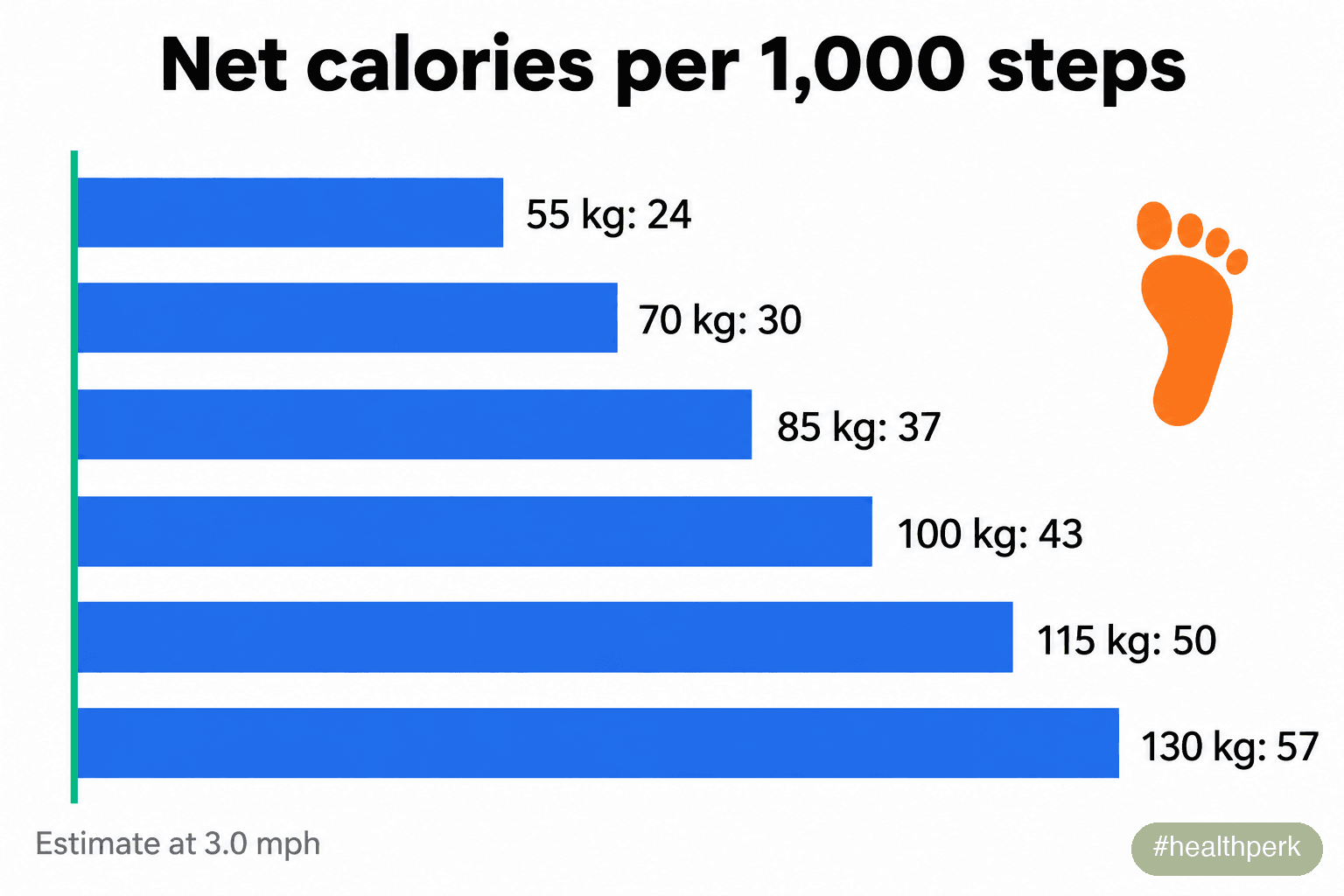
Estimated net calories per 1,000 steps at 3.0 mph, calculated from 2024 Compendium MET values; individual results vary with stride and pace.
What the Research Says About Steps and Weight Loss
The best-known trial evidence on walking alone is modest. A 2008 meta-analysis in Annals of Family Medicine pooled nine pedometer-based walking programs without any diet change. Participants lost an average of 1.27 kg, about 0.05 kg per week, and longer programs produced more loss [7].
Bravata's 2007 review of 26 studies found pedometer users added about 2,500 steps a day compared with controls and lowered their BMI by 0.38 points on average [8]. Those are real but small changes.
Large observational data point the same way. In a 2022 study of 15,708 Japanese working-age adults with smartphone-recorded steps over two years, every extra 1,000 steps a day was associated with 0.33 kg lower weight in men; in women, the link appeared only above 5,000 steps [14].
The 2026 finding: 8,500 steps for keeping weight off
The most relevant new evidence came in 2026. A systematic review and meta-analysis by Saadeddine and colleagues, published in the International Journal of Environmental Research and Public Health and presented at the European Congress on Obesity in May 2026, analyzed 14 randomized trials of lifestyle weight-loss programs with 3,758 adults [6].
- During the weight-loss phase (average 7.9 months), program participants raised their steps from about 7,500 to 8,454 a day and lost 4.39% of body weight.
- During maintenance (average 10.3 months), they kept off 3.28% of their starting weight.
- Higher daily steps at both points were positively associated with long-term weight loss in the meta-regression.
Crucially, the authors note that steps were not what drove the initial loss; calorie reduction did most of that work. Walking appears to matter most for preventing regain. This matches what we see in our guide to why you can't lose weight even when dieting.
Why Walking More Often Doesn't Cut Weight on Its Own
If 4,000 extra steps burn about 850 calories a week for a 70 kg person, why do the trials show so little loss? Three reasons.
1. Your body compensates
Herman Pontzer's 2016 study in Current Biology measured total energy expenditure with doubly labeled water in 332 adults across five countries. Energy expenditure rose with physical activity at lower activity levels but plateaued at higher ones, which the authors called a "constrained" energy model [9].
A larger 2021 analysis of 1,754 adults found that energy compensation averaged 28%: only about 72% of the extra calories burned through activity showed up as extra calories burned that day [10]. That figure comes from observational modeling rather than an exercise trial, and the mechanism is still debated. Compensation was larger in people with more body fat.
2. Appetite and "earned" snacks
Walking can nudge hunger up, and many people unconsciously eat back some of what they burned. In one randomized trial, first-year college women assigned to 10,000, 12,500, or 15,000 daily steps for 24 weeks still gained weight and fat, with no difference between the groups [15].
3. Weight change is slow
Kevin Hall's energy-balance model shows the body adjusts gradually: a sustained change of about 100 kJ (24 kcal) per day eventually shifts body weight by about 1 kg, with half the change taking about a year [11]. An extra 120 calories a day is meaningful over years, not weeks.
The lesson is not that walking is pointless. It is that steps are a support act. The lead role belongs to the calorie deficit. If you are not exercising formally, our guide to losing weight without structured exercise shows how daily movement and eating habits fit together.
Steps for Health: The Mortality Meta-Analyses
Even when the scale moves slowly, steps pay off in other ways. Three meta-analyses define the current evidence.
Paluch et al., 2022, Lancet Public Health [2]. Pooling individual data from 15 cohorts (47,471 adults, 3,013 deaths), the Steps for Health Collaborative found that, compared with the lowest quartile (median 3,553 steps), people in the highest quartile (median 10,901 steps) had a 53% lower risk of death. Risk kept falling until about 6,000–8,000 steps a day in adults 60 and older, and 8,000–10,000 in younger adults.
Ding et al., 2025, Lancet Public Health [1]. This review of 57 studies from 35 cohorts compared 7,000 with 2,000 steps a day. At 7,000 steps, risk was:
- 47% lower for all-cause mortality
- 25% lower for cardiovascular disease
- 38% lower for dementia
- 22% lower for depressive symptoms
- 14% lower for type 2 diabetes
For mortality, the curve flattened around 5,000–7,000 steps. The authors concluded that 7,000 is "a more realistic and achievable target for some," while 10,000 remains a viable goal for more active people.
Banach et al., 2023, European Journal of Preventive Cardiology [3]. Across 17 cohorts and 226,889 people, each extra 1,000 steps a day was associated with a 15% lower risk of all-cause mortality, with benefits starting at about 3,867 steps.
These are observational associations, so healthier people may simply walk more. Still, the dose-response pattern is consistent across studies.
Step Count vs Cadence: Does Walking Pace Matter?
Cadence is how many steps you take per minute. In the CADENCE-Adults study, about 100 steps per minute matched moderate intensity (3 METs) and about 130 steps per minute matched vigorous intensity (6 METs) in adults aged 21–40 [13].
That gives you a simple field test. Count your steps for 15 seconds and multiply by four. If you are near 100, you are walking at moderate intensity; at that pace, a 30-minute walk adds about 3,000 steps.
Does pace matter beyond total steps? The evidence is mixed. In the Paluch meta-analysis, higher peak 30-minute cadence was associated with lower mortality after adjusting for total steps, but time spent at 100+ steps per minute was not significant [2]. In older women, step volume was linked to lower mortality, while intensity measures did not add much once volume was accounted for [4].
For weight loss, faster walking burns more calories per minute, which helps if your time is limited. To set intensity by heart rate instead, try our heart rate zones calculator.
Which Step Counter Is Most Accurate: Phone, Watch, or Pedometer?
For counting steps, most modern devices are good enough. For counting calories, none are.
A 2015 JAMA study had participants walk 500 and 1,500 steps on a treadmill at 3.0 mph. Error compared with direct counting was –0.3% to 1.0% for research-grade pedometers and accelerometers, –6.7% to 6.2% for smartphone apps, and –22.7% to –1.5% for the wrist wearables tested at the time [16].
A 2020 systematic review of 158 publications found Fitbit, Apple Watch, and Samsung devices measured steps accurately in lab settings, but "no brand was accurate" for energy expenditure [17]. A Stanford study of seven wrist devices found none estimated energy expenditure with less than 20% error [18].
| Tracking method | Step accuracy (lab) | Calorie accuracy | Best for | Main drawback |
|---|---|---|---|---|
| Smartphone (built-in app) | Good: about ±6% in 2015 testing [16] | Poor | Free, already in your pocket | Misses steps when phone is on a desk |
| Wrist fitness tracker or smartwatch | Good for recent major brands [17] | Poor; errors often over 20% [18] | All-day wear, reminders, heart rate | Wrist motion can add or miss steps |
| Hip pedometer or clip-on accelerometer | Very good: about ±1% [16] | Not designed for it | Simple, accurate counts | Easy to forget; no app ecosystem |
| Smart ring | Varies by model; less research | Poor | Comfort, sleep tracking | Fewer step validation studies |
Editorial verdict: Use whatever device you will wear every day. Consistency matters more than precision, because you are comparing your own numbers over time. Ignore the "calories burned" figure for food decisions; use the step count, and estimate energy needs with a TDEE calculator instead. If you are choosing hardware, our fitness tracker vs smartwatch comparison covers the trade-offs.
Most current phones and wearables count steps well; their calorie estimates are far less reliable.
How Many Steps a Day to Lose Weight: Which Goal Is Right for You?
The sedentary starter (under 5,000 steps). Your biggest health gains are right here: the Ding meta-analysis found steep risk reductions between 2,000 and 7,000 steps [1]. Aim for 7,000 first. Weight loss will come mainly from diet.
The active dieter (5,000–8,000 steps). Target about 8,500 a day, the level linked to better weight maintenance in 2026 trial data [6]. Pair it with a moderate calorie deficit and adequate protein; see our guide to how much protein you need per day.
The maintainer (lost weight, wants to keep it off). This is where steps earn their keep. Hold 8,500 or more and treat a falling step count as an early warning sign.
The older adult (60+). Benefits in the Paluch data leveled off at 6,000–8,000 steps [2]. Prioritize consistency and balance over big numbers.
The busy desk worker. Accumulate steps in short bouts: a 10-minute walk after each meal adds roughly 3,000 steps. Raising cadence toward 100 steps per minute gets you moderate-intensity minutes at the same time.
A 12-Week Progressive Step Plan for Weight Loss
- Week 1: Measure your baseline. Wear your phone or tracker normally for seven days without changing anything. Average the daily totals.
- Weeks 2–3: Add 1,000 steps. Set your daily goal at baseline + 1,000. A 10-minute walk usually covers it.
- Weeks 4–5: Add another 1,000. Attach a walk to a fixed cue, such as after lunch or a phone call.
- Weeks 6–7: Add intensity. Make one walk a day brisk, near 100 steps per minute, for at least 20 minutes.
- Weeks 8–9: Reach 7,000–8,500. Keep adding 1,000 a day every two weeks until you reach this range.
- Weeks 10–12: Lock it in. Hold your goal on at least five days a week. Check weight weekly, not daily.
- Throughout: Set a calorie target. Use the TDEE calculator and subtract a moderate amount, usually 300–500 kcal per day.
- After 12 weeks: Maintain. Keep steps at 8,500+ even once weight loss slows, because this is when walking matters most for preventing regain [6].
A habit tracking app can help you see streaks rather than single bad days.
Common Myths About Steps and Weight Loss
Myth: You need 10,000 steps to see any benefit. Health risks fall steeply well below 10,000; much of the mortality benefit appears by 5,000–7,000 steps [1].
Myth: 10,000 steps a day guarantees weight loss. In a randomized trial, women walking 10,000–15,000 steps a day still gained weight [15]. Diet decides most of the outcome.
Myth: Your watch tells you how much you can eat. Wrist devices misjudge energy expenditure, often by 20% or more [18].
Myth: More steps always means proportionally more calories burned. Compensation means about 28% of activity calories may be offset on average [10].
Myth: Slow steps don't count. All steps contribute to total volume, which is the strongest predictor of health outcomes in the meta-analyses [2].
When to See a Doctor
Walking is safe for most people, but stop and seek medical advice if you notice:
- Chest pain, pressure, or tightness while walking
- Unusual shortness of breath, dizziness, or fainting
- Calf pain that comes on with walking and eases with rest (a possible sign of peripheral artery disease)
- Joint pain or swelling that lasts more than a few days
- Foot sores that don't heal, especially if you have diabetes
- Unexplained weight loss without trying, or weight gain despite consistent effort
Talk to your doctor before starting if you have heart disease, uncontrolled blood pressure, diabetes, or recent surgery. Call emergency services immediately for chest pain that doesn't go away with rest.
Related Articles on Health Perk
- Best apps for weight loss tracking in 2026
- How to lose weight without exercise
- Why you can't lose weight even when dieting
- How to keep weight off after stopping GLP-1 drugs
- Fitness tracker vs smartwatch: which should you choose
- How to boost metabolism naturally
Frequently Asked Questions
Is 10,000 steps a day enough to lose weight?
Not by itself for most people. For a 70 kg adult, 10,000 steps burn roughly 300 net calories. Without a calorie deficit from diet, the body often offsets part of that through appetite and metabolic compensation. Studies of walking without diet changes show average losses of about 1.27 kg over several months.
How many steps a day to lose 1 pound a week?
Steps alone rarely achieve this. Losing about 1 pound a week requires a deficit of roughly 500 calories a day, which would take about 17,000 extra steps for a 70 kg person. A more realistic approach is about 8,500 steps a day plus a 300–500 calorie dietary deficit.
How many calories does walking 10,000 steps burn?
About 240–570 net calories, depending mainly on body weight, based on a 3.0 mph pace and a 75 cm stride. A 55 kg person burns about 240, a 100 kg person about 435. Brisk walking, hills, and longer strides increase the number. Wearable calorie estimates can be off by 20% or more.
Is 7,000 steps a day enough?
Yes, for health. The 2025 Lancet Public Health meta-analysis found 7,000 steps a day was linked to 47% lower mortality risk than 2,000 steps. For weight maintenance after dieting, 2026 trial data suggest aiming slightly higher, at about 8,500 steps.
Can walking reduce belly fat?
Yes, as part of overall fat loss, but you cannot target belly fat specifically. Walking contributes to the calorie deficit that reduces total body fat, including abdominal fat. Combining regular walking with a moderate calorie deficit and adequate protein is more effective than walking alone.
Does walking speed matter for weight loss?
Somewhat. Brisk walking at 3.5–3.9 mph burns about 4.8 METs versus 3.8 METs at 3.0 mph, so you burn more per minute. A cadence of about 100 steps per minute marks moderate intensity. For total calories, distance covered matters more than speed.
Are phone step counters accurate?
Yes, reasonably. In a 2015 JAMA treadmill test, smartphone apps were within about –6.7% to +6.2% of actual steps. The main real-world problem is that phones miss steps when left on a desk or in a bag. Their calorie estimates are much less reliable than their step counts.
Medical disclaimer: This article is for informational purposes only and does not constitute medical advice. Consult a qualified healthcare professional before starting a new exercise or weight-loss program, especially if you have a medical condition, take medication, or are pregnant. See our review methodology for how we evaluate evidence.
References
- Ding D, Nguyen B, Nau T, et al. (2025). Daily steps and health outcomes in adults: a systematic review and dose-response meta-analysis. The Lancet Public Health, 10(8), e668–e681. https://doi.org/10.1016/S2468-2667(25)00164-1
Supports: 7,000 vs 2,000 steps/day linked to 47% lower mortality, 25% lower CVD, 38% lower dementia, 22% lower depressive symptoms, 14% lower type 2 diabetes; inflection at 5,000–7,000 steps.
- Paluch AE, Bajpai S, Bassett DR, et al. (2022). Daily steps and all-cause mortality: a meta-analysis of 15 international cohorts. The Lancet Public Health, 7(3), e219–e228. https://doi.org/10.1016/S2468-2667(21)00302-9
Supports: 47,471 adults; HR 0.47 for highest vs lowest quartile; plateau at 6,000–8,000 (60+) and 8,000–10,000 (<60) steps; cadence findings.
- Banach M, Lewek J, Surma S, et al. (2023). The association between daily step count and all-cause and cardiovascular mortality: a meta-analysis. European Journal of Preventive Cardiology, 30(18), 1975–1985. https://doi.org/10.1093/eurjpc/zwad229
Supports: each 1,000-step increment associated with 15% lower all-cause mortality; benefit from about 3,867 steps/day.
- Lee IM, Shiroma EJ, Kamada M, et al. (2019). Association of Step Volume and Intensity With All-Cause Mortality in Older Women. JAMA Internal Medicine, 179(8), 1105–1112. https://doi.org/10.1001/jamainternmed.2019.0899
Supports: step volume associated with lower mortality in older women; intensity added little beyond volume.
- Tudor-Locke C, Bassett DR (2004). How many steps/day are enough? Preliminary pedometer indices for public health. Sports Medicine, 34(1), 1–8. https://doi.org/10.2165/00007256-200434010-00001
Supports: 10,000 steps/day traced to Japanese walking clubs and a business slogan.
- Saadeddine D, Foglia M, Berri E, et al. (2026). Daily Steps During Nutritional Lifestyle Modification Programs for Obesity Management: A Systematic Review and Meta-Analysis. International Journal of Environmental Research and Public Health, 23(4), 522. https://doi.org/10.3390/ijerph23040522
Supports: 14 RCTs; steps rose to 8,454/day with 4.39% weight loss, 3.28% maintained; higher steps associated with long-term weight loss.
- Richardson CR, Newton TL, Abraham JJ, et al. (2008). A meta-analysis of pedometer-based walking interventions and weight loss. Annals of Family Medicine, 6(1), 69–77. https://doi.org/10.1370/afm.761
Supports: walking without diet change produced mean loss of 1.27 kg, about 0.05 kg per week.
- Bravata DM, Smith-Spangler C, Sundaram V, et al. (2007). Using pedometers to increase physical activity and improve health: a systematic review. JAMA, 298(19), 2296–2304. https://doi.org/10.1001/jama.298.19.2296
Supports: pedometer users added about 2,491 steps/day, BMI fell 0.38; step goal predicted increased activity.
- Pontzer H, Durazo-Arvizu R, Dugas LR, et al. (2016). Constrained Total Energy Expenditure and Metabolic Adaptation to Physical Activity in Adult Humans. Current Biology, 26(3), 410–417. https://doi.org/10.1016/j.cub.2015.12.046
Supports: total energy expenditure plateaus at higher activity levels (constrained model).
- Careau V, Halsey LG, Pontzer H, et al. (2021). Energy compensation and adiposity in humans. Current Biology, 31(20), 4659–4666.e2. https://doi.org/10.1016/j.cub.2021.08.016
Supports: average energy compensation of 28%; greater compensation with higher adiposity.
- Hall KD, Sacks G, Chandramohan D, et al. (2011). Quantification of the effect of energy imbalance on bodyweight. The Lancet, 378(9793), 826–837. https://doi.org/10.1016/S0140-6736(11)60812-X
Supports: 100 kJ/day energy change leads to about 1 kg eventual weight change, half within about a year.
- Herrmann SD, Willis EA, Ainsworth BE, et al. (2024). 2024 Adult Compendium of Physical Activities: A third update of the energy costs of human activities. Journal of Sport and Health Science, 13(1), 6–12. https://doi.org/10.1016/j.jshs.2023.10.010
Supports: walking 2.8–3.4 mph = 3.8 METs; 3.5–3.9 mph = 4.8 METs (basis for calorie table).
- Tudor-Locke C, Aguiar EJ, Han H, et al. (2019). Walking cadence (steps/min) and intensity in 21–40 year olds: CADENCE-adults. International Journal of Behavioral Nutrition and Physical Activity, 16(1), 8. https://doi.org/10.1186/s12966-019-0769-6
Supports: 100 steps/min ≈ moderate intensity; 130 steps/min ≈ vigorous.
- Hamaya R, Mori M, Miyake K, Lee IM (2022). Association of Smartphone-Recorded Steps Over Years and Change in Cardiovascular Risk Factors Among Working-Age Adults. Journal of the American Heart Association, 11(14), e025689. https://doi.org/10.1161/JAHA.121.025689
Supports: per 1,000 steps/day, 0.33 kg lower weight in men; in women only above 5,000 steps.
- Bailey BW, Bartholomew CL, Summerhays C, et al. (2019). The Impact of Step Recommendations on Body Composition and Physical Activity Patterns in College Freshman Women: A Randomized Trial. Journal of Obesity, 2019, 4036825. https://doi.org/10.1155/2019/4036825
Supports: 10,000, 12,500 or 15,000 step goals did not prevent weight or fat gain.
- Case MA, Burwick HA, Volpp KG, Patel MS (2015). Accuracy of smartphone applications and wearable devices for tracking physical activity data. JAMA, 313(6), 625–626. https://doi.org/10.1001/jama.2014.17841
Supports: step error –6.7% to 6.2% for smartphone apps, –22.7% to –1.5% for wearables, –0.3% to 1.0% for pedometers/accelerometers.
- Fuller D, Colwell E, Low J, et al. (2020). Reliability and Validity of Commercially Available Wearable Devices for Measuring Steps, Energy Expenditure, and Heart Rate: Systematic Review. JMIR mHealth and uHealth, 8(9), e18694. https://doi.org/10.2196/18694
Supports: Fitbit, Apple Watch, Samsung accurate for steps in lab; no brand accurate for energy expenditure.
- Shcherbina A, Mattsson CM, Waggott D, et al. (2017). Accuracy in Wrist-Worn, Sensor-Based Measurements of Heart Rate and Energy Expenditure in a Diverse Cohort. Journal of Personalized Medicine, 7(2), 3. https://doi.org/10.3390/jpm7020003
Supports: no wrist device achieved energy expenditure error below 20%.
Frequently Asked Questions
Is 10,000 steps a day enough to lose weight?
Not by itself for most people. For a 70 kg adult, 10,000 steps burn roughly 300 net calories. Without a calorie deficit from diet, the body often offsets part of that through appetite and metabolic compensation. Studies of walking without diet changes show average losses of about 1.27 kg over several months.
How many steps a day to lose 1 pound a week?
Steps alone rarely achieve this. Losing about 1 pound a week requires a deficit of roughly 500 calories a day, which would take about 17,000 extra steps for a 70 kg person. A more realistic approach is about 8,500 steps a day plus a 300–500 calorie dietary deficit.
How many calories does walking 10,000 steps burn?
About 240–570 net calories, depending mainly on body weight, based on a 3.0 mph pace and a 75 cm stride. A 55 kg person burns about 240, a 100 kg person about 435. Brisk walking, hills, and longer strides increase the number. Wearable calorie estimates can be off by 20% or more.
Is 7,000 steps a day enough?
Yes, for health. The 2025 Lancet Public Health meta-analysis found 7,000 steps a day was linked to 47% lower mortality risk than 2,000 steps. For weight maintenance after dieting, 2026 trial data suggest aiming slightly higher, at about 8,500 steps.
Can walking reduce belly fat?
Yes, as part of overall fat loss, but you cannot target belly fat specifically. Walking contributes to the calorie deficit that reduces total body fat, including abdominal fat. Combining regular walking with a moderate calorie deficit and adequate protein is more effective than walking alone.
Does walking speed matter for weight loss?
Somewhat. Brisk walking at 3.5–3.9 mph burns about 4.8 METs versus 3.8 METs at 3.0 mph, so you burn more per minute. A cadence of about 100 steps per minute marks moderate intensity. For total calories, distance covered matters more than speed.
Are phone step counters accurate?
Yes, reasonably. In a 2015 JAMA treadmill test, smartphone apps were within about –6.7% to +6.2% of actual steps. The main real-world problem is that phones miss steps when left on a desk or in a bag. Their calorie estimates are much less reliable than their step counts.