How to Lower Cortisol: What Works, What's TikTok Hype, and When It's a Medical Problem
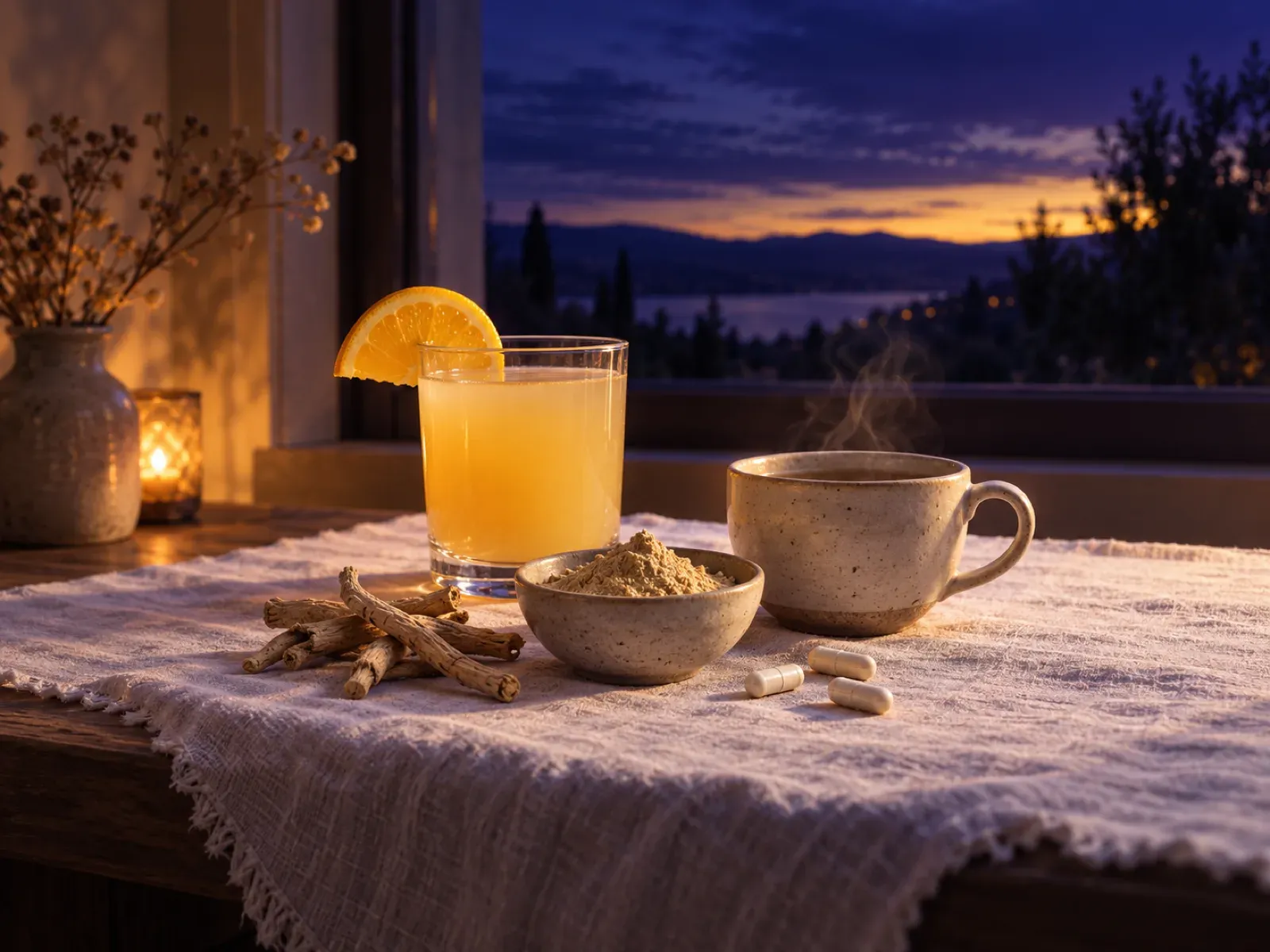
Cortisol is meant to be high in the morning and low at night, and that rhythm is normal. The best-tested ways to keep it in check are dull ones: enough sleep, easier evenings, and time outdoors. Ashwagandha has the most trial data, but a 2025 meta-analysis found a drop of only 1.16 mcg/dL. We found no study of the TikTok cortisol cocktail. Truly high cortisol, as in Cushing's syndrome, is rare and needs a doctor, not a drink.
How do you lower cortisol?
Mostly through sleep and daily habits, not supplements. In a lab study, one short night raised next-evening cortisol by 37–45%. Time in nature lowered it. Ashwagandha lowers it modestly in small trials. We found no study of the cortisol cocktail. Purple stretch marks, easy bruising and weak muscles are a reason to see a doctor.
Protect 7 or more hours of sleep and keep caffeine to the morning
Drink it if you like it, but don't expect it to change cortisol
Ashwagandha has the most data; check the liver, thyroid and pregnancy cautions first
A puffy face alone rarely means high cortisol; look at sleep, salt and weight first
Book a doctor's visit and ask whether you need testing for Cushing's syndrome
Keep taking it and ask your prescriber about side effects; don't stop on your own
Cortisol has become wellness content's favorite villain. Exploding Topics, a service that tracks rising searches, has flagged “cortisol supplement” as a trending topic since March 2025. On TikTok, people blame “cortisol face” for puffy cheeks and mix a “cortisol cocktail” of orange juice, coconut water and salt to calm it down. At CES in January 2026, a startup showed a saliva cortisol test that is read with your phone's camera.
Most of this skips a basic fact: cortisol is supposed to go up and down. It peaks soon after you wake and falls to its lowest point around midnight. A short spike during a stressful day is the system working. This guide explains what cortisol does, how normal stress differs from Cushing's syndrome, what the evidence says about the cortisol cocktail, ashwagandha, phosphatidylserine and magnesium, which daily habits move cortisol in trials, whether home testing is worth it, and when to see a doctor.
What Cortisol Does, and Why It's Supposed to Be High in the Morning
Cortisol rises 50–160% in the first 30 minutes after waking and is lowest around midnight. That rhythm is healthy. A normal 8 a.m. blood level is 5–25 mcg/dL.
What it is. Cortisol is a steroid hormone made by the adrenal glands, which sit on top of the kidneys. It raises blood sugar when you need fuel, helps control blood pressure and inflammation, and shapes how you wake up. The brain controls it through a chain called the hypothalamic-pituitary-adrenal axis, written HPA axis. When you face a stressor, the chain releases more cortisol. When the stressor passes, cortisol tells the brain to switch the chain back down.
The morning surge is normal. In healthy adults, cortisol in saliva rises by 50–160% in the first 30 minutes after waking, according to a 2004 review in the journal Stress by Angela Clow and colleagues at the University of Westminster. Researchers call this the cortisol awakening response. It peaks 30–45 minutes after you wake, then cortisol falls slowly through the day. It reaches its lowest point around midnight. Doctors rely on that night-time low when they screen for Cushing's syndrome with a late-night saliva test.
Within 30–45 minutes of waking, cortisol rises 50–160%. This is the cortisol awakening response. It helps you get going, and it is normal.
Cortisol drifts down through the day. A tense meeting, a hard workout or a strong coffee can lift it for a while, then it settles again.
Levels should be low by late evening. After one night of short sleep, evening cortisol ran 37–45% higher the next day in a lab study.
Around midnight cortisol hits its lowest point. That's why doctors use a late-night saliva test to screen for Cushing's syndrome.
What “high” means. A normal blood cortisol taken at 8 a.m. is 5–25 mcg/dL, or 138–690 nmol/L, according to MedlinePlus, the US National Library of Medicine's consumer site. Ranges vary a little between labs. A level at the top of that range in the morning is not a disease. A level that stays high into the night, day after day, is what doctors look for. That's the difference between a busy week and a hormone disorder.
Everyday High Cortisol vs Cushing's Syndrome
Stress raises cortisol for hours, not for good. Cushing's syndrome is rare (about 40–70 people per million) and is most often caused by steroid medicines.
Stress, illness, short sleep, hard exercise and caffeine all push cortisol up for a while. Then it comes back down, and the daily rhythm stays in place. Cushing's syndrome is different. The body is exposed to too much cortisol for months, and the night-time low disappears. The tabs below compare the two.
- Common causes
- A stressful event, acute illness, a short night, hard exercise, or caffeine.
- Pattern
- Cortisol rises for minutes to hours, then falls. It is still high in the morning and low at night.
- Typical signs
- None that are specific. Feeling wired or tired has many causes.
- Testing
- Usually not needed.
- What helps
- Sleep, a calmer evening, time outdoors, and the habits in section 05.
- Most common cause
- Long-term, high-dose glucocorticoid medicines, such as those used for asthma, rheumatoid arthritis or lupus. Less often, a tumor makes the body produce too much cortisol.
- How common
- When the body makes the cortisol itself, estimates range from about 40 to 70 people per million.
- Who
- Mostly adults aged 30–50, and about three times as many women as men.
- Signs
- A round face, a fatty hump between the shoulders, wide purple stretch marks, easy bruising, weak muscles, and in women, extra hair on the face and body.
- Testing
- Doctors usually confirm with two tests: a 24-hour urine cortisol, a late-night saliva cortisol, or a dexamethasone suppression test.
Who should be tested. The Endocrine Society's guideline on diagnosing Cushing's syndrome, published in the Journal of Clinical Endocrinology & Metabolism in May 2008, says doctors should first rule out steroid medicines. These include tablets, inhalers, injections and creams. It then recommends testing people with several features that are getting worse over time, especially the more specific ones, people with features unusual for their age, and people found to have a lump on an adrenal gland. It does not support routine testing in people who feel stressed. The signs that point most clearly to Cushing's are the less common ones: wide purple stretch marks, easy bruising and weak thigh and shoulder muscles. A round face alone is not one of them.
What about “adrenal fatigue”? It isn't a recognized diagnosis. A 2016 systematic review in BMC Endocrine Disorders by Flavio Cadegiani and Claudio Kater screened 3,470 articles and analyzed 58 studies. They found no substantiation that “adrenal fatigue” exists. Their paper's title is direct: “Adrenal fatigue does not exist.” Low cortisol is a real but separate condition, called adrenal insufficiency, and it needs medical care.
The Cortisol Cocktail and “Cortisol Face”: What the Evidence Says
We found no study that tested the cortisol cocktail. “Cortisol face” is not a medical term; a round face from cortisol comes with other signs.
The drink. Versions vary, but a typical cortisol cocktail, sometimes called an “adrenal cocktail,” mixes the following. CNBC described this recipe in July 2025:
What goes into a typical cortisol cocktail
Orange juice and lemon juice. Vitamin C, sugar and some potassium.
Coconut water. Potassium and fluid.
A pinch of sea salt. Sodium.
Magnesium powder and sparkling water. Optional extras in many versions.
I'm not aware of any studies that looked at the effects of these individual ingredients on cortisol levels.
What doctors say and don't say. Neither expert in the CNBC piece called the drink harmful for most people. Both said it can be a pleasant way to get fluid. Jessica R. Lee, MD, of the University of Maryland School of Medicine, added that none of the ingredients on their own “are actually known to reduce stress, except maybe magnesium.” Both doctors advised people with chronic kidney disease or diabetes to check with a doctor first, because of the potassium, salt and sugar. Lee summed up the evidence plainly: “There's not great studies out about any of this.”
“Cortisol face.” The trend blames puffy cheeks on stress. Christie Turin More, MD, an endocrinologist at the University of Colorado, told the university's news service in November 2024 that “cortisol face and moon face are not medical terms.” She explained that “persistently elevated levels of cortisol can lead to weight gain in the face,” as in Cushing's syndrome. But “the majority of patients who have Cushing's syndrome will have other symptoms.” A puffy face after a salty dinner, a short night or a few extra pounds is far more common than a hormone disorder.
Supplements to Lower Cortisol: What the Trials Show
Ashwagandha lowered cortisol by 1.16 mcg/dL in a 2025 meta-analysis of 7 trials, but didn't clearly reduce perceived stress. Phosphatidylserine blunted cortisol after exercise in small trials. Magnesium has no direct cortisol trials.
Ashwagandha: the best-studied option. Ashwagandha (Withania somnifera) is a shrub used in Ayurvedic medicine. Supplements are usually extracts of its root. In a systematic review and meta-analysis by A. A. Albalawi, published in Nutrition and Health in December 2025, randomized controlled trials of at least two weeks and at least 250 mg a day were pooled. Seven trials measured cortisol. The review included 488 participants across its cortisol and stress analyses.
To put that in context, a normal 8 a.m. blood cortisol is 5–25 mcg/dL. A drop of 1.16 mcg/dL, about 32 nmol/L, is real but small. It is a shift within the normal range, not a change from “high” to “normal.” In the same review, ashwagandha did not clearly lower perceived stress scores (standardized mean difference −0.355, 95% CI −1.188 to 0.47). Most trials were small and short, and the author notes gaps on long-term safety, dosing and effectiveness across different populations.
- 2012 · Randomized trial, 64 adults
600 mg a day of root extract for 60 days lowered serum cortisol more than placebo in adults with chronic stress.
- 2019 · Randomized trial, 60 adults
240 mg a day for 60 days lowered morning cortisol more than placebo and modestly improved anxiety scores.
- 2025 · Meta-analysis, 7 cortisol trials
Cortisol fell by 1.16 mcg/dL on average. Perceived stress did not change significantly.
- 2026 · Meta-analysis, 23 trials, 1,706 people
Cortisol fell across hormone studies, with high variation between trials.
The evidence has limits. The 2026 meta-analysis by Fornalik and colleagues in Planta Medica pooled 23 trials with 1,706 people. It also found lower cortisol (standardized mean difference −1.18). But the trials varied a lot, and ashwagandha also nudged other hormones: thyroxine (T4) rose slightly, and testosterone rose in men. Most trials tested stressed adults for about two months, using branded extracts. They tell us little about long-term use or about people who aren't stressed.
Safety. Ashwagandha is usually well tolerated in trials, but rare liver injury has been reported. A 2023 review in Pharmaceuticals by Bokan and colleagues described two new cases and reviewed earlier ones. One reported case ended in a liver transplant. Patients improved after stopping the supplement. In 2023 Denmark moved to ban ashwagandha in supplements after a national risk assessment raised concerns about thyroid and sex hormones and pregnancy. Industry groups dispute that assessment. Our guide to ashwagandha side effects covers who should avoid it.
Phosphatidylserine. Phosphatidylserine, often shortened to PS, is a fat-like molecule found in cell membranes. In a small crossover trial published in the Journal of the International Society of Sports Nutrition in 2008, 10 healthy men took 600 mg a day for 10 days. After moderate-to-hard cycling, their peak cortisol was about 39% lower than on placebo. A 2014 trial in 75 men found that 400 mg PS plus 400 mg phosphatidic acid a day for 42 days calmed the cortisol response to a lab stress test, but only in men with high chronic stress. That is promising, but it is two small studies in men.
Magnesium. Magnesium is often sold as a “cortisol” mineral. A 2020 review in Nutrients describes a possible vicious circle: stress raises magnesium loss, and low magnesium may make the stress response stronger. We found no randomized trials showing that magnesium supplements lower cortisol in healthy adults. If you take it for sleep or cramps, stay at or below 350 mg a day from supplements, the adult upper limit set in the US. Our magnesium guide covers forms and doses.
Cortisol Supplements Compared
| Criterion | Ashwagandha | Phosphatidylserine | Magnesium | Cortisol cocktail |
|---|---|---|---|---|
| Lowers cortisol in trials | Yes, modestly: −1.16 mcg/dL | Blunted the spike after exercise or a lab stress test | No direct trials found | No studies found |
| Best evidence | Meta-analyses of small trials | Two small trials | A narrative review | None |
| Doses studied | 240–600 mg extract a day for about 8 weeks | 600 mg a day, or 400 mg with 400 mg phosphatidic acid | Upper limit 350 mg a day from supplements | Not applicable |
| Who was tested | Mostly stressed adults | Healthy men | Not applicable | No studies found |
| Main cautions | Rare liver injury, thyroid effects, pregnancy | Little long-term data | Diarrhea at high doses; kidney disease | Sugar and salt; kidney disease or diabetes |
| Our take | A reasonable short trial for stressed adults without the cautions | Only for athletes curious to try it | Fine for other reasons, not for cortisol | A drink, not a treatment |
No supplement fixes cortisol; ashwagandha is the only one with consistent trial data, and its effect is small.
If you are a stressed adult and want to try something, ashwagandha has the best evidence. Choose a tested extract, use it for about 8 weeks, and stop if you notice itching, dark urine or yellow skin. Skip it if you are pregnant, have a thyroid or liver condition, or take thyroid medicine, and ask your doctor first. Sleep and daily habits, covered next, move cortisol more than any capsule.
What Actually Changes Cortisol: Sleep, Exercise, Caffeine, and Calm
One short night raised next-evening cortisol 37–45%. Hard exercise raises it for a while. 20–30 minutes in nature lowered it. Meditation helped mostly in people at risk.
Sleep comes first. In a classic 1997 study in the journal Sleep, Rachel Leproult, Eve Van Cauter and colleagues kept healthy young men in the lab. After a night of only 4 hours of sleep, their evening cortisol the next day was 37% higher than before. After a night with no sleep, it was 45% higher. The evening drop in cortisol also started at least an hour late. One night is not a lifestyle, but the direction is clear: short sleep keeps cortisol up when it should be falling.
Sleeping only from 4 to 8 a.m. raised cortisol between 6 and 11 p.m. the following evening. Lab study in healthy young men, 1997.
A full night without sleep raised the next evening's cortisol even more, and delayed its nightly drop by at least an hour.
Hard exercise (80% of VO2max) raises cortisol for a while. That's a normal training signal, not damage. Keep hard sessions away from bedtime.
Moderate exercise (60% of VO2max) also lifts cortisol briefly. Part of the rise comes from the blood becoming more concentrated during exercise.
Easy exercise (40% of VO2max), like a brisk walk, barely moved cortisol. It is a good evening choice.
Time outdoors in a green space lowered saliva cortisol in 36 city dwellers over 8 weeks. The best return came from 20–30 minutes.
Exercise: a spike, then recovery. In a 2008 study in the Journal of Endocrinological Investigation, Hill and colleagues had 12 trained men exercise for 30 minutes at three intensities. Cortisol rose 5.7% at 40% of VO2max, 39.9% at 60%, and 83.1% at 80%. VO2max is the most oxygen your body can use. Those spikes are short and part of how training works. Regular exercise is not a cortisol problem. Hard sessions late at night may be, if they cost you sleep.
Caffeine. A 2005 trial in Psychosomatic Medicine gave 96 adults capsules of caffeine in three daily doses. After five days without caffeine, a 250 mg dose clearly raised cortisol. In people taking 300–600 mg a day, the morning response faded, but an afternoon dose still raised cortisol into the evening. Moving coffee earlier in the day is a simple fix.
Meditation. A 2021 meta-analysis of randomized trials in Health Psychology Review, by Koncz and colleagues, found that meditation programs had a medium effect on cortisol measured in blood (10 studies). The effect appeared only in people with a physical illness. In 21 studies that used saliva, the effect was small and not significant. Meditation may help most when stress is high. Our comparison of Calm and Headspace covers the main apps.
Nature. In a 2019 study in Frontiers in Psychology, Hunter and colleagues asked 36 city dwellers to spend at least 10 minutes in a green outdoor place three times a week for 8 weeks. Saliva cortisol fell 21.3% per hour beyond its normal daily decline. The best return per minute came at 20–30 minutes. The study was small and people chose their own times and places, so treat the number as a guide.
Should You Test Your Cortisol at Home?
Usually not. One reading says little, because cortisol swings 50–160% within 30 minutes of waking. Doctors test only when there are signs of Cushing's, and they use two tests.
Home saliva kits and phone-connected trackers promise to show your “stress hormone” in real time. The problem is not the chemistry. It is that cortisol changes so much over a normal day. Clow's 2004 review noted there are no agreed norms for saliva cortisol right after waking. A reading depends on when you woke up, when you sampled, what you ate and drank, and how you slept. We found no peer-reviewed studies showing that consumer cortisol trackers improve health. These are the tests doctors use:
| Test | What it shows | When it's used |
|---|---|---|
| Morning blood cortisol | Level at about 8 a.m.; normal 5–25 mcg/dL (138–690 nmol/L) | Mainly to look for low cortisol |
| Late-night saliva cortisol | Whether the night-time low is missing | First-line screen for Cushing's syndrome |
| 24-hour urine free cortisol | Total cortisol over a full day | First-line screen for Cushing's syndrome |
| 1 mg overnight dexamethasone test | Whether cortisol switches off when it should | First-line screen for Cushing's syndrome |
To convert units, 1 mcg/dL equals 27.59 nmol/L. If one screening test is abnormal, the Endocrine Society advises seeing an endocrinologist for a second test.
If you use a home tracker anyway
Sample at the same time every day. A morning reading taken 10 minutes after waking and one taken 40 minutes after can differ a lot.
Look at the pattern, not one number. High in the morning and low at night is the healthy shape.
Don't self-diagnose. If you also have signs of Cushing's syndrome, see a doctor, who will order validated lab tests.
How to Lower Cortisol in Your Situation
Busy, stressed, and sleeping 5–6 hours a night.
Start with sleep. Aim for 7 or more hours, the amount sleep scientists recommend for adults. Keep coffee to the morning, move hard workouts earlier, and take a 20–30 minute walk somewhere green on most days. Give it a few weeks before judging. If low mood, anxiety or insomnia persist, talk to your doctor.
Our guide to improving sleep quality naturally explains how.You want to try a supplement for stress.
Ashwagandha has the most data. Trials used 240–600 mg of root extract a day for about 8 weeks. Pick a third-party-tested product, set an end date, and stop if you notice itching, dark urine or yellow skin. Expect a small change, not a reset. Ask your pharmacist about interactions if you take other medicines.
Read who should avoid ashwagandha first.Your face looks puffier and you've seen “cortisol face” videos.
A round face by itself rarely means a hormone disorder. Salt, alcohol, short sleep and weight gain are far more common causes. See a doctor if it comes with wide purple stretch marks, easy bruising, weak muscles, or a fatty hump between your shoulders.
See our guide to hormonal weight gain causes.You take a steroid medicine such as prednisone.
Steroid medicines are the most common cause of Cushing's syndrome, but they treat serious conditions. Never stop or cut down on your own. Tell your prescriber about weight gain, bruising, mood changes or high blood sugar, and ask whether the dose can be adjusted. Skip cortisol supplements unless your doctor agrees.
You train hard and worry it raises your cortisol.
It does, for a while, and that's normal. Keep hard sessions earlier in the day and balance them with easy ones and rest days. Phosphatidylserine blunted the cortisol spike in two small trials in men, but no one has shown that this improves results. Sleep and recovery matter more.
Our Zone 2 training guide covers easy-hard balance.You're pregnant, or have a thyroid or liver condition.
Skip ashwagandha unless your doctor approves it. It can affect thyroid hormones, rare liver injury has been reported, and Denmark restricted it partly over pregnancy concerns. Focus on sleep, gentle activity and support for stress. Ask your doctor or midwife before taking any supplement for stress.
Practical Tips to Lower Cortisol Naturally
Protect seven hours of sleep.
The American Academy of Sleep Medicine and the Sleep Research Society recommend 7 or more hours a night for adults. Short sleep kept evening cortisol high in the lab.
Keep caffeine to the morning.
Regular coffee drinkers still had a cortisol rise after an afternoon dose, and it lasted into the evening.
Move hard workouts earlier.
Hard exercise raises cortisol by up to 83% for a while. In the evening, choose an easy walk or stretching instead.
Take a 20-minute green break.
A park, a tree-lined street or a garden counts. The best return per minute came at 20–30 minutes.
Try a structured calming practice.
A meditation course or app is low-risk. The cortisol benefit was clearest in people under real strain, so it is worth trying when stress is high.
Treat the cortisol cocktail as a drink, not a treatment.
It is fine as a snack. Count the sugar and salt, and ask first if you have kidney disease or diabetes.
Give any supplement an end date.
Most ashwagandha trials lasted about 8 weeks. Decide in advance how you will judge it, and stop if it doesn't help. Our guide to choosing supplements safely explains what to look for on the label.
Common Misconceptions About Cortisol
The cortisol cocktail lowers cortisol.
True or not? Tap to find outHere’s what the evidence says
Not shown. We found no study of the drink, and endocrinologists interviewed by CNBC knew of no studies on its ingredients and cortisol. It can be a pleasant way to get fluids.
A puffy face means my cortisol is high.
True or not? Tap to find outHere’s what the evidence says
Rarely. “Cortisol face” is not a medical term. Cushing's syndrome causes a round face, but almost always with other signs such as purple stretch marks, bruising and weak muscles.
High cortisol in the morning is bad.
True or not? Tap to find outHere’s what the evidence says
It's the opposite. Cortisol is supposed to rise 50–160% after you wake. A missing night-time low is what doctors worry about.
Stress has burned out my adrenals.
True or not? Tap to find outHere’s what the evidence says
“Adrenal fatigue” isn't a recognized diagnosis. A 2016 systematic review of 58 studies found no evidence that it exists. Ongoing fatigue deserves a real workup.
Exercise is bad because it raises cortisol.
True or not? Tap to find outHere’s what the evidence says
Not true. Hard exercise raises cortisol for a short time, which is part of training. Easy exercise barely moves it. The issue is hard sessions that cut into sleep.
A home test can tell me if I have Cushing's.
True or not? Tap to find outHere’s what the evidence says
It can't. Diagnosis needs validated lab tests, usually two, read by a doctor. One saliva reading shifts with sleep, timing and caffeine.
When to See a Doctor
See a clinician promptly if you have:
- Several signs of Cushing's syndrome together: wide purple stretch marks, easy bruising, weak thigh or shoulder muscles, a fatty hump between the shoulders, a round face, or new hair growth on the face in women.
- Long-term steroid medicine (tablets, inhalers, injections or creams) with weight gain, bruising or mood changes. Don't stop it on your own.
- Signs of liver trouble while taking ashwagandha: itching, dark urine, nausea, or yellow skin or eyes. Stop the supplement and get checked.
- A thyroid condition, liver disease, or pregnancy and you are thinking about ashwagandha or other stress supplements.
- Kidney disease or diabetes before drinking potassium- and sugar-rich “adrenal cocktails” every day.
- Stress, anxiety, low mood or insomnia that lasts more than a few weeks or makes daily life hard.