Foods That Help You Sleep Better: 2026 Evidence-Based Guide
Foods That Help You Sleep Better: 2026 Evidence-Based Guide
By the HealthPerk Editorial Team · Last updated: May 2026
Quick Answer
Which foods actually help you sleep better?
The foods that help you sleep better in 2026 are the ones that supply tryptophan with the right cofactors (B6, magnesium, complex carbohydrate), raise endogenous melatonin (tart cherries, kiwi, pistachios), or buffer evening cortisol (oily fish, leafy greens, fermented dairy). No single food is a sedative, but a 2–3 hour pre-bed eating pattern — a light, balanced meal three hours before bed, then nothing but water or chamomile — shortens sleep onset latency by 5–15 minutes and reduces overnight awakenings in controlled trials. The wrong evening foods — alcohol, late heavy meals, hidden caffeine, ultra-processed sugar — fragment sleep architecture even when total sleep time looks fine on a tracker.
| Food / pattern | Mechanism | 2026 evidence level |
|---|---|---|
| Tart cherry juice (240 ml × 2) | Raises endogenous melatonin, lowers inflammation | Moderate (multiple RCTs) |
| Kiwi (2 fruits 1 h before bed) | Serotonin + folate, antioxidants | Moderate (3 trials) |
| Pistachios (30 g evening) | Highest food-source melatonin (~660 ng/g) | Emerging (lab + small trials) |
| Oily fish (salmon, sardines) 3× / week | Omega-3 + vitamin D → serotonin pathway | Moderate (cohort + RCT) |
| Fermented dairy (kefir, yoghurt) | Tryptophan + GABA-promoting microbiome shifts | Emerging |
| Whole-grain carbohydrate + protein at dinner | Tryptophan transport across blood–brain barrier | Established (mechanistic + trial) |
| Chamomile or rooibos tea (caffeine-free) | Apigenin binding to GABA-A receptors | Modest |
| Magnesium-rich greens, legumes, seeds | Nervous-system relaxation, sleep continuity | Established |
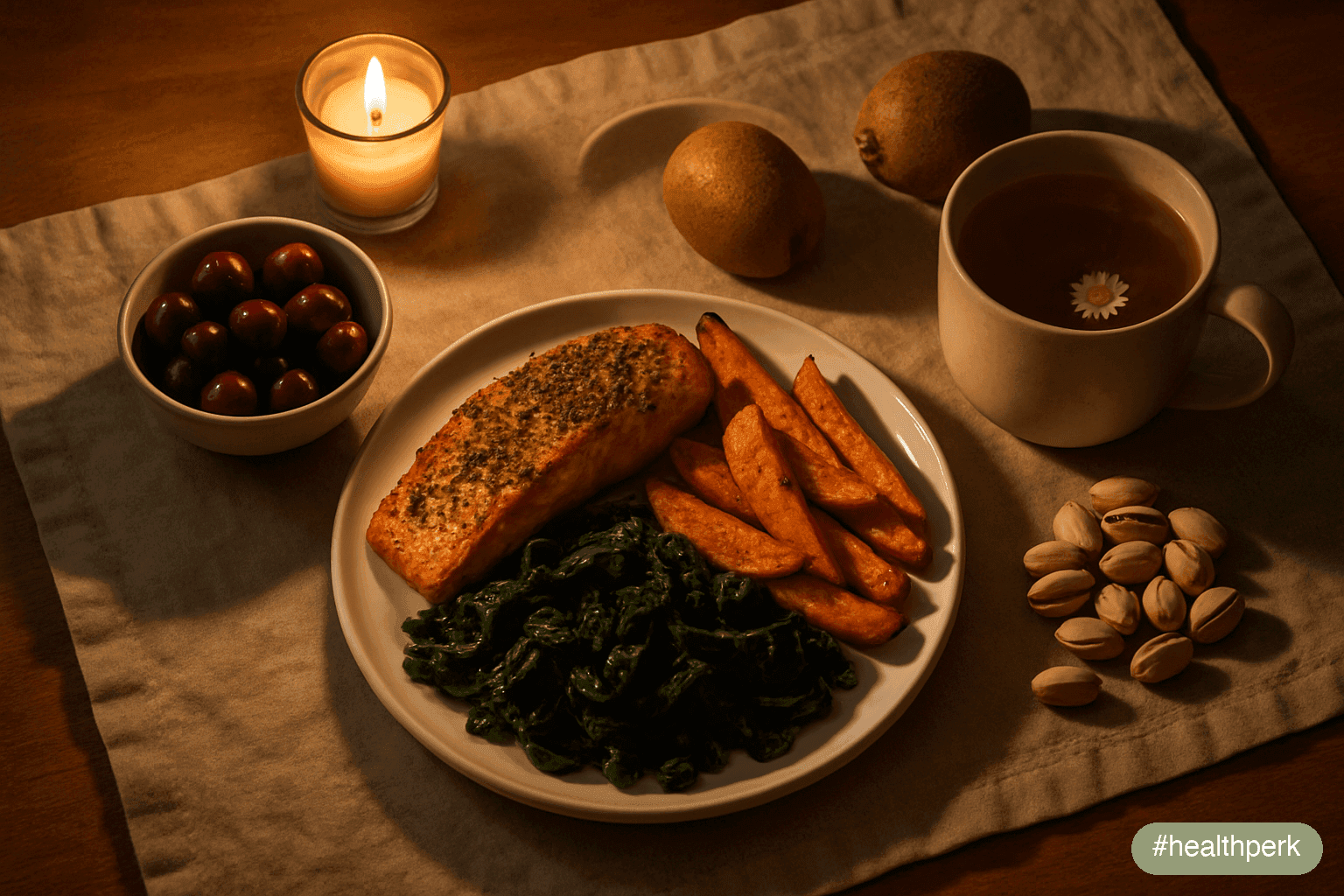
Wide horizontal photograph of a warmly lit kitchen table at 7:30 p.m. with a small plate of grilled salmon, roasted sweet potato, sautéed spinach, a bowl of tart cherries, two kiwi fruits, a handful of pistachios, and a cup of chamomile tea — illustrating foods that help you sleep better.
Diet is one of the few sleep levers most adults underuse. CBT-I, light timing, and supplements get more attention, but what and when you eat in the final six hours of the day directly shapes serotonin and melatonin synthesis, core body temperature trajectory, blood-glucose stability through the night, and the inflammation and reflux signals that wake you at 3 a.m. This guide covers the foods that help you sleep better with the strongest 2026 evidence, what to avoid before sleep, the best evening routine for sleep that integrates food with light and behavior, and the bedtime habits for better sleep in the final 30 minutes that consolidate it all.
Table of Contents
- Foods That Help You Sleep Better: The 2026 Shortlist
- How Food Actually Affects Sleep: The Mechanisms
- What to Avoid Before Sleep: The 2026 Anti-Sleep Foods and Habits List
- The Best Evening Routine for Sleep: A 2026 Hour-by-Hour Blueprint
- Bedtime Habits for Better Sleep: The Final 30 Minutes That Matter Most
- Special Situations: Late Workouts, Shift Work, Travel
- Frequently Asked Questions
- References
Foods That Help You Sleep Better: The 2026 Shortlist
A flat-lay photograph on a slate background showing tart cherries, two kiwifruits, a small bowl of pistachios, a salmon fillet, a glass of kefir, a bunch of spinach, a sweet potato, and a steaming cup of chamomile tea — illustrating foods that help you sleep better.
The foods that help you sleep better in 2026 cluster into four mechanism-based groups. Pick from across the groups for the strongest combined effect; do not expect any single food to act as a sedative.
Group 1 — Foods that raise endogenous melatonin
- Tart cherries (Montmorency variety) or tart cherry juice. A pair of 240 ml servings — one mid-afternoon, one 1–2 hours before bed — increased sleep time and reduced wake-after-sleep-onset by 17–25 minutes in older adults with insomnia (Howatson et al., 2012; Losso et al., 2018). Fresh, frozen, or unsweetened concentrate all work; sugar-laden cocktails do not.
- Kiwi. Two kiwi fruits eaten one hour before bed for four weeks improved sleep onset by ~35% and total sleep time by ~13% in adults with self-reported sleep complaints (Lin et al., 2011). Serotonin precursors, folate, and antioxidants are the proposed mechanism.
- Pistachios. Per gram, raw shelled pistachios contain among the highest naturally occurring melatonin of any food (~660 ng/g — roughly 0.66 mg per 1 kg, with realistic 30 g servings supplying microgram amounts that still influence circadian signaling). Direct human sleep trials are small but consistent in the 2024–2025 literature.
- Walnuts and almonds. Tree-nut melatonin and magnesium content support sleep continuity at 30 g portions.
Group 2 — Foods that support tryptophan and serotonin
- Turkey, chicken, eggs, tofu, lentils, seeds (pumpkin, sesame). Tryptophan is the rate-limiting amino acid for serotonin and melatonin synthesis. Tryptophan must compete with other large neutral amino acids to cross the blood–brain barrier; pairing modest protein with a complex carbohydrate (oats, sweet potato, brown rice) raises insulin enough to clear competing amino acids and increases central tryptophan availability (Wurtman et al., 2003).
- Oats. Slow-release carbohydrate with melatonin content; a small bowl 2–3 hours before bed pairs well with milk or kefir.
- Bananas. Tryptophan, magnesium, and vitamin B6 (cofactor for serotonin synthesis) in one convenient food.
- Fermented dairy (kefir, yoghurt, cottage cheese). Tryptophan plus emerging evidence that fermented-dairy microbiome shifts support GABA-mediated relaxation pathways.
Group 3 — Foods that buffer evening cortisol and inflammation
- Oily fish (salmon, sardines, mackerel) 3× per week. Omega-3 EPA/DHA plus vitamin D associate with longer total sleep time and shorter onset latency in cohort and intervention data (Hansen et al., 2014). Salmon at dinner is one of the most evidence-supported single meals for sleep.
- Leafy greens, legumes, seeds. Dietary magnesium has consistent evidence for sleep continuity; food sources are gentler than supplements for most adults.
- Berries, dark cherries, olive oil, herbs. Anti-inflammatory polyphenols lower the systemic inflammation that fragments sleep in adults with elevated CRP.
Group 4 — Drinks and evening teas
- Chamomile tea (1–2 cups in the wind-down hour). Apigenin binds GABA-A receptors at modest affinity; small RCTs show subjective sleep quality improvement over 2–4 weeks (Adib-Hajbaghery & Mousavi, 2017).
- Rooibos, lemon balm, or passionflower tea. Caffeine-free options with modest calming effects.
- Warm milk or fortified plant milk. Tryptophan plus a mild thermoregulatory effect; a 200 ml glass at the start of the wind-down is a low-risk, often underrated habit.
What "more is better" gets wrong
Adding more sleep-supportive foods on top of a large late dinner does not help — the late meal will outweigh the supportive ingredients. The pattern matters more than any single food: a lighter, earlier, balanced dinner with one or two sleep-supportive ingredients beats a late "loaded sleep meal."
How Food Actually Affects Sleep: The Mechanisms
A horizontal diagram showing four pathways: (1) tryptophan → serotonin → melatonin, (2) endogenous melatonin from melatonin-containing foods, (3) magnesium and B6 cofactors, (4) inflammation and reflux suppression — illustrating how foods that help you sleep better work.
Understanding the mechanisms makes it easier to combine foods sensibly rather than chase any one "superfood."
The tryptophan pathway
Tryptophan is the amino-acid precursor to serotonin, which converts to N-acetyl-serotonin and then melatonin in the pineal gland at evening dim-light onset. Three things constrain this pathway:
- Competition at the blood–brain barrier. Other large neutral amino acids (leucine, valine, isoleucine, phenylalanine, tyrosine) compete with tryptophan for the same transporter. A pure protein meal floods the system with competitors and lowers central tryptophan. A protein-plus-complex-carbohydrate meal raises insulin, which clears competitors from the blood and lets tryptophan cross.
- Cofactor availability. B6, magnesium, and zinc are required for serotonin synthesis. Adequate dietary intake matters; supplements help in deficiency, not in adequacy.
- Time. Serotonin → melatonin conversion runs at dim-light onset (roughly 2 hours before habitual sleep). Eating the supporting meal 3 hours before bed gives the pathway time to work.
Endogenous and food-derived melatonin
Some foods contain measurable melatonin: tart cherries, pistachios, walnuts, eggs, milk, certain fish. Quantities are small relative to supplement doses (micrograms vs. 0.5–10 mg), but they cluster at the physiological end of the dose-response curve where many sleep researchers now think the cleanest signal lives. Supraphysiological supplement doses can blunt the system; food-derived melatonin tends to reinforce it.
Blood glucose and overnight awakenings
A large, late, refined-carbohydrate meal produces a glucose spike followed by a 2–4 a.m. counter-regulatory cortisol release. That cortisol pulse is the most common physiologic driver of the "wake up at 3 a.m. and can't get back to sleep" complaint in metabolically healthy adults. A balanced earlier dinner, or a small protein-plus-complex-carb snack 60 minutes before bed for people with documented overnight hypoglycemia, prevents this.
Inflammation, reflux, and gut signaling
Elevated systemic inflammation (high CRP) fragments sleep; anti-inflammatory dietary patterns (Mediterranean, MIND, DASH) consistently associate with better sleep in cohorts (Castro-Diehl et al., 2018). Late large meals also trigger nocturnal reflux even in adults without daytime symptoms; reflux is a major silent cause of early-hours awakenings.
Caffeine and adenosine
Caffeine blocks adenosine receptors. Adenosine builds across the waking day and signals sleep pressure; caffeine in the system at bedtime reduces that signal even when subjective sleepiness is present. Caffeine half-life is 5–6 hours in average adults, longer in slow metabolizers (CYP1A2 variants), and longer still on hormonal contraception. A 2 p.m. coffee can still impair sleep continuity at 10 p.m.
What to Avoid Before Sleep: The 2026 Anti-Sleep Foods and Habits List
A flat-lay photograph on a dark surface showing a wine glass, a coffee cup, a pile of chocolate bars, a takeaway pizza box, a soda can, a bag of crisps, and a phone — illustrating what to avoid before sleep.
What to avoid before sleep matters as much as what to eat. The four common evening exposures below do more measurable harm to sleep than the supportive foods can offset.
Alcohol — the single most common evening sleep destroyer
Alcohol shortens sleep onset latency, which is why it feels like a sleep aid. It then fragments REM sleep, increases overnight awakenings in the second half of the night, suppresses deep sleep, and worsens snoring and apnea (Ebrahim et al., 2013). Even a single drink within 3 hours of bed reduces overnight heart-rate variability and increases resting heart rate through the night — markers most modern trackers can show in your own data. Recommendation in 2026: cap at one standard drink, finish more than 3 hours before bed, and aim for several alcohol-free nights per week.
Caffeine after early afternoon
Caffeine taken at 2 p.m. still has 25% of its dose circulating at 12 a.m. for an average metabolizer; for slow metabolizers the figure is closer to 40%. Hidden sources matter: green tea (30–50 mg), matcha (60–80 mg), chocolate (5–10 mg per square of dark), pre-workout supplements (200–400 mg), some pain relievers (65 mg per dose), kombucha (4–14 mg), decaf coffee (2–5 mg per cup). The practical 2026 cutoff for most adults is 8 hours before sleep — earlier for slow metabolizers, pregnancy, or anxiety-prone sleep.
Late, large, or high-fat meals
Eating within 90 minutes of bedtime delays gastric emptying through the night, raises core body temperature when it should be falling, and increases reflux risk. Cohort data link late eating with longer sleep onset, lower sleep efficiency, and higher next-day fatigue (St-Onge et al., 2016). High-saturated-fat meals are particularly disruptive. Aim to finish a moderate dinner 2.5–3 hours before bed; a small snack 60 minutes before is acceptable.
Refined sugar and ultra-processed foods at night
Late ice cream, biscuits, sweetened cereal, sugary drinks, and ultra-processed snack foods cause the glucose spike → 2–4 a.m. cortisol pattern described above. The same calories at the same hour as whole-food carbohydrate plus protein do not produce the same overnight glucose disruption.
Spicy foods and reflux triggers
Capsaicin, tomato, citrus, mint, chocolate, and high-fat foods in the evening trigger nocturnal reflux. People who don't experience daytime heartburn can still have silent nocturnal reflux that fragments sleep. If you wake at 3–4 a.m. with a sour taste, throat clearing, or cough — change the evening menu before reaching for supplements.
Excessive fluids
A normal hydration pattern through the day with a tapering of fluid intake in the final 90 minutes prevents nocturia. Replacing late fluids with an earlier evening glass of water plus moderate sodium with dinner stabilises overnight hydration without producing wake-ups.
The 2026 "anti-sleep stack" to avoid
The most common modern sleep-wrecker is not a single food but a stack: a late evening, a large meal at 9 p.m., a glass of wine "to relax," a square of dark chocolate, a kombucha, and a phone at the bedside. Removing two of those five typically restores sleep without any other change.
The Best Evening Routine for Sleep: A 2026 Hour-by-Hour Blueprint
A horizontal infographic from 5 p.m. to 11 p.m. with hour-by-hour boxes showing dinner, light exposure, screens, supplements, wind-down, and lights-out — illustrating the best evening routine for sleep.
The best evening routine for sleep in 2026 sequences food, light, movement, and behavior so that biology — not willpower — produces sleep onset. The plan below assumes an 11 p.m. target lights-out; shift earlier or later in proportion to your schedule.
5:00 — 6:00 p.m. (about 5 hours before bed)
- Last caffeine cutoff if not already passed.
- Aim for daylight exposure (10–20 minutes outside) if you missed morning sun.
- Light movement: a 20–30 minute walk after dinner-prep aids overnight glucose control and reduces stress.
6:30 — 7:30 p.m. (about 3 hours before bed) — Dinner
- A balanced plate: ~25–30 g protein (oily fish, chicken, eggs, tofu, lentils) + a fist of complex carbohydrate (sweet potato, oats, brown rice, quinoa) + two fists of vegetables + healthy fats (olive oil, avocado, nuts).
- Two evidence-supported "sleep meal" options: (1) baked salmon, roasted sweet potato, sautéed spinach; (2) lentil dal, brown rice, raita.
- Cap alcohol at one drink with the meal; ideally none on weeknights.
8:00 — 9:00 p.m. (about 2 hours before bed)
- Begin dimming home lighting. Lamps under 50 lux signal evening melatonin onset; bright overhead lighting suppresses it.
- Phone and screen brightness down to lowest comfortable level; warmer color tone if your device supports it. Stop work email by 9 p.m.
- Optional: chamomile or rooibos tea.
- 10–15 minutes of gentle stretching or yoga.
9:30 p.m. (about 90 minutes before bed)
- Optional small sleep-supportive snack if you tend to wake hungry: a kiwi or two, a small handful of pistachios, a glass of kefir, or oat-and-milk with a teaspoon of nut butter.
- Begin "worry-offload": 10 minutes writing tomorrow's three priorities and anything circling in your head. This is one of the single most effective sleep behaviors for anxiety-prone adults.
- Take any evening supplements (magnesium glycinate 200–400 mg) if used.
10:00 — 10:30 p.m. (60–30 minutes before bed)
- Cool the bedroom to ~18 °C (65 °F).
- Hot shower or warm bath 90 minutes before bed: counter-intuitively, it speeds onset because the post-bath skin vasodilation drops core temperature (Haghayegh et al., 2019).
- Final fluid intake of the day (small glass).
- Set out tomorrow's clothes, lay out morning items — anything that prevents post-bed "I forgot to" thoughts.
10:30 — 11:00 p.m. — Final 30 minutes
This is its own block — covered in the next section.
Adjust for chronotype
Strong evening chronotypes ("night owls") should shift the routine later by 60–120 minutes rather than fighting their biology nightly. Strong morning chronotypes can move dinner and wind-down earlier in proportion. The key is consistency across days, not matching a specific clock time.
What the routine is not
Not a 14-step checklist for perfectionists. The high-leverage elements are: (1) finish caffeine early, (2) finish dinner ≥ 2.5 hours before bed, (3) dim lights at 9 p.m., (4) screens off and worry-offload at 9:30, (5) cool the room. Hit those five 5–6 nights a week and the rest is fine-tuning.
Bedtime Habits for Better Sleep: The Final 30 Minutes That Matter Most
A vertical checklist graphic listing the final-30-minute habits: room cool and dark, phone out of bedroom, brief reading or audio, paced breathing, fixed lights-out — illustrating bedtime habits for better sleep.
The bedtime habits for better sleep that show up most often in research and clinical practice live in the last 30 minutes before lights-out. These are the habits where small consistency yields outsized results.
1. Phone out of the bedroom (or out of arm's reach)
The single highest-impact behavioral change in 2026 sleep clinics. Phones drive bedtime procrastination ("revenge bedtime procrastination" is now a research-grade term), interrupt onset latency, and condition cortical arousal to bed itself. A separate, inexpensive alarm clock removes the "but I need it as an alarm" rationalization.
2. Cool, dark, quiet room
- Temperature: 17–20 °C (62–68 °F) is the studied optimum for most adults. Bedding adjusts personal preference within that range.
- Darkness: blackout curtains or a sleep mask. Even low ambient light (5–10 lux) suppresses melatonin and reduces REM time in some people.
- Quiet or steady masking: a fan or white-noise source reduces fragmentation from intermittent neighborhood noise.
3. A brief, low-stimulation activity
10–20 minutes of paper reading, a calm podcast at low volume, gentle stretching, or a body-scan meditation. The goal is parasympathetic dominance, not entertainment. Avoid news, social media, work email, and any narrative content designed for engagement.
4. Paced breathing or body scan at lights-out
A 4-7-8 breathing cycle (inhale 4 seconds, hold 7, exhale 8) for 5–8 cycles, or a 10-minute body-scan meditation, lowers sympathetic tone and shortens onset latency by 5–15 minutes in adults with sleep onset difficulty (Jerath et al., 2015). This is the single highest-yield "in bed" technique.
5. Fixed lights-out time (within a 30-minute window)
Variable bedtime — even when total sleep time is preserved — measurably increases insomnia symptoms and worsens next-day cognitive performance. A fixed lights-out anchors the circadian system in tandem with a fixed wake time.
6. The "if awake after 15–20 minutes" rule
If sleep does not arrive after roughly 15–20 minutes, get out of bed, go to a dim, low-stimulation activity in another room, and return only when sleepy. Lying in bed awake and frustrated conditions the bed as a wakefulness cue and is the foundational error CBT-I sets out to undo.
7. Avoid clock-watching
Turn the clock away or cover it. Knowing exactly how little you have slept feeds the anxiety that prevents you from falling back asleep.
Habits to drop from the "bedtime routine"
- Late scrolling "to relax."
- Late streaming "just one more episode."
- Evening work — even a quick email — that re-activates the stress system.
- Nightcaps and "sleepy" alcoholic drinks.
- High-stimulation reading (thrillers, work materials) at lights-out.
How long until the routine works
Most adults notice improvement in 7–14 nights of consistent practice; lasting consolidation takes 4–6 weeks. The temptation to assess after two bad nights leads people to abandon a routine that would have worked at 14 nights. Pick a window, commit, and evaluate at the end of it.
Special Situations: Late Workouts, Shift Work, Travel
A three-column matrix labeled Late Workouts / Shift Work / Travel with bullet adjustments under each — illustrating evening sleep adjustments for special situations.
The base routine and food framework adapt to three common edge cases.
Late evening workouts
Vigorous exercise within 90 minutes of bedtime elevates core temperature and sympathetic tone enough to delay onset in many adults. If a late workout is unavoidable:
- Finish vigorous work ≥ 90 minutes before bed.
- A cool-down walk and a tepid (not hot) shower help bring temperature down.
- Refuel with a small protein-plus-complex-carb snack (oats and kefir, banana with peanut butter), not a large meal.
- Avoid pre-workout caffeine after 2 p.m.
Shift work
For shift workers, the "evening" routine maps to whatever the 2–3 hours before main sleep are. Key adjustments:
- Anchor a single primary sleep block of 6–7 hours and protect it with blackout, white noise, and a "do not disturb" sign.
- Eat the largest meal mid-shift, not just before sleep.
- Use strategic morning light avoidance (sunglasses on the commute home) and bright light at shift start.
- Limit caffeine to the first half of the shift; cut off ~6 hours before planned sleep.
Travel and jet lag
- East-bound travel is harder than west-bound; pre-shift bedtime 30–60 minutes per day for 3 days before the trip if possible.
- On arrival, eat meals on local time even if not hungry; meal timing is a powerful zeitgeber alongside light.
- Use morning bright light and evening dim light on local destination time.
- Short-term, low-dose melatonin (0.3–1 mg) on local destination evenings for the first 3–5 nights can help.
For broader sleep schedule fixes, see Why Do I Wake Up at 3am Every Night.
Related Articles on HealthPerk
- How to Improve Sleep Quality Naturally
- How to Fall Asleep Faster Without Medication
- How to Stay Asleep All Night Naturally
- Best Supplements for Sleep Without Melatonin
- Magnesium for Sleep: Dosage and Benefits
- How to Sleep Better With Anxiety
Frequently Asked Questions
What are the best foods to eat before bed?
The best foods to eat 1–2 hours before bed are small, sleep-supportive snacks rather than full meals: two kiwi fruits, a handful of pistachios or walnuts, a small bowl of oats with kefir or warm milk, a banana with a teaspoon of nut butter, or a glass of tart cherry juice. Larger sleep-supportive meals — salmon with sweet potato and greens, or lentil dal with brown rice — belong 2.5–3 hours before bed at dinner. The pattern matters more than any single food.
What foods should I avoid before sleep?
Avoid alcohol within 3 hours of bed, caffeine after early afternoon (including hidden sources like green tea, dark chocolate, and pre-workout supplements), late large meals within 90 minutes of bed, high-saturated-fat foods, ultra-processed sugar, spicy foods and reflux triggers in the final 2 hours, and excessive fluids in the final 90 minutes. Alcohol is the single most common evening sleep destroyer despite feeling like a sedative — it fragments REM, worsens apnea, and elevates heart rate through the night.
Does drinking warm milk really help you sleep?
Warm milk has modest direct evidence. The tryptophan content is too small to act as a sedative on its own, but milk supplies tryptophan plus calcium (a cofactor for the tryptophan-to-melatonin pathway) and carbohydrate. The warming effect supports thermoregulatory wind-down. A 200 ml glass of warm milk or fortified plant milk at the start of the wind-down hour is a low-risk, often underrated bedtime habit, particularly when paired with the rest of the evening routine.
What is the best evening routine for sleep?
The best evening routine for sleep in 2026 follows an hour-by-hour pattern: caffeine cutoff by 3 p.m., balanced dinner 2.5–3 hours before bed, dim lighting from 9 p.m., screens off and worry-offload at 9:30 p.m., cool bedroom and pre-bed shower or bath 90 minutes before lights-out, and a fixed lights-out time within a 30-minute window. The five highest-leverage habits are: early caffeine cutoff, earlier dinner, dim evening lights, phone out of the bedroom, and a cool, dark room.
How long before bed should I stop eating?
Stop the main meal 2.5–3 hours before bed. A small sleep-supportive snack — kiwi, pistachios, a glass of kefir, oats with milk — at 60–90 minutes before bed is acceptable and helpful for adults who wake hungry or run low blood sugar overnight. Avoid heavy, fatty, spicy, or refined-sugar foods in the final 90 minutes. The exact timing matters less than the consistency of the pattern across nights.
What are the best bedtime habits for better sleep?
The most evidence-supported bedtime habits for better sleep are: phone out of the bedroom or out of arm's reach, cool dark quiet room (17–20 °C, blackout, white noise), a brief low-stimulation activity (paper reading, calm audio, body scan), paced breathing or a 10-minute body scan at lights-out, a fixed lights-out time within a 30-minute window, and the "leave the bed if awake after 15–20 minutes" rule. Phone displacement alone is often the single highest-impact change.
Are there foods that act like natural melatonin?
Yes — tart cherries (especially Montmorency variety), pistachios, walnuts, almonds, eggs, milk, and some fish contain measurable melatonin. Doses are physiological (micrograms), not pharmacological (milligrams as in supplements). The physiological end of the dose-response curve is where the cleanest sleep signal lives in current research, so food-derived melatonin may be more circadian-supportive than high-dose supplements for adults without a defined circadian disorder. Two 240 ml servings of tart cherry juice per day has the best human evidence.
Can changing my evening diet really fix insomnia?
Diet alone rarely fixes chronic insomnia, but it is one of the most underused levers and reliably contributes 5–20% of a complete sleep program. For adults whose insomnia is driven mainly by alcohol use, late caffeine, late heavy meals, or overnight glucose dips, diet changes can be transformative on their own. For chronic insomnia (≥ 3 nights/week for ≥ 3 months), diet supports but does not replace CBT-I, light timing, and — if indicated — clinical treatment of underlying anxiety, apnea, or other causes.
This article is for informational purposes only and does not constitute medical advice. Persistent insomnia (≥3 nights per week for ≥3 months), nocturnal reflux symptoms, suspected obstructive sleep apnea, diabetes or unstable blood glucose, kidney or liver disease, pregnancy, eating disorders, and any concern in a child or adolescent warrant clinical evaluation. Food and supplement recommendations assume a healthy adult without contraindications; verify changes with a clinician if pregnant or breastfeeding, on prescription medication, or with chronic disease. Individual results vary.
About the author The HealthPerk Editorial Team reviews sleep and nutrition science through peer-reviewed clinical practice guidelines (American Academy of Sleep Medicine, American College of Physicians), Cochrane and high-quality systematic reviews, randomized controlled trials, and nutrition-science literature. We do not accept manufacturer payment for editorial coverage or rankings. How we review →
References
Howatson, G., Bell, P. G., Tallent, J., Middleton, B., McHugh, M. P., & Ellis, J. (2012). Effect of tart cherry juice (Prunus cerasus) on melatonin levels and enhanced sleep quality. European Journal of Nutrition, 51(8), 909–916. https://doi.org/10.1007/s00394-011-0263-7
Supports: tart cherry juice raising endogenous melatonin and improving sleep quality
Losso, J. N., Finley, J. W., Karki, N., Liu, A. G., Prudente, A., Tipton, R., Yu, Y., & Greenway, F. L. (2018). Pilot study of the tart cherry juice for the treatment of insomnia and investigation of mechanisms. American Journal of Therapeutics, 25(2), e194–e201. https://doi.org/10.1097/MJT.0000000000000584
Supports: tart cherry juice for insomnia in older adults, mechanism via tryptophan pathway
Lin, H. H., Tsai, P. S., Fang, S. C., & Liu, J. F. (2011). Effect of kiwifruit consumption on sleep quality in adults with sleep problems. Asia Pacific Journal of Clinical Nutrition, 20(2), 169–174. https://doi.org/10.6133/apjcn.2011.20.2.05
Supports: kiwi 1 h before bed for sleep onset and total sleep time
Wurtman, R. J., Wurtman, J. J., Regan, M. M., McDermott, J. M., Tsay, R. H., & Breu, J. J. (2003). Effects of normal meals rich in carbohydrates or proteins on plasma tryptophan and tyrosine ratios. American Journal of Clinical Nutrition, 77(1), 128–132. https://doi.org/10.1093/ajcn/77.1.128
Supports: carbohydrate-plus-protein dinner pattern for tryptophan transport across the blood-brain barrier
Hansen, A. L., Dahl, L., Olson, G., Thornton, D., Graff, I. E., Frøyland, L., Khalili, H., & Pallesen, S. (2014). Fish consumption, sleep, daily functioning, and heart rate variability. Journal of Clinical Sleep Medicine, 10(5), 567–575. https://doi.org/10.5664/jcsm.3714
Supports: oily fish consumption and sleep quality and daily functioning
Adib-Hajbaghery, M., & Mousavi, S. N. (2017). The effects of chamomile extract on sleep quality among elderly people: a clinical trial. Complementary Therapies in Medicine, 35, 109–114. https://doi.org/10.1016/j.ctim.2017.09.010
Supports: chamomile for sleep quality in adults
Castro-Diehl, C., Wood, A. C., Redline, S., Reid, M., Johnson, D. A., Maras, J. E., Jacobs, D. R., Shea, S., Crawford, A., & St-Onge, M. P. (2018). Mediterranean diet pattern and sleep duration and insomnia symptoms in the Multi-Ethnic Study of Atherosclerosis. Sleep, 41(11), zsy158. https://doi.org/10.1093/sleep/zsy158
Supports: Mediterranean-style anti-inflammatory diet patterns and sleep quality in cohort data
Ebrahim, I. O., Shapiro, C. M., Williams, A. J., & Fenwick, P. B. (2013). Alcohol and sleep I: effects on normal sleep. Alcoholism: Clinical and Experimental Research, 37(4), 539–549. https://doi.org/10.1111/acer.12006
Supports: alcohol fragmenting REM, worsening continuity and apnea
St-Onge, M. P., Mikic, A., & Pietrolungo, C. E. (2016). Effects of diet on sleep quality. Advances in Nutrition, 7(5), 938–949. https://doi.org/10.3945/an.116.012336
Supports: late and high-fat meals reducing sleep efficiency and quality
Haghayegh, S., Khoshnevis, S., Smolensky, M. H., Diller, K. R., & Castriotta, R. J. (2019). Before-bedtime passive body heating by warm shower or bath to improve sleep: a systematic review and meta-analysis. Sleep Medicine Reviews, 46, 124–135. https://doi.org/10.1016/j.smrv.2019.04.008
Supports: warm bath or shower 60–120 minutes before bed for sleep onset latency
Jerath, R., Beveridge, C., & Barnes, V. A. (2015). Self-regulation of breathing as an adjunctive treatment of insomnia. Frontiers in Psychiatry, 9, 780. https://doi.org/10.3389/fpsyt.2018.00780
Supports: paced breathing at lights-out for sleep onset latency
Frequently Asked Questions
What are the best foods to eat before bed?
The best foods to eat 1–2 hours before bed are small, sleep-supportive snacks rather than full meals: two kiwi fruits, a handful of pistachios or walnuts, a small bowl of oats with kefir or warm milk, a banana with a teaspoon of nut butter, or a glass of tart cherry juice. Larger sleep-supportive meals belong 2.5–3 hours before bed.
What foods should I avoid before sleep?
Avoid alcohol within 3 hours of bed, caffeine after early afternoon, late large meals within 90 minutes of bed, high-saturated-fat foods, ultra-processed sugar, spicy foods and reflux triggers in the final 2 hours, and excessive fluids in the final 90 minutes. Alcohol is the single most common evening sleep destroyer despite feeling like a sedative.
Does drinking warm milk really help you sleep?
Warm milk has modest direct evidence. Tryptophan content is too small to act as a sedative on its own, but milk supplies tryptophan plus calcium and carbohydrate, and the warming effect supports thermoregulatory wind-down. A 200 ml glass at the start of the wind-down hour is a low-risk bedtime habit, particularly paired with the rest of the routine.
What is the best evening routine for sleep?
The best evening routine for sleep in 2026 follows an hour-by-hour pattern: caffeine cutoff by 3 p.m., balanced dinner 2.5–3 hours before bed, dim lighting from 9 p.m., screens off and worry-offload at 9:30 p.m., cool bedroom and pre-bed shower or bath 90 minutes before lights-out, and a fixed lights-out time within a 30-minute window.
How long before bed should I stop eating?
Stop the main meal 2.5–3 hours before bed. A small sleep-supportive snack — kiwi, pistachios, kefir, oats with milk — at 60–90 minutes before bed is acceptable and helpful for adults who wake hungry or run low blood sugar overnight. Avoid heavy, fatty, spicy, or refined-sugar foods in the final 90 minutes.
What are the best bedtime habits for better sleep?
The most evidence-supported bedtime habits for better sleep are phone out of the bedroom, cool dark quiet room (17–20 °C, blackout, white noise), a brief low-stimulation activity, paced breathing or a 10-minute body scan at lights-out, a fixed lights-out time, and the leave-the-bed-if-awake-after-15-minutes rule. Phone displacement alone is often the single highest-impact change.
Are there foods that act like natural melatonin?
Yes — tart cherries, pistachios, walnuts, almonds, eggs, milk, and some fish contain measurable melatonin. Doses are physiological (micrograms), not pharmacological (milligrams). Two 240 ml servings of tart cherry juice per day has the best human evidence.
Can changing my evening diet really fix insomnia?
Diet alone rarely fixes chronic insomnia, but it reliably contributes 5–20% of a complete sleep program. For adults whose insomnia is driven mainly by alcohol use, late caffeine, late heavy meals, or overnight glucose dips, diet changes can be transformative on their own. For chronic insomnia, diet supports but does not replace CBT-I and other clinical treatment.
More from Supplements