CGM for Non-Diabetics: Is a Glucose Monitor Worth It If You're Healthy?
For most healthy adults, a continuous glucose monitor (CGM) is an interesting gadget, not a health tool. A 2026 review in JAMA Internal Medicine found no evidence that wearing one improves health in people without diabetes. Healthy people already spend about 96% of the day between 70 and 140 mg/dL, and over-the-counter sensors were off by 12.9% on average in their first independent test. If you want to know your risk, start with a lab A1C test.
Should you wear a CGM if you don't have diabetes?
Usually not. There is no evidence it makes healthy people healthier, and normal meals cause normal, short rises that the app can make look alarming. A two-week trial can be useful if you have prediabetes or a clear question. A lab A1C test answers the risk question better.
Skip it, or wear one sensor for two weeks with one question
A short trial may help; agree on a plan with your doctor
Ask for an A1C or fasting glucose test first
Don't count on it; trials found no clear weight loss
Avoid it, and talk to your doctor before trying one
Over-the-counter sensors aren't for you; ask your care team
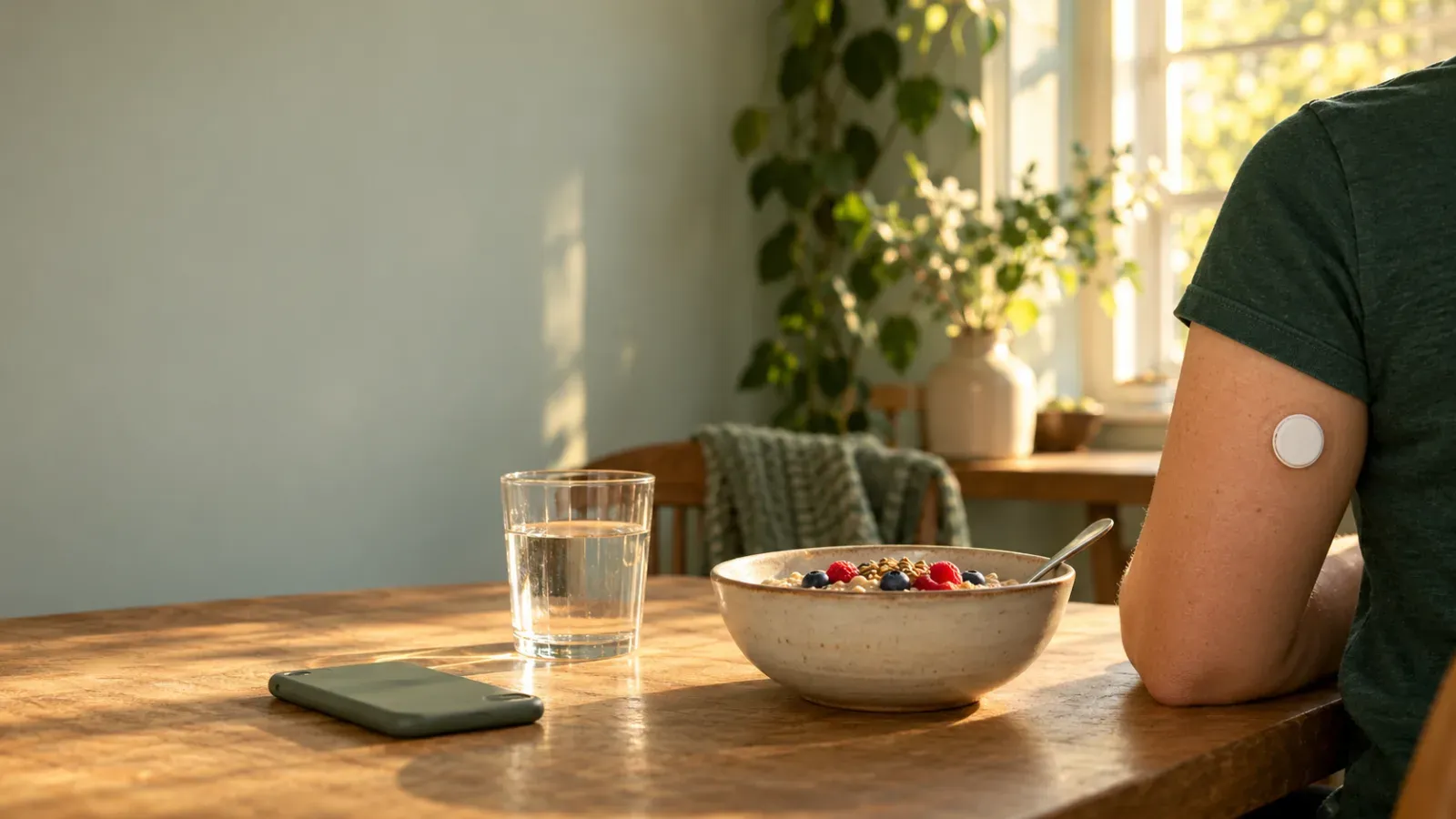
On August 3, 2026, researchers from Yale, the University of Gothenburg, and Mayo Clinic published a review online in JAMA Internal Medicine with a blunt message for the wellness market: there is no scientific evidence that continuous glucose monitors improve health or prevent disease in people without diabetes. Seven weeks later, the first independent accuracy test of over-the-counter sensors in people without diabetes found that they track trends reasonably well but miss exact values, especially after sugar.
Since March 2024, anyone in the US aged 18 or older who doesn't use insulin can buy a CGM without a prescription. The sensors are marketed for "metabolic health," weight loss, and spotting "spikes." This guide explains what the new review found, what normal glucose looks like on a sensor, how accurate the readings are, whether wearing one changes anything, how a CGM compares with a simple lab test, how to read the numbers you see, and who should talk to a doctor first.
What's New: The 2026 Review of CGMs for People Without Diabetes
A 2026 JAMA Internal Medicine review found CGMs lower A1C by about 0.3 points in type 2 diabetes but found no evidence of health benefit in people without diabetes. A September 2026 test put over-the-counter sensors' average error at 12.9%.
The review. Jacob Dower and Kasia Lipska of Yale School of Medicine, Minna Johansson of the University of Gothenburg, Victor Montori of Mayo Clinic, and a community-health physician pulled together the systematic reviews, meta-analyses of randomized trials, and clinical guidelines on CGM use beyond type 1 diabetes. It appeared in JAMA Internal Medicine, in print in the September 1, 2026 issue. In adults with type 2 diabetes, CGM use lowered hemoglobin A1C, the three-month blood sugar average written HbA1c, by about 0.3 percentage points compared with finger-stick testing or usual care. For prediabetes and obesity, the authors found "only limited and indirect evidence." For people without diabetes, the press release put it more plainly: no evidence of better health or prevented disease.
What the authors say and don't say. The review does not call CGMs useless. It calls them valuable for specific patients, such as people on insulin or at high risk of low blood sugar, and asks that they be used "in response to a specific patient problem rather than as a default intervention." It also flags a harm that is easy to miss: normal ups and downs can be misread, leading to needless food restriction or anxiety. What it does not show is that CGMs harm healthy people. The point is that benefit has not been demonstrated.
Continuous glucose monitors generate enormous amounts of data that are difficult to interpret.
The accuracy test. On September 20, 2026, Neha Prakash, Garrett Ash, and colleagues at Yale and the University of South Florida published what they described as the first independent evaluation of over-the-counter CGMs, in the Journal of Diabetes Science and Technology. They tested 39 young adults without diabetes at rest and during exercise, after a sugary drink or a placebo drink, and compared each sensor reading with a finger-stick meter. Section 3 has the numbers.
How the evidence stacked up
- 2019 · Reference study, 153 people
Healthy volunteers spent a median 96% of the day between 70 and 140 mg/dL.
- 2024 · FDA clearance
The first over-the-counter CGM is cleared in March; a second follows in June.
- 2024 · Inpatient feeding study, 30 people
The same meal, a week apart, gave poorly matching glucose responses.
- 2026 · Meta-analysis, 23 studies
Glucose improved in prediabetes; no clear benefit in healthy people.
- 2026 · JAMA Internal Medicine review
No evidence that CGMs improve health in people without diabetes.
- 2026 · Independent accuracy test, 39 people
Over-the-counter sensors averaged 12.9% error against finger sticks.
What Normal Glucose Looks Like on a CGM
In 153 healthy people, average sensor glucose was 98–99 mg/dL, and they spent a median 30 minutes a day above 140 and 15 minutes below 70. Short excursions are normal.
The best yardstick comes from a 2019 study led by Viral Shah of the Barbara Davis Center for Diabetes, published in the Journal of Clinical Endocrinology & Metabolism. At 12 US centers, 153 healthy, non-obese volunteers aged 7 to 80 wore a blinded Dexcom G6 sensor for up to 10 days. They couldn't see their numbers, so they ate and lived as usual. Glucose is given here in mg/dL, the US unit; divide by 18 to get mmol/L.
The finding. Average glucose was 98 to 99 mg/dL (5.4 to 5.5 mmol/L) in every age group except people 60 and older, whose average was 104 mg/dL (5.8 mmol/L). The middle volunteer spent 96% of the day between 70 and 140 mg/dL. They also spent a median 2.1% of the day above 140, about 30 minutes, and 1.1% below 70, about 15 minutes. Glucose varied by an average of 17% around each person's own mean.
Why this matters. A healthy body is not flat. A reading of 150 after lunch, or a brief dip under 70 at night, sits inside what healthy volunteers showed. An app that flags every rise above 140 as a "spike" is flagging something healthy people do every day.
The "estimated A1C" problem. Many apps convert your sensor average into a glucose management indicator, or GMI, shown as an estimated A1C. In a follow-up analysis of the same 153 volunteers, published in Diabetes Technology & Therapeutics in 2023, GMI came out 0.59 points higher than the lab A1C on average, and missed it by 0.4 points or more in 71% of people.
That matters because 5.7% is where prediabetes starts. A healthy person with a lab A1C of 5.2% could see an estimate near 5.8% and wrongly believe they have prediabetes. The study authors concluded that GMI "does not accurately estimate HbA1c in healthy people without diabetes."
How Accurate Are Over-the-Counter CGMs?
Good at trends, weak at exact numbers. In people without diabetes, over-the-counter sensors were off by 12.9% on average, 15.3% after a sugary drink, and lagged blood by about 6 minutes.
A CGM doesn't measure blood. A thin filament under the skin reads glucose in the interstitial fluid, the fluid around your cells, and an algorithm turns that into a number on your phone. Glucose reaches that fluid a few minutes after it rises in the blood, so the reading trails behind when levels change fast, for example right after a meal.
The filament produces a signal that rises and falls with glucose in the fluid. In the 2026 test, the delay behind finger-stick glucose was 6.2 minutes.
An algorithm converts the signal into mg/dL, draws a curve, adds trend arrows and, often, an estimated A1C. Every one of those steps adds some error.
To put that in context. A 12.9% average error means that when your true glucose is 140 mg/dL, a typical reading could land around 122 or 158. Only two in three readings fell within 15% (or 15 mg/dL) of the meter. Errors grew when glucose was changing fast, which is exactly when people look at their phones after a meal. Among the trend arrows, 13.8% pointed in a direction rated moderate to extreme risk.
Sensors may also read high. In a 2025 crossover trial at the University of Bath, 15 healthy adults drank fruit smoothies and other test drinks on seven visits. The CGM read about 0.9 mmol/L (16 mg/dL) higher than finger-prick samples, fasting and after drinks, and overstated the time spent above 140 mg/dL about fourfold. The size of the error varied from person to person.
The evidence has limits. The 2026 test was small, in young adults, and its abstract doesn't name the brands. Finger-stick meters have their own error too. The authors' conclusion is still useful: over-the-counter sensors "may aid lifestyle monitoring" but call for caution with "threshold-based decisions such as hypoglycemia detection or self-screening for diabetes."
Does Wearing a CGM Improve Your Health If You Don't Have Diabetes?
A 2026 meta-analysis of 23 studies found lower average glucose with CGM, driven by people with prediabetes, and no clear change in BMI. In healthy people with normal glucose, there was no appreciable benefit.
The strongest pooled data come from a systematic review and meta-analysis by Xiaoyan Liao and colleagues, published in the European Journal of Medical Research on January 26, 2026. It included 23 studies with 1,074 people without diabetes from 11 countries; only seven were randomized trials. Most used the sensor alongside diet or exercise coaching.
The finding. CGM users ended up with lower average glucose than controls, a moderate effect on a standardized scale. Body mass index didn't change significantly. The authors noted that the glucose benefit showed up in people with prediabetes, while "no appreciable glycemic benefit was observed in healthy normoglycemic populations." They concluded that a CGM is "unlikely to achieve weight management goals independently" and works best inside a structured lifestyle program.
An older contrary-looking result. A 2024 meta-analysis of 25 randomized trials, led by Kelli Richardson and published in the International Journal of Behavioral Nutrition and Physical Activity, found a small A1C drop of 0.28 percentage points with CGM feedback across people with and without diabetes. But only three of the 25 trials included people without diabetes, all with overweight or obesity, too few to analyze on their own. Weight fell by 0.7 kg, a result that wasn't statistically significant.
Same meal, different spike. The promise of a CGM is personal food advice: learn which foods "spike" you and avoid them. A study from Kevin Hall's lab at the US National Institutes of Health tested that idea. Thirty adults without diabetes lived on a research ward and ate the same meals twice, about a week apart, while wearing two different sensors.
Both scores mean low reliability. A person's response to the same meal varied about as much as their responses to different meals. The authors, writing in the American Journal of Clinical Nutrition in December 2024, concluded that diet advice based on CGM readings "requires more reliable methods involving aggregated repeated measurements." In plain terms: one test meal tells you little about that food.
CGM vs Lab Test vs Finger-Stick Meter: Comparison Table
| Criterion | Lab A1C or fasting glucose | CGM, one 2-week sensor | CGM, worn all year | Finger-stick meter |
|---|---|---|---|---|
| What it tells you | Whether you have prediabetes or diabetes | How your glucose moves through ordinary days | The same curves, every day | One blood value at one moment |
| Can it diagnose? | Yes: A1C 5.7–6.4% or fasting 100–125 mg/dL means prediabetes | No, not intended for diagnosis | No, not intended for diagnosis | No, but useful to check a sensor reading |
| Accuracy | The clinical reference | 12.9% average error; worse after sugar | 12.9% average error; worse after sugar | The reference used in sensor tests |
| Evidence of benefit without diabetes | Screening recommended at 35–70 with overweight | Some benefit in prediabetes; none shown in healthy people | None shown | None shown for routine use |
| Main downsides | A blood draw | Skin irritation; normal rises can look alarming | Cost; risk of food anxiety; data hard to interpret | Finger pricks; snapshots only |
| Our verdict | Start here | Optional experiment with a question | Not worth it for most | Only to double-check a worrying reading |
If you don't have diabetes, a lab A1C test is our default. A CGM is worth it only as a short experiment with a clear question.
The question most people really have is "am I heading toward diabetes?" A lab A1C or fasting glucose test answers it; a sensor can't. If you have prediabetes and want to see how meals and walks move your numbers, one two-week sensor, ideally with a clinician or a structured program, is a reasonable experiment. Wearing one all year as a healthy person buys data with no proven payoff, and the 2026 review warns it can feed food anxiety.
Decode Your CGM Reading
Already wearing a sensor? Pick the pattern closest to what your app shows. The gauge places it against the range healthy volunteers lived in, and the note says what, if anything, to do. These are rough guides, not a diagnosis.

Healthy volunteers averaged 98–99 mg/dL across the whole day. A lab fasting glucose of 99 or lower is normal. Nothing to change.
Healthy people spent a median 30 minutes a day above 140. Sensors also tend to overstate post-meal peaks, and errors are largest after sugar. Don't drop a food because of one peak.
Healthy volunteers spent a median 15 minutes a day below 70, and over-the-counter sensors aren't designed to detect low blood sugar. If you wake shaky, sweaty, or confused, check with a finger-stick meter and see a doctor.
On a lab test, fasting glucose of 100–125 means prediabetes. Sensors can read about 16 mg/dL high, so this isn't a diagnosis. Ask your doctor for an A1C or fasting glucose test.
This is outside what healthy volunteers showed. A blood glucose of 200 or more with symptoms such as thirst and frequent urination meets the definition of diabetes. Get tested promptly rather than relying on the sensor.
| Lab test | Normal | Prediabetes | Diabetes |
|---|---|---|---|
| A1C | Under 5.7% | 5.7–6.4% | 6.5% or higher |
| Fasting glucose | 99 mg/dL or lower | 100–125 mg/dL | 126 mg/dL or higher |
| 2-hour glucose test | 139 mg/dL or lower | 140–199 mg/dL | 200 mg/dL or higher |
CGM for Non-Diabetics: Is It Right for You?
Healthy adult who wants to "optimize" their metabolism.
You don't need one. If you're curious, wear a single sensor for two weeks with one question in mind, such as "does a 15-minute walk after dinner change my evening curve?" Then stop. Ignore the estimated A1C. If anything on the sensor worries you, ask your doctor for a lab test instead of buying more sensors.
See which wearables have the strongest evidence.Your lab A1C or fasting glucose showed prediabetes.
This is the group where the 2026 meta-analysis saw lower average glucose with CGM, mostly alongside diet and exercise coaching. A two-week sensor can show how meals, walks, and sleep move your numbers. Agree on a plan with your doctor or a diabetes prevention program, and keep your follow-up lab tests: they, not the app, tell you whether things are improving.
Aged 35 to 70, with overweight, and never had a glucose test.
The US Preventive Services Task Force recommends screening you for prediabetes and type 2 diabetes with an A1C, fasting glucose, or glucose tolerance test. Start there: a lab test can actually diagnose, and a sensor can't. For Asian American adults, the Task Force says to consider screening at a BMI of 23 or higher. More than 2 in 5 US adults have prediabetes, and 8 in 10 of them don't know it.
You hope a CGM will help you lose weight.
The trials don't support buying one for that. BMI didn't change significantly in the 2026 meta-analysis, and weight fell by 0.7 kg in the 2024 trials, a result that wasn't statistically significant. The authors say a sensor works, if at all, as part of a structured program. Spend the money on a program you'll stick with.
Stuck on a plateau? Here's what usually explains it.You've had an eating disorder, or you tend to worry about food.
Be cautious. The 2026 review warns that normal glucose swings can lead to unnecessary food restriction and anxiety, and one manufacturer's own label tells people with a history of eating disorders to consult a health professional first. Talk to your doctor or therapist before trying a sensor.
You use insulin, have diabetes, or are pregnant.
Over-the-counter sensors are not cleared for people who use insulin and aren't designed to warn about dangerous lows. If you have diabetes, a prescription CGM may be right for you; ask your diabetes care team. In pregnancy, glucose testing is part of prenatal care, so follow your obstetric provider's plan. Don't change any prescribed treatment based on a wellness sensor.
Practical Tips If You Try a CGM
Get a lab test first.
An A1C or fasting glucose test tells you whether you have prediabetes. A sensor can't, and its makers say so.
Wear it with one question.
Two weeks is one sensor. Decide in advance what you want to learn, such as how a walk after dinner or a late meal changes your curve.
Judge patterns, not single peaks.
The same meal eaten a week apart gave poorly matching responses. Repeat a test several times before drawing a conclusion about a food.
Ignore the estimated A1C.
In healthy people it ran 0.59 points above the lab value on average. Only a lab A1C counts.
Try a walk after meals.
A 2026 meta-analysis of 23 exercise studies in people without diabetes found exercise trimmed peak glucose by about 11 mg/dL (0.63 mmol/L). The effect was small, but it's an experiment worth running. Our guide to the afternoon slump has more ideas.
Confirm worrying numbers in blood.
The FDA says not to make medical decisions from the sensor without your healthcare provider. A finger-stick meter or a lab test settles it.
Stop if it makes you anxious about food.
Cutting out fruit or whole grains because of a normal rise does more harm than the rise. Take the sensor off.
Common Misconceptions About CGMs for Non-Diabetics
Any spike above 140 is unhealthy.
True or not? Tap to find outHere’s what the evidence says
Not true. Healthy volunteers spent a median 30 minutes a day above 140 mg/dL. Brief rises after meals are part of normal metabolism.
A CGM can tell me if I have prediabetes.
True or not? Tap to find outHere’s what the evidence says
It can't. Over-the-counter sensors are not intended for diagnosis, and their estimated A1C ran 0.59 points high in healthy people. Prediabetes is diagnosed with a lab A1C, fasting glucose, or glucose tolerance test.
If the app says a food spikes me, I should cut it.
True or not? Tap to find outHere’s what the evidence says
Not on one test. In an NIH feeding study, the same meal eaten a week apart gave poorly matching glucose responses. One reading says little about a food.
Wearing a CGM will help me lose weight.
True or not? Tap to find outHere’s what the evidence says
The trials don't show it. BMI didn't change significantly in the 2026 meta-analysis, and its authors say a sensor is unlikely to help with weight on its own.
The number on my phone is my blood sugar.
True or not? Tap to find outHere’s what the evidence says
It's an estimate from the fluid under your skin, about 6 minutes behind blood, with a 12.9% average error in people without diabetes. In one trial it read about 16 mg/dL high.
When to See a Doctor
A sensor reading is never a reason to panic, but some signs need a real test. See a clinician if you have:
- Symptoms of high blood sugar, such as heavy thirst, frequent urination, blurred vision, fatigue, sores that don't heal, or unexplained weight loss, whatever your sensor shows.
- Sensor readings often above 200 mg/dL, or most mornings above 100. Ask for a lab A1C or fasting glucose test.
- Symptoms of low blood sugar, such as shakiness, sweating, a racing heart, confusion, or nightmares and damp sheets at night.
- Redness, pain, or signs of infection where the sensor was attached.
- Anxiety about food, skipping meals, or cutting out whole food groups because of your readings.
- Diabetes, insulin use, or pregnancy. Talk to your care team about prescription monitoring instead of a wellness sensor, and don't change prescribed treatment based on it.