Can a Smartwatch or Smart Ring Track Blood Pressure? The 2026 Guide
No smartwatch or smart ring replaces a validated upper-arm cuff in 2026. Apple's FDA-cleared Hypertension Notifications only flags possible hypertension (41.2% sensitivity), while Samsung, Whoop, Google and Oura features are uncleared wellness tools. Confirm any wearable alert with a week of correct cuff readings.
Can a Smartwatch or Smart Ring Track Blood Pressure? The 2026 Guide
By the HealthPerk Editorial Team · Last updated: October 2026
Quick Answer
Can my smartwatch or smart ring measure my blood pressure accurately?
Not reliably enough for diagnosis. Some watches flag patterns of possible high blood pressure or estimate trends, but no smartwatch or ring replaces a validated upper-arm cuff. Confirm anything they show with a cuff.
| Your situation | First step |
|---|---|
| Your watch sent a "possible hypertension" notification | Take cuff readings twice a day for 7 days, then share the log with a clinician |
| Your ring or band shows a "rising" or red blood pressure trend | Check with a validated upper-arm cuff before you change anything |
| You already take blood pressure medication | Use a validated cuff only; don't adjust doses from wearable data |
| A single reading is above 180/120 mmHg | Wait one minute and measure again with a cuff; call 911 if it's still that high and you have symptoms |
| You want to start monitoring at home | Buy an upper-arm cuff from the validatebp.org list and learn the correct technique |
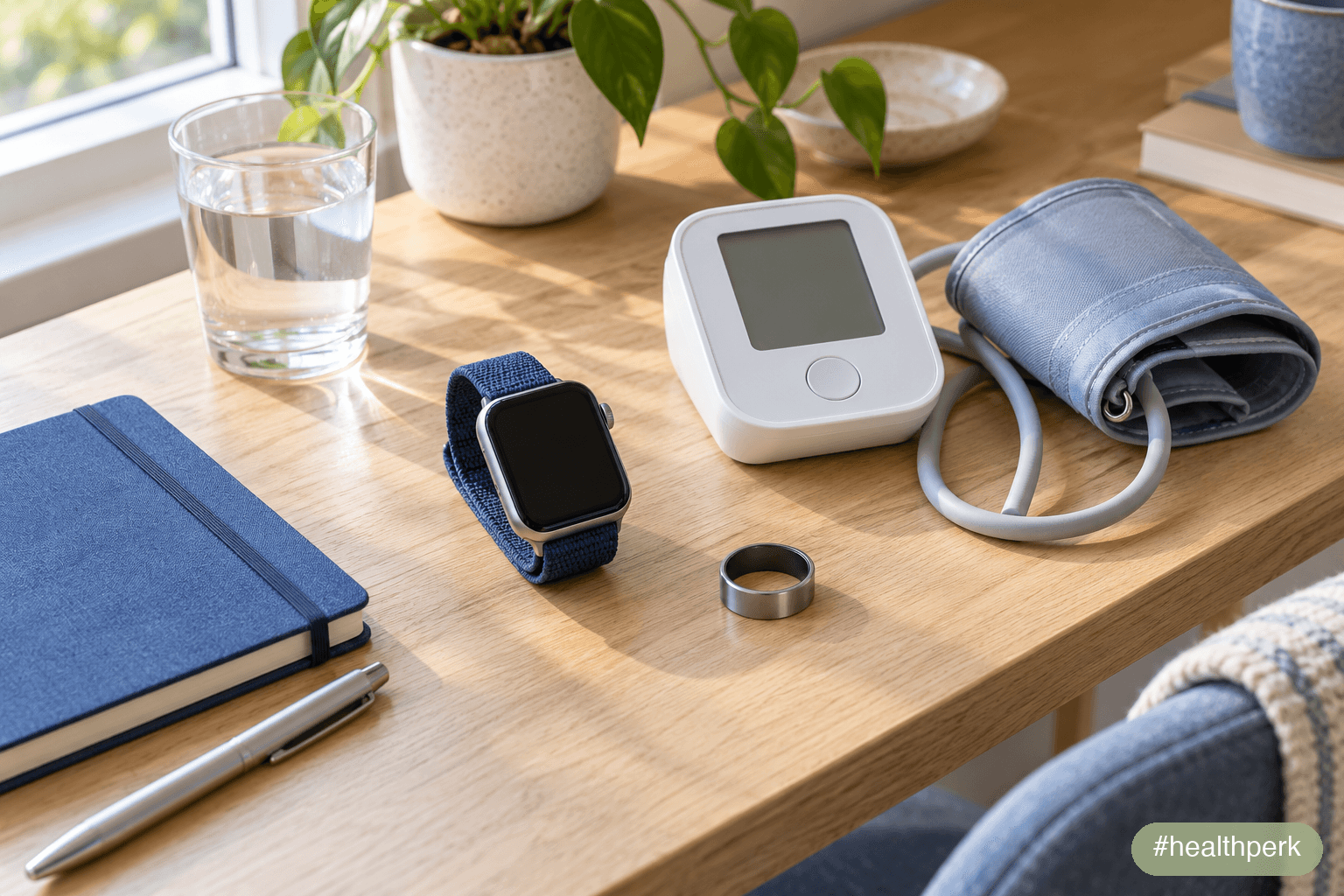
Wrist and finger wearables can flag blood pressure patterns, but an upper-arm cuff is still how you get a number you can act on.
Blood pressure tracking was the headline health feature of autumn 2026. Apple released the Apple Watch Series 12 on September 9 with a redesigned sensor array. Google began rolling out Blood Pressure Trends to Pixel Watch owners in late September. Samsung, Whoop, and Oura also sell blood pressure features. None of them has replaced the cuff, and the differences between these features matter more than the brand names.
Some features hold FDA clearance as medical devices. Others are sold as "general wellness" products under a looser FDA policy that took effect in January 2026. Some features give you numbers. Others only tell you that something looks off. And none of them is recommended for diagnosing or managing hypertension under the 2025 American Heart Association and American College of Cardiology guideline [1][2]. Here is what each device actually does, what is cleared, and how to get a home reading you can trust.
Table of Contents
- What's New in Autumn 2026
- How Wearables Estimate Blood Pressure (and Why Cuffs Still Win)
- Device by Device: What Each Feature Actually Does
- Comparison Table: Wearable Blood Pressure Features in 2026
- Which Blood Pressure Option Is Right for You?
- How to Measure Blood Pressure Correctly at Home
- What Your Numbers Mean: 2025 AHA/ACC Categories
- Common Misconceptions About Wearable Blood Pressure
- When to See a Doctor
- Related Articles on Health Perk
- Frequently Asked Questions
- References
What's New in Autumn 2026
Apple Watch Series 12 (announced September 9, 2026). Apple introduced the Series 12 and Ultra 4 with what it calls a new Health Sensing System. The redesigned optical sensor uses larger green LEDs that can measure heart rate every five seconds throughout the day [8]. Apple's launch release doesn't mention blood pressure. The blood pressure feature on Apple Watch is still Hypertension Notifications, which launched in September 2025 for Series 9 and later and Ultra 2 and later [7].
There is a catch for upgraders. On September 10, MacRumors reported that Apple's watchOS feature-availability page warns that hypertension notifications "may not be available" on Series 12 and Ultra 4 at launch in 33 countries and regions, including Canada, Australia, India, Brazil, and Japan. Apple's stated reason is that "additional regulatory clearances for these devices are in process" [9]. According to the same report, the US, UK, and EU are not on that list.
Google Pixel Watch: Blood Pressure Trends (rolling out from late September 2026). Google announced Blood Pressure Trends alongside the Pixel Watch 5, which began shipping on August 20, 2026. The feature started reaching Pixel Watch 3, 4, and 5 owners in the last week of September [10][11]. It uses no cuff and no calibration. The watch passively analyzes pulse waveform shape and speed over a month, and on the first of each month it delivers one summary insight. Google states that the feature is for general wellness only, "is not a prescreener for hypertension," and should not guide medication or treatment decisions [10]. Google's page doesn't mention FDA clearance.
The regulatory backdrop: a looser FDA wellness policy. On January 6, 2026, the FDA revised its General Wellness: Policy for Low Risk Devices guidance [5]. Low-risk, non-invasive wearables that estimate blood pressure can now be sold as wellness products under FDA enforcement discretion, but only if they meet all of the policy's conditions: no claims to diagnose or manage hypertension, not intended to replace an authorized medical device, and validated values whenever they show numbers that look like clinical measurements. On January 23, 2026, the agency also published draft guidance on how cuffless blood pressure devices that are medical devices should be clinically tested [6]. Two developments followed from this. In June 2026 the FDA closed its July 2025 warning letter to Whoop over the Blood Pressure Insights feature, after Whoop changed the feature's labeling and design [12]. And Oura launched a wellness feature called Blood Pressure Signals with Oura Ring 5 in May 2026 [13].
What this means in practice: a cleared feature and a wellness feature can look alike on your wrist, but only the cleared one had to show the FDA clinical performance data for a specific intended use.
How Wearables Estimate Blood Pressure (and Why Cuffs Still Win)
How a cuff measures
A home upper-arm monitor uses the oscillometric method. The cuff inflates until it stops blood flow in the brachial artery, then slowly deflates. As blood starts flowing again, the artery wall creates small pressure oscillations in the cuff. The monitor's algorithm turns those oscillations into systolic and diastolic values. The cuff applies a known pressure to an artery, so the result is anchored to physical pressure. That's why clinically validated cuffs reach the accuracy limits in ISO 81060-2 (an average error within ±5 mmHg, with a standard deviation of no more than 8 mmHg).
How a watch or ring estimates
Wearables mostly use photoplethysmography (PPG): green or infrared LEDs shine into the skin and a photodiode measures how much light the blood volume under the sensor absorbs from beat to beat. This produces a pulse waveform. Blood pressure is then inferred from features of that wave:
- Pulse wave shape (pulse wave analysis). Stiffer, higher-pressure arteries change the waveform's upstroke, reflected waves, and decay.
- Pulse transit or arrival time. A pulse wave travels faster through arteries under higher pressure. Some devices time it between the heart's electrical signal (ECG) and the pulse at the wrist.
- Machine learning. Large models match waveform features against reference blood pressure collected in research studies.
The AHA's scientific statement on cuffless devices, published in Hypertension, explains the limitation. Most cuffless outputs show change relative to a calibration point, not a direct pressure measurement. Most devices need regular recalibration against a cuff. Motion, sensor position, posture, and wrist height relative to the heart all shift the signal, and most validation happens in calm, seated lab conditions right after calibration [2]. The statement and the 2025 guideline both recommend against using cuffless devices to diagnose or manage hypertension until they show better accuracy and reliability [1][2].
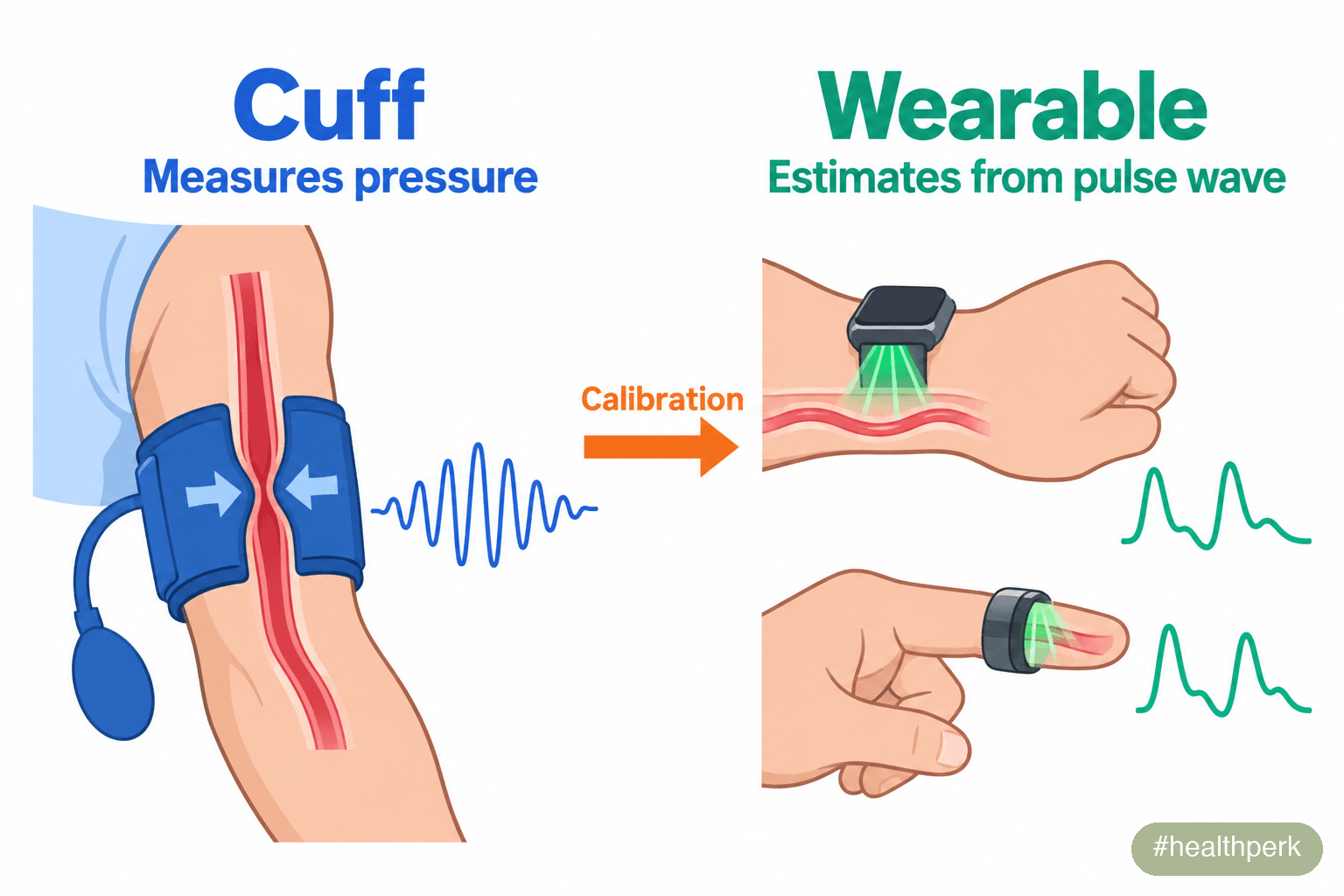
A cuff measures pressure directly at the artery. A watch or ring infers it from the shape and timing of the pulse wave.
The evidence is mixed. A 2025 systematic review and meta-analysis in the American Journal of Preventive Cardiology compared wearable cuffless devices with standard 24-hour ambulatory monitoring. It found reasonable agreement for daytime averages and notable discrepancies at night [16].
Device by Device: What Each Feature Actually Does
Apple Watch: Hypertension Notifications (FDA-cleared, notifications only)
- Regulatory status: FDA 510(k) clearance K250507, decision date September 11, 2025. It is classified as machine-learning notification software for over-the-counter use [3].
- What it does: It analyzes PPG data collected opportunistically from the optical heart sensor over 30-day windows. If it sees patterns suggestive of hypertension, it sends a notification. It never shows a blood pressure number [3][7].
- Who can use it: Adults 22 and older who are not pregnant and have not been diagnosed with hypertension. Requires Series 9 or later or Ultra 2 or later; Apple Watch SE isn't supported [7].
- Performance in the FDA submission: In 1,863 participants with usable data, measured against an FDA-cleared home cuff, sensitivity was 41.2% and specificity was 92.3%. Sensitivity for stage 2 hypertension was 53.7% [3]. In practical terms, most people with hypertension in the study did not get a notification, while about 1 in 13 people without hypertension did.
- What to do after a notification: Apple says to log cuff readings for 7 days and discuss them with a clinician [7]. No notification doesn't mean your blood pressure is normal. The FDA-cleared labeling says so directly [3].
Google Pixel Watch 3/4/5: Blood Pressure Trends (wellness)
No cuff, no calibration, and one monthly trend insight instead of daily readings. Google says it was validated against 24-hour ambulatory monitoring but explicitly calls it a wellness feature, not a hypertension prescreener or a replacement for a blood pressure monitor [10].
Samsung Galaxy Watch: Blood Pressure (wellness, cuff-calibrated readings)
- US availability: Since March 31, 2026, via the Samsung Health Monitor app, on Galaxy Watch4 and later. It requires a Samsung Galaxy phone running Android 12 or later [15].
- How it works: The watch estimates systolic and diastolic pressure with pulse wave analysis. You must calibrate it with an upper-arm cuff every 28 days [15].
- Regulatory status: Samsung's US announcement says the feature "is not intended to prevent or diagnose high blood pressure." The release lists FDA authorization only for the watch's ECG, irregular rhythm, and sleep apnea features, not for blood pressure [15]. Samsung has said passive trend monitoring is coming later in 2026.
Whoop: Blood Pressure Insights (wellness, cuff-calibrated estimates)
Whoop gives daily systolic and diastolic estimates based on heart rate and blood flow patterns during sleep, after calibration with a standard cuff. In July 2025 the FDA sent Whoop a warning letter saying the feature was an unauthorized medical device. In June 2026, after the wellness policy changed, the FDA closed the letter. Whoop had removed the color boundaries that suggested clinical categories, and the agency said it doesn't intend to enforce device requirements against the modified feature [12]. The feature is not FDA-cleared. The FDA declined to enforce requirements against it, which is a different thing.
Oura Ring 5: Blood Pressure Signals (wellness, patterns only)
Oura introduced Blood Pressure Signals with Ring 5 in May 2026 as part of Health Radar. It includes a nighttime blood pressure view that looks for the normal overnight drop ("dipping") and flags when it doesn't happen consistently [13]. No FDA clearance has been announced. Separately, in October 2025 Oura said it would seek FDA clearance for a hypertension-risk feature and was running a US study to support it [20]. As of mid-October 2026, we found no public FDA decision on that feature. Our Oura Ring 5 review covers the ring's other sensors.
Hilo (Aktiia) band: FDA-cleared cuffless monitor (cuff-calibrated)
This is the only device in this guide cleared by the FDA as a blood pressure monitor that works without a cuff during use. FDA clearance K250415 (July 2, 2025) covers the G0 Blood Pressure Monitoring System for spot-checking at home in adults aged 22–59 with wrist circumference of 14–21 cm, after a calibration process every 24 hours using the supplied oscillometric cuff [4]. A consumer version, Hilo Core, launched in the US in July 2026. The AHA notes that FDA clearance doesn't guarantee real-world accuracy [2].
Garmin Index BPM and other connected cuffs (FDA-cleared cuffs)
Garmin's Index BPM is an upper-arm cuff that Garmin announced in 2022 as FDA-cleared. It fits arms from 22 to 42 cm and syncs readings to Garmin Connect, where you can export reports for your clinician [19]. Garmin watches themselves don't estimate blood pressure. For any cuff, connected or not, check whether the model appears on the AMA's US Blood Pressure Validated Device Listing at validatebp.org [17].
Comparison Table: Wearable Blood Pressure Features in 2026
| Option | What you get | Cuff needed? | FDA status (Oct 2026) | OK to diagnose or adjust meds? |
|---|---|---|---|---|
| Validated upper-arm cuff (e.g., VDL-listed; Garmin Index BPM) | Actual systolic/diastolic readings | It is the cuff | Cleared as BP monitors | Yes, the guideline standard for home use |
| Hilo band (Aktiia G0) | Systolic/diastolic spot checks | Yes, calibration every 24 h in cleared indication | 510(k) cleared, OTC, ages 22–59 | Discuss with your clinician; not endorsed by the AHA for diagnosis |
| Apple Watch Hypertension Notifications | Alert after 30-day analysis, no numbers | No | 510(k) cleared, notification only | No; confirm with a cuff |
| Samsung Galaxy Watch BP | Systolic/diastolic estimates | Yes, every 28 days | Wellness, not cleared | No |
| Whoop Blood Pressure Insights | Daily systolic/diastolic estimates | Yes, at setup | Wellness; warning letter closed June 2026 | No |
| Google Pixel Watch BP Trends | Monthly trend insight | No | Wellness, not cleared | No |
| Oura Ring 5 BP Signals | Nighttime pattern flags | No | Wellness, not cleared | No |
Editorial verdict: For anyone who needs to know their blood pressure, the best device in 2026 is still a validated upper-arm cuff. A wearable is a reasonable second layer. Apple's Hypertension Notifications has the strongest regulatory footing among smartwatch features because it is FDA-cleared for its specific job. That job is a notification, it misses more than half of people with hypertension, and staying quiet tells you nothing. Calibrated estimates from Samsung and Whoop can help you notice day-to-day changes, but they depend on the cuff you calibrate them with. If you buy one device for blood pressure, make it the cuff. See how we review for our methodology.
Which Blood Pressure Option Is Right for You?
You've never checked your blood pressure at home and you feel fine. Start with a validated upper-arm cuff. High blood pressure usually causes no symptoms. One week of correct readings tells you more than months of wearable trends. If you already wear an Apple Watch Series 9 or later, turning on Hypertension Notifications costs nothing. Just don't treat silence as a clean result.
You have diagnosed hypertension or take blood pressure medication. Use a validated cuff only, and follow your clinician's plan. Apple's feature is not intended for people with a diagnosis [7], and none of the wellness features should guide doses [10][15].
You're a data-driven athlete or biohacker. A calibrated estimate from Whoop or Samsung can show how sleep, alcohol, and training load relate to your numbers. Calibrate carefully with a validated cuff and recheck any surprising result with the cuff. Pair it with resting heart rate and HRV trends; our guide to devices that track heart rate covers which sensors are most reliable.
You're pregnant. Don't rely on any of these wearable features. Apple and Google both exclude pregnancy [7][10]. Blood pressure in pregnancy needs cuff measurements and prenatal care.
You're buying a new watch or ring partly for blood pressure. Compare what each feature actually outputs, not the marketing name. See our fitness tracker vs smartwatch comparison for the rest of the feature set. If you live outside the US, UK, or EU and want Apple's notifications, check Apple's feature-availability page before upgrading to a Series 12 or Ultra 4 [9].
How to Measure Blood Pressure Correctly at Home
Even a validated cuff gives wrong numbers if you measure the wrong way. Two randomized crossover trials show how big these errors can be:
- Cuff size. In the Cuff(SZ) trial, people who needed a large cuff but were measured with a regular one read about 4.8 mmHg higher systolic. People who needed an extra-large cuff read about 19.5 mmHg higher [14].
- Arm position. In the ARMS trial, resting the arm on the lap overestimated systolic pressure by 3.9 mmHg. Letting it hang unsupported at the side overestimated it by 6.5 mmHg, compared with resting it on a desk [18].

Correct posture matters: back supported, feet flat, arm resting on a table with the cuff at heart level.
The AHA home-measurement routine [21]:
- Pick the right device. Choose an automatic upper-arm cuff listed on validatebp.org [17]. Measure your mid-upper-arm circumference and buy the cuff size that fits it.
- Prepare for 30 minutes. No caffeine, exercise, or smoking in the half hour before measuring. Empty your bladder.
- Sit and rest for 5 minutes. Back supported, feet flat on the floor, legs uncrossed, no talking or scrolling.
- Position the cuff. Put it on bare skin just above the bend of the elbow, with the middle of the cuff at heart level and your arm resting on a table.
- Take two readings one minute apart, ideally in the morning before medication and in the evening. Record both.
- Collect a week of readings before drawing conclusions, especially after a wearable alert. Apple recommends this 7-day log too [7].
If you also wear a calibrated watch or band, calibrate it right after a correct cuff session like this one. The estimate can't be more accurate than the cuff reading it's calibrated against.
What Your Numbers Mean: 2025 AHA/ACC Categories
The 2025 AHA/ACC guideline kept the adult categories from 2017. It recommends a treatment goal below 130/80 mmHg for most adults and encourages home monitoring with validated devices [1]:
| Category | Systolic (top) | Diastolic (bottom) | |
|---|---|---|---|
| Normal | Under 120 | and | Under 80 |
| Elevated | 120–129 | and | Under 80 |
| Stage 1 hypertension | 130–139 | or | 80–89 |
| Stage 2 hypertension | 140 or higher | or | 90 or higher |
| Severe/crisis range | Above 180 | and/or | Above 120 |
If your two numbers fall into different categories, the higher category applies. Diagnosis is based on the average of several readings on separate days, never on one reading, and never on a wearable estimate [1][2].
Common Misconceptions About Wearable Blood Pressure
"FDA-cleared means it measures my blood pressure." Apple's cleared feature measures no blood pressure at all. It is a notification algorithm [3]. Clearance applies to one specific intended use.
"No alert means my blood pressure is fine." Apple's FDA labeling says that the absence of a notification doesn't mean you don't have hypertension, and sensitivity in the pivotal study was 41.2% [3].
"Wellness features are basically the same as cleared ones." Since January 2026, qualifying wellness blood pressure features can launch without FDA clearance if they avoid disease claims and meet the policy's other conditions [5]. That says nothing about how accurate they are. It only means the FDA didn't evaluate them.
"Once calibrated, the watch is as good as the cuff." Calibration drifts as your blood pressure, medications, and arteries change. That's why Samsung requires recalibration every 28 days and the cleared Hilo indication requires it every 24 hours [4][15].
When to See a Doctor
Make an appointment if:
- Your home cuff readings average 130/80 mmHg or higher over a week.
- You got a hypertension notification and your 7-day cuff log confirms elevated readings.
- Your readings are much higher or lower than usual while you're taking medication.
- You notice dizziness or lightheadedness when standing along with low readings.
Get emergency care (call 911) if a cuff reading is above 180/120 mmHg on a repeat measurement and you have any of the following: chest pain, shortness of breath, back pain, numbness or weakness, a change in vision, or difficulty speaking. These can be signs of organ damage or stroke. If you have no symptoms, rest and remeasure within a few minutes, and contact your clinician the same day if it stays that high. Apple's watch can't detect heart attacks or strokes, and neither can any other wearable discussed here [7].
Related Articles on Health Perk
- Best Devices to Track Heart Rate at Home in 2026
- Oura Ring 5 Review: Is It the Best Smart Ring of 2026?
- Fitness Tracker vs Smartwatch for Health: Which Should You Choose in 2026?
- Best Health Devices for Home Use in 2026: Complete Guide
- Wearable Health Devices List 2026: Sleep, Focus, Recovery & App Integration
You can also use our heart rate zones calculator to plan training around your resting heart rate.
Frequently Asked Questions
Does the Apple Watch Series 12 measure blood pressure?
No. The Apple Watch Series 12 doesn't display blood pressure readings. It supports Hypertension Notifications, an FDA-cleared feature that analyzes optical heart sensor data over 30-day periods and alerts you to patterns suggestive of hypertension. At launch, Apple said the feature may not be available on Series 12 and Ultra 4 in 33 countries and regions while additional regulatory clearances are pending. The US, UK, and EU were not on that list.
Is any smartwatch FDA-approved for blood pressure?
As of October 2026, no optical-sensor (cuffless) smartwatch is FDA-cleared to display blood pressure readings in the US. The exception is a watch-format device with a built-in inflatable wrist cuff, the Omron HeartGuide, cleared in 2018 [22]. Apple's Hypertension Notification Feature is FDA-cleared, but only to send a notification, not to measure. The Hilo (Aktiia) wrist band is an FDA-cleared cuffless monitor for adults aged 22 to 59, and it requires cuff calibration. Samsung, Whoop, Google, and Oura blood pressure features are sold as general wellness features.
How accurate are Apple's hypertension notifications?
In the study Apple submitted to the FDA, the feature identified 41.2% of participants who had hypertension and correctly stayed silent for 92.3% of those who didn't. For stage 2 hypertension, it caught 53.7%. So a notification is worth following up with a cuff, but no notification doesn't rule out high blood pressure. Regular cuff checks are still necessary.
Can a smart ring measure blood pressure?
Not as a validated measurement. Oura Ring 5's Blood Pressure Signals is a wellness feature that looks for nighttime blood pressure patterns, such as a missing overnight dip, without FDA clearance. Oura is separately pursuing FDA clearance for a hypertension-risk feature but had not announced a decision as of mid-October 2026. Confirm any ring alert with a validated upper-arm cuff.
Why does my Samsung Galaxy Watch need a cuff every 28 days?
The Galaxy Watch estimates blood pressure from pulse wave analysis, which shows relative change rather than absolute pressure. Calibrating with an upper-arm cuff gives the algorithm a reference point, and that reference drifts as your physiology changes. Samsung requires recalibration every 28 days. Each estimate can only be as accurate as the cuff reading you calibrate with, so calibrate with a validated cuff and good technique.
What blood pressure is considered high in 2026?
Under the 2025 AHA/ACC guideline, normal is below 120/80 mmHg, elevated is 120–129 systolic with diastolic below 80, stage 1 hypertension is 130–139 or 80–89, and stage 2 is 140/90 or higher. Readings above 180/120 need urgent repeat measurement, and emergency care if symptoms are present. Diagnosis uses averages of several readings, not a single value.
Medical disclaimer: This article is for general information only and is not medical advice. Smartwatch, smart ring, and band blood pressure features are not substitutes for a validated cuff or professional diagnosis. Do not start, stop, or change any medication based on wearable data. If you have chest pain, shortness of breath, weakness, vision changes, or difficulty speaking, call 911 or your local emergency number immediately. Always consult a qualified healthcare professional about your blood pressure.
References
Jones, D. W., Ferdinand, K. C., Taler, S. J., et al. (2025). 2025 AHA/ACC/AANP/AAPA/ABC/ACCP/ACPM/AGS/AMA/ASPC/NMA/PCNA/SGIM Guideline for the Prevention, Detection, Evaluation and Management of High Blood Pressure in Adults: A Report of the American College of Cardiology/American Heart Association Joint Committee on Clinical Practice Guidelines. Hypertension, 82(10), e212–e316. https://doi.org/10.1161/HYP.0000000000000249
Supports: BP categories retained from 2017, <130/80 goal, home monitoring with validated devices, cuffless devices not recommended for clinical use.
Cohen, J. B., Byfield, R. L., Hardy, S. T., Juraschek, S. P., et al. (2026). Cuffless Devices for the Measurement of Blood Pressure: A Scientific Statement From the American Heart Association. Hypertension, 83(3). https://doi.org/10.1161/HYP.0000000000000254
Supports: Cuffless devices estimate BP indirectly relative to calibration; accuracy limits; AHA recommends against cuffless devices for diagnosis or treatment.
U.S. Food and Drug Administration (2025). 510(k) Premarket Notification K250507: Hypertension Notification Feature (HTNF), Apple Inc. FDA 510(k) Database. https://www.accessdata.fda.gov/scripts/cdrh/cfdocs/cfpmn/pmn.cfm?ID=K250507
Supports: Clearance date September 11, 2025; intended use; 41.2% sensitivity, 92.3% specificity, 53.7% stage 2 sensitivity; absence of notification does not rule out hypertension.
U.S. Food and Drug Administration (2025). 510(k) Premarket Notification K250415: G0 Blood Pressure Monitoring System, Aktiia SA. FDA 510(k) Database. https://www.accessdata.fda.gov/scripts/cdrh/cfdocs/cfpmn/pmn.cfm?ID=K250415
Supports: Hilo/Aktiia cuffless monitor cleared July 2, 2025 for home spot-checks in adults 22–59 with 24-hour cuff calibration.
U.S. Food and Drug Administration (2026). General Wellness: Policy for Low Risk Devices. FDA Guidance Document. https://www.fda.gov/regulatory-information/search-fda-guidance-documents/general-wellness-policy-low-risk-devices
Supports: January 2026 revision allowing non-invasive wellness wearables that estimate blood pressure without disease claims.
U.S. Food and Drug Administration (2026). Cuffless Non-Invasive Blood Pressure Measuring Devices: Clinical Performance Testing and Evaluation (Draft Guidance). FDA Guidance Document. https://www.fda.gov/regulatory-information/search-fda-guidance-documents/cuffless-non-invasive-blood-pressure-measuring-devices-clinical-performance-testing-and-evaluation
Supports: January 23, 2026 draft guidance on clinical testing of cuffless BP medical devices.
Apple Inc. (2026). Hypertension notifications on your Apple Watch. Apple Support. https://support.apple.com/en-us/117296
Supports: Eligibility (22+, not pregnant, no diagnosis), Series 9/Ultra 2 or later, 30-day evaluation, 7-day cuff log advice, cannot detect heart attacks.
Apple Inc. (2026). Introducing Apple Watch Series 12, with the all-new Health Sensing System. Apple Newsroom. https://www.apple.com/newsroom/2026/09/introducing-apple-watch-series-12-with-the-all-new-health-sensing-system/
Supports: September 9, 2026 announcement, new optical sensor with heart rate every five seconds, watchOS 27 release September 14.
Clover, J. (2026). Upgrading to Apple Watch Series 12 Could Cost You Hypertension Notifications. MacRumors. https://www.macrumors.com/2026/09/10/apple-watch-series-12-hypertension-alerts/
Supports: Hypertension notifications may be unavailable on Series 12/Ultra 4 in 33 countries and regions pending regulatory clearances.
Google (2026). Blood Pressure. Google Health. https://healthapp.google/latest-news/blood-pressure/
Supports: Pixel Watch Blood Pressure Trends is cuffless, calibration-free, monthly insight, wellness-only, not a hypertension prescreener.
Android Headlines (2026). Blood Pressure Trends begins hitting a few Pixel Watch models this week. Android Headlines. https://www.androidheadlines.com/2026/09/blood-pressure-trends-begins-hitting-a-few-pixel-watch-models-this-week.html
Supports: Late-September 2026 rollout to Pixel Watch 3, 4 and 5; Pixel Watch 5 shipping from August 20, 2026.
MedTech Dive (2026). FDA drops Whoop warning letter over blood pressure feature. MedTech Dive. https://www.medtechdive.com/news/fda-drops-whoop-warning-letter-over-blood-pressure-feature/823652/
Supports: June 2026 FDA closeout of the July 2025 Whoop warning letter after labeling and design changes.
9to5Mac (2026). New Oura Ring 5 unveiled with dramatically smaller design, Blood Pressure Signals, more. 9to5Mac. https://9to5mac.com/2026/05/28/oura-ring-5-launched-features-price/
Supports: Oura Blood Pressure Signals and nighttime blood pressure patterns launched with Ring 5 in May 2026.
Ishigami, J., Charleston, J., Miller, E. R., et al. (2023). Effects of Cuff Size on the Accuracy of Blood Pressure Readings. JAMA Internal Medicine, 183(10), 1061–1068. https://doi.org/10.1001/jamainternmed.2023.3264
Supports: Too-small cuffs overestimate systolic BP by about 4.8 mmHg (one size) and 19.5 mmHg (two sizes).
Samsung (2026). Samsung's Blood Pressure Monitoring Feature Now Available to U.S. Users in Samsung Health. Samsung Mobile Press. https://www.samsungmobilepress.com/articles/samsung-health-blood-pressure-monitoring-us-galaxy-watch
Supports: US rollout from March 31, 2026; 28-day cuff calibration; not intended to diagnose; supported models.
Lee, I., & Chang, M. J. (2025). Comparing the accuracy of continuous blood pressure monitoring using wearable cuffless devices with conventional 24-hour ambulatory blood pressure monitoring: A systematic review and meta-analysis. American Journal of Preventive Cardiology, 24, 101342. https://doi.org/10.1016/j.ajpc.2025.101342
Supports: Cuffless devices comparable for daytime averages but with notable nighttime discrepancies.
American Medical Association (2026). US Blood Pressure Validated Device Listing. ValidateBP. https://www.validatebp.org/
Supports: Independent listing of home BP monitors validated for clinical accuracy.
Liu, H., Zhao, D., Sabit, A., Pathiravasan, C. H., et al. (2024). Arm Position and Blood Pressure Readings. JAMA Internal Medicine, 184(12), 1436. https://doi.org/10.1001/jamainternmed.2024.5213
Supports: Lap and unsupported arm positions overestimate systolic BP by 3.9 and 6.5 mmHg.
Garmin (2022). See a more complete picture of your health with Index BPM, an FDA-cleared smart blood pressure monitor from Garmin. Garmin Newsroom. https://www.garmin.com/en-US/newsroom/?p=3884
Supports: Garmin Index BPM is an FDA-cleared upper-arm cuff (22–42 cm) syncing to Garmin Connect.
MedTech Dive (2025). Ōura to pursue FDA clearance of blood pressure feature for smart ring. MedTech Dive. https://www.medtechdive.com/news/oura-fda-clearance-smart-ring-blood-pressure/803181/
Supports: Oura announced in October 2025 that it would seek FDA clearance for a hypertension-risk feature.
American Heart Association (2025). Monitoring Your Blood Pressure at Home. heart.org. https://www.heart.org/en/health-topics/high-blood-pressure/understanding-blood-pressure-readings/monitoring-your-blood-pressure-at-home
Supports: Home technique: 30 minutes without caffeine/exercise/smoking, 5 minutes rest, supported posture, cuff on bare upper arm, two readings one minute apart.
U.S. Food and Drug Administration (2018). 510(k) K182481: Omron HeartGuide wearable blood pressure monitor (HEM-6410T-ZM). FDA. https://www.accessdata.fda.gov/cdrh_docs/pdf18/K182481.pdf
Supports: A watch-format monitor with a built-in inflatable wrist cuff has been FDA-cleared since 2018.
Frequently Asked Questions
Does the Apple Watch Series 12 measure blood pressure?
No. The Apple Watch Series 12 doesn't display blood pressure readings. It supports Hypertension Notifications, an FDA-cleared feature that analyzes optical heart sensor data over 30-day periods and alerts you to patterns suggestive of hypertension. At launch, Apple said the feature may not be available on Series 12 and Ultra 4 in 33 countries and regions while additional regulatory clearances are pending. The US, UK, and EU were not on that list.
Is any smartwatch FDA-approved for blood pressure?
As of October 2026, no optical-sensor (cuffless) smartwatch is FDA-cleared to display blood pressure readings in the US. The exception is a watch-format device with a built-in inflatable wrist cuff, the Omron HeartGuide, cleared in 2018. Apple's Hypertension Notification Feature is FDA-cleared, but only to send a notification, not to measure. The Hilo (Aktiia) wrist band is an FDA-cleared cuffless monitor for adults aged 22 to 59, and it requires cuff calibration. Samsung, Whoop, Google, and Oura blood pressure features are sold as general wellness features.
How accurate are Apple's hypertension notifications?
In the study Apple submitted to the FDA, the feature identified 41.2% of participants who had hypertension and correctly stayed silent for 92.3% of those who didn't. For stage 2 hypertension, it caught 53.7%. So a notification is worth following up with a cuff, but no notification doesn't rule out high blood pressure. Regular cuff checks are still necessary.
Can a smart ring measure blood pressure?
Not as a validated measurement. Oura Ring 5's Blood Pressure Signals is a wellness feature that looks for nighttime blood pressure patterns, such as a missing overnight dip, without FDA clearance. Oura is separately pursuing FDA clearance for a hypertension-risk feature but had not announced a decision as of mid-October 2026. Confirm any ring alert with a validated upper-arm cuff.
Why does my Samsung Galaxy Watch need a cuff every 28 days?
The Galaxy Watch estimates blood pressure from pulse wave analysis, which shows relative change rather than absolute pressure. Calibrating with an upper-arm cuff gives the algorithm a reference point, and that reference drifts as your physiology changes. Samsung requires recalibration every 28 days. Each estimate can only be as accurate as the cuff reading you calibrate with, so calibrate with a validated cuff and good technique.
What blood pressure is considered high in 2026?
Under the 2025 AHA/ACC guideline, normal is below 120/80 mmHg, elevated is 120–129 systolic with diastolic below 80, stage 1 hypertension is 130–139 or 80–89, and stage 2 is 140/90 or higher. Readings above 180/120 need urgent repeat measurement, and emergency care if symptoms are present. Diagnosis uses averages of several readings, not a single value.