The Best Weightlifting Apps in 2026, and the Free Ones That Are Enough

The best weightlifting app for most people is Hevy: its free tier logs unlimited workouts, and Pro is $23.99 a year. Boostcamp is the best free way to follow a set program, Strong suits experienced lifters on Apple Watch, Caliber suits complete beginners and Fitbod writes each workout with AI for up to $95.99 a year. Garmin owners should use the watch's free strength workouts, because Hevy and other apps can't push sets into Garmin Connect.
What's the best weightlifting app?
Hevy for most people, because the free tier is enough. Pay only for what you'd otherwise skip: a written plan (Boostcamp Pro or Caliber Plus), AI planning (Fitbod) or Fitness+ Gym Strength if you already subscribe. Paid tiers run from $23.99 to $95.99 a year.
Caliber free, or a Boostcamp beginner program.
Boostcamp: the program library is free.
Hevy free, or lifetime Pro for $74.99.
Strong or Hevy; Gym Strength if you pay for Fitness+.
The watch's free strength workouts.
What's New: Apple Fitness+ Now Builds a Gym Plan
On November 3, 2026, Apple announced Gym Strength, a Fitness+ feature that builds a four-week lifting plan and adjusts it each week. It's in the 27.3 betas now, and Apple hasn't dated the public release.
The best weightlifting app question changed a little this month. On November 3, 2026, Apple announced Gym Strength for Apple Fitness+. As MacRumors reported, it builds a four-week plan from your goals, experience, schedule and equipment, gives sets, reps and a suggested load for each exercise with short trainer demo videos, and adjusts each week's sessions based on what you logged the week before. On Apple Watch you can see and log exercises, reps and load.
It needs iOS, iPadOS or watchOS 27.3, which were in beta when we checked on November 16, and Apple hasn't given a public release date. It's included in Fitness+, which costs $9.99 a month or $79.99 a year in the US, according to Apple's Fitness+ page. If you already pay for Fitness+, this is a free upgrade. If you don't, it's one more paid option, and the rest of this guide shows what you get for less.
How to read this guide. Health Perk didn't test these apps. We checked every price and free-tier limit on the App Store, Google Play or the maker's own help pages on November 16, 2026, and we attribute every hands-on verdict to the reviewer who reached it: Garage Gym Reviews, BarBend and Fortune each tested a set of lifting apps this year.
The Best Weightlifting Apps at a Glance
Hevy is the best free weightlifting app for most people. Boostcamp is best for following a program for free, Strong for experienced lifters, Caliber for beginners, Fitbod for AI plans and Fitness+ Gym Strength for Apple users already subscribed.
| Pick | Best for | Free tier | Paid, per year |
|---|---|---|---|
| Hevy | Free logging for most lifters | Unlimited workouts, 4 routines | $23.99 |
| Boostcamp | Following a set program | Program library and tracker, no program cap | $59.99 |
| Strong | Experienced lifters, Apple Watch | Unlimited workouts, 3 routines | $29.99 |
| Caliber | Complete beginners | Unlimited workouts, form tutorials | $36 to $72 |
| Fitbod | AI-built workouts | 7-day trial only | $79.99 to $95.99 |
| Fitness+ Gym Strength | Apple users already on Fitness+ | 1-month trial for new subscribers | $79.99 |
| Garmin Connect | Garmin watch owners | Free with the watch | $0 |
Where two prices appear, the App Store lists more than one plan at different prices, often an older one still offered to some users. Check the price on your own payment screen before you subscribe.
Each of the three big test roundups crowned a different winner. Garage Gym Reviews named Boostcamp best overall, BarBend chose Caliber, and Fortune picked SHRED. All three put Hevy, Strong or Boostcamp somewhere on their lists as the free choice. That split is the useful finding: the best weightlifting app depends far more on whether you want a logger, a program or a coach than on any single feature, and the same is true of any strength training app.
Best Free Weightlifting App: Hevy
Hevy's free tier logs unlimited workouts with no ads and caps you at 4 saved routines and 3 months of history. Pro costs $2.99 a month, $23.99 a year or $74.99 once.
For most people, Hevy is the first app to consider, and BarBend named it the best free weightlifting app. The free version logs sets, reps and weight for as many workouts as you like, has no ads according to its App Store listing, and includes a large exercise library and ready-made programs.
The limits are in Hevy's own help centre: free accounts can save 4 routines and 7 custom exercises and see 3 months of data history. Hevy Pro removes those caps and adds a warm-up calculator and more detailed stats, such as sets per muscle group. If you run one program with 3 or 4 training days, the routine cap is rarely a problem. If you like to keep a dozen templates, it will be.
Pro is the cheapest paid tier here: $2.99 a month, $23.99 a year or $74.99 for life. The App Store also lists a $3.99 monthly price, so check yours. The lifetime plan pays for itself after about 3.1 years compared with paying yearly.
Watches. Hevy has an Apple Watch app that logs sets and runs rest timers without your phone, and its Google Play listing describes a Wear OS app with live sync. There's no Garmin app: Hevy says Garmin rejected its application to send workouts into Garmin Connect, and that the alternatives Garmin offered didn't meet its standards.
Best for Following a Program: Boostcamp
Boostcamp's free tier includes its program library and full tracker with no cap on programs. Pro costs $59.99 a year or $14.99 a month and adds auto progression and deeper stats.
Garage Gym Reviews named Boostcamp the best weightlifting app overall, Fortune called it the best free one, and BarBend picked it for weightlifting routines. Its strength is the library: well-known programs such as GZCLP, 5/3/1, nSuns and PHUL are laid out week by week, so the app tells you what to lift today instead of leaving you to plan it.
Boostcamp's own free vs Pro page, updated October 15, 2026, says the tracker, exercise demos, RPE logging, rest timers and custom program builder are free with no time limit, and that 99 of its 132 coach-designed programs are free. Pro adds Auto Progression, a per-muscle volume heatmap, personalized programs built from a questionnaire and about 20 Pro-only coach programs.
Pro is $59.99 a year with a 7-day trial or $14.99 a month, which works out to $179.88 over 12 months. There's no lifetime plan. One gap to know about: the App Store listing lists iPhone, iPad and Vision Pro but not Apple Watch, so you log on your phone.
Best for Experienced Lifters: Strong
Strong is a clean, fast logger with a full Apple Watch app. Free saves unlimited workouts and 3 routines; PRO costs $4.99 a month or $29.99 a year.
BarBend picked Strong for experienced weightlifters, and the reason is what it leaves out. There are no programs to follow and no coaching. You build your own routines, log your sets and look back at your history.
Its App Store listing says the free version saves unlimited workouts but only 3 custom routines. Strong PRO removes the limit for $4.99 a month or $29.99 a year. The store lists two lifetime prices, $79.99 and $99.99, so a lifetime plan beats paying yearly after roughly 2.7 to 3.3 years.
Strong's listing describes a full Apple Watch app that logs workouts with or without your iPhone nearby. Its Google Play listing doesn't mention Wear OS, so Android watch owners should look at Hevy instead.
Best Weightlifting App for Beginners: Caliber
Caliber's free tier includes unlimited workouts, 800+ exercises and form tutorials. Caliber Plus, with 120+ coach-designed plans, costs $9 to $12 a month on the App Store.
If you've never followed a lifting plan, the hard part is knowing what to do and how to do it. Fortune named Caliber the best weightlifting app for beginners, and BarBend named it the best overall.
Its App Store listing says the free version includes unlimited workouts, more than 800 exercises with form tutorials and Apple Health sync. Caliber Plus adds 120+ coach-designed training plans, a Strength Score, nutrition targets and custom exercises. The store lists Plus at $9 or $12 a month and $36, $54 or $72 a year.
Caliber also sells one-to-one Premium Coaching with a human coach. The App Store page doesn't give its price; it costs about $200 a month, as reported by BarBend (checked November 16, 2026). That's personal-training money, so treat it as a separate decision from the app. The listing doesn't include Apple Watch among supported devices.
Best AI Weightlifting App: Fitbod
Fitbod builds each workout for you from your history and equipment. There's no free tier after a 7-day trial; the App Store lists $12.99 to $15.99 a month or $79.99 to $95.99 a year.
Garage Gym Reviews named Fitbod the best AI weightlifting app. Instead of following a fixed program, you open the app and it builds today's workout for you, personalised from what you've logged.
That convenience costs the most of any app here. Its App Store listing offers 7 days free, then shows monthly plans at $12.99 and $15.99 and yearly plans at $79.99 and $95.99, alongside older legacy prices. Fitbod works on Apple Watch and, per its help centre, on Wear OS, where you can start a workout and log sets with your phone locked but within Bluetooth range.
Is an AI plan better than a written program? We found no study comparing them. The honest case for Fitbod is that it removes planning if you don't want to think about it; the case against is that free libraries like Boostcamp's already give you a plan.
Best Weightlifting App for Apple Watch and Garmin
On Apple Watch, Strong and Hevy log from the wrist, and Fitness+ Gym Strength is the pick if you already subscribe. On Garmin, the built-in strength workouts are free, and Hevy can't sync sets into Garmin Connect.
Apple Watch. Strong and Hevy both log sets from the watch, and Strong's listing says its watch app works without the iPhone nearby. Fitbod also has a watch app. If you already pay for Fitness+, Gym Strength adds a plan, demo videos and wrist logging at no extra cost once 27.3 is out. If you don't, Hevy or Strong do the logging for less. Our review of whether Apple Fitness+ is worth it covers the rest of the subscription.
Garmin. This is the weak spot. Hevy says Garmin turned down its request to write workouts into Garmin Connect, and the5krunner reported in March 2026 that Garmin offered only a restricted integration that couldn't push sets, reps and weights. So for most Garmin owners the best weightlifting app for Garmin is the one already on the watch.
Garmin's strength activity is free. Garmin's manual says the watch counts reps by default, shows a count after at least 4 reps, and lets you add the weight after each set. You can build strength workouts in Garmin Connect and send them to the watch. The catch, in the manual's own words: leg exercises may not be counted. Garmin Connect+ adds a phone view during workouts; our look at whether Garmin Connect+ is worth it has the details. Choosing between the two watches? See Apple Watch vs Garmin.
What Each Weightlifting App Costs Over 3 Years
Over 3 years, paying yearly costs $71.97 for Hevy Pro and $89.97 for Strong PRO, up to $287.97 for Fitbod. Staying on a free tier costs nothing.
Lifetime is $74.99, about the same as 3 years of yearly billing. Worth it if you're sure you'll keep lifting.
Lifetime is listed at $79.99 or $99.99. Most lifters can stay free if 3 routines is enough.
No lifetime plan. Most popular programs are in the free tier, so pay only for Auto Progression or Pro-only programs.
The App Store lists yearly plans from $36 to $72; your price may be lower.
Covers every Fitness+ workout type, not just Gym Strength, and needs an Apple device.
The App Store lists yearly plans at $79.99 and $95.99. No free tier after the trial.
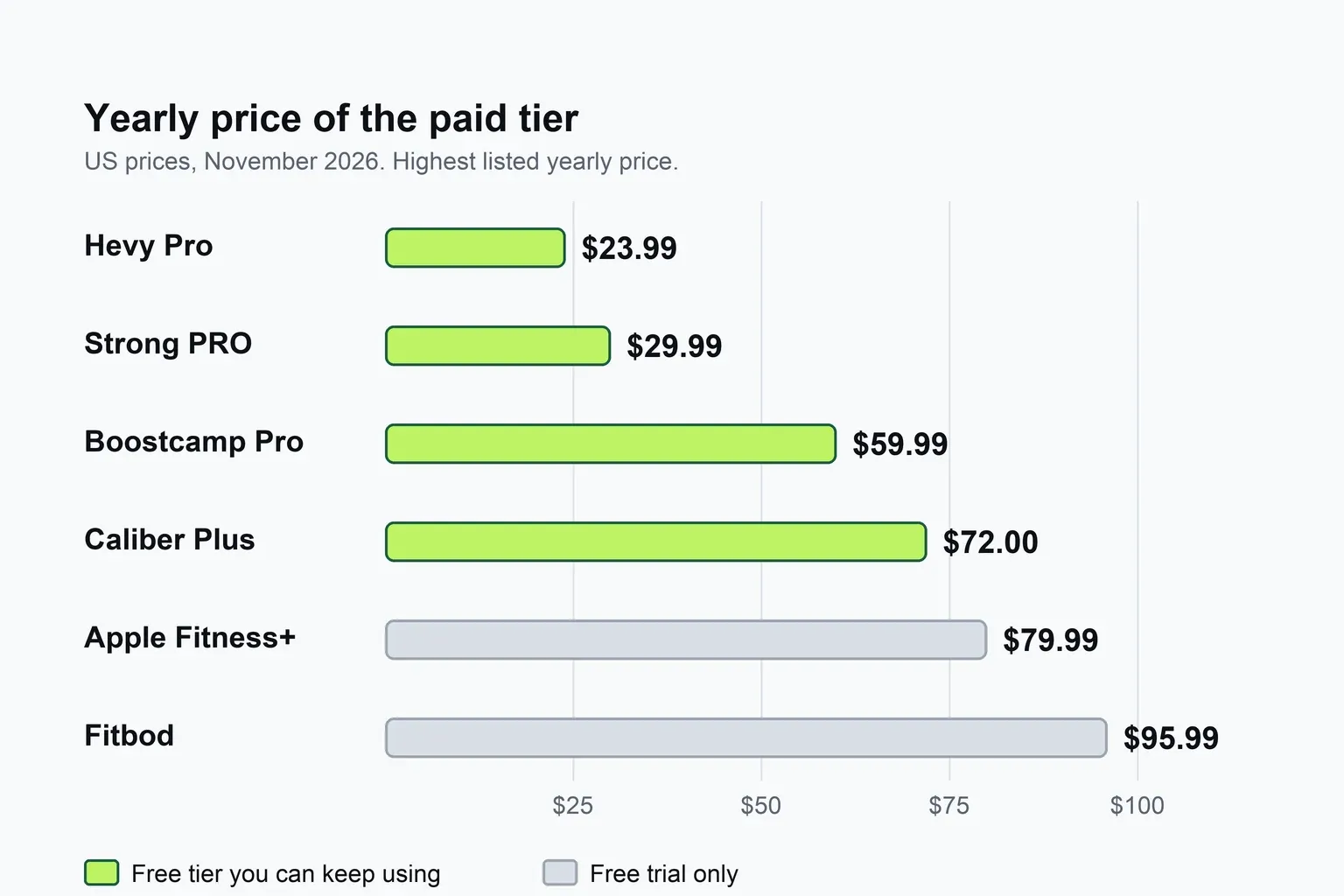
The gap matters more than any single price. Three years of Fitbod at its higher yearly price costs four times as much as Hevy Pro, and Hevy's free tier is enough for many lifters. Pay for the app that does the job you'd otherwise skip: planning, if you never know what to do; logging, if you already have a plan.
Other Weightlifting Apps the Big Reviews Picked
SHRED, Future, JuggernautAI, Jefit and several others made other roundups. We left them out of our main picks for price or focus, not quality.
- SHRED: Fortune's best weightlifting app overall. Pro costs $19.99 a month or $119.99 a year, as reported by Garage Gym Reviews and BarBend (checked November 16, 2026), five times Hevy Pro's yearly price.
- Future: a human coach who writes your plan, at $199 a month as reported by Garage Gym Reviews, BarBend and Fortune (checked November 16, 2026). That's coaching, not an app subscription.
- JuggernautAI: Garage Gym Reviews' and BarBend's pick for powerlifters, at $35 a month as reported by both (checked November 16, 2026). Specialised for squat, bench and deadlift meets.
- Jefit: BarBend's pick for variety, at $12.99 a month as reported by BarBend (checked November 16, 2026).
- Muscle Booster, Ladder, TR[Ai]NER and BodyFit: picked by Garage Gym Reviews or BarBend for beginners, home gyms, AI or budget. Prices run from $6.99 to $29.99 a month, as reported by those two reviews and Fortune (checked November 16, 2026).
We didn't verify these prices on the App Store; they're as each review reported them, read on November 16, 2026.
Which Weightlifting App Should You Use?
You've never followed a lifting plan.
Start with Caliber's free tier for form tutorials, or a beginner program in Boostcamp's free library. Pay for Caliber Plus only if you want a plan picked for you after a few weeks.
You already run a program like 5/3/1 or GZCLP.
Boostcamp's free tier lays it out week by week. Hevy or Strong work too if you'd rather type the program in yourself.
You don't want another monthly bill.
Stay on Hevy's or Strong's free tier. If you outgrow the routine cap, Hevy's $74.99 lifetime plan ends the bills for good.
You want to log from your wrist.
Strong and Hevy both log from the watch; Hevy Pro costs less. If you already pay for Fitness+, try Gym Strength once 27.3 is out.
You train with a Garmin watch.
Use the free strength activity on the watch and plan workouts in Garmin Connect. Log in Hevy or Strong on your phone if you want better history, knowing it won't sync to Garmin.
You have an Android phone or Wear OS watch.
Hevy has a Wear OS app with live sync, and Fitbod has one too. Strong's Play listing doesn't mention one.
How to Pick a Weightlifting App Without Overpaying
Start on the free tier for a month.
Hevy, Strong, Boostcamp and Caliber all have free tiers with no time limit. A month shows you whether the limits actually get in your way.
Count the routines you really use.
Hevy's free tier saves 4 routines and Strong's saves 3. Most programs run 3 or 4 days a week, which fits.
Pick a program before you pick an app.
An app can't make an aimless plan work. Choose a program first, then the app that lays it out best.
Do the lifetime maths.
Hevy's $74.99 lifetime plan beats yearly billing after about 3.1 years. If you've lifted for years already, it's a safe bet.
Cancel trials before they renew.
Fitbod's 7-day trial and the Fitness+ trial both renew into paid plans. Set a reminder the day you start.
True or Not? 4 Myths About Weightlifting Apps
An AI plan beats a proven program.
True or not? Tap to find outHere's what the sources say
We found no study showing that. AI apps like Fitbod save you planning time, but well-known programs such as GZCLP and 5/3/1 are free in Boostcamp, and Garage Gym Reviews named Boostcamp, not Fitbod, its best weightlifting app overall.
Free weightlifting apps limit how many workouts you can log.
True or not? Tap to find outHere's what the sources say
Not for the main ones. Hevy and Strong both log unlimited workouts for free; their limits are on saved routines, custom exercises and, for Hevy, 3 months of history.
You need a smartwatch to use a lifting app.
True or not? Tap to find outHere's what the sources say
No. Every app here works on a phone alone, and Boostcamp and Caliber don't list Apple Watch support at all. A watch adds heart rate and wrist logging.
Your Garmin counts every rep.
True or not? Tap to find outHere's what the sources say
Not always. Garmin's manual says leg exercises may not be counted and the count only appears after at least 4 reps. You can edit the count after each set.
What This Data Can't Tell You
A weightlifting app records what you tell it, plus estimates such as rep counts and one-rep max that can be off. None of these apps can watch your form in the room, and this guide compares features and prices, not whether any app leads to better strength gains. No source we found measured that. If you have an injury, a health condition or haven't exercised in a while, ask a doctor or physiotherapist which exercises suit you before following a plan.