Garmin Enduro 4 vs Fenix 9: Battery Life or a Better Screen?
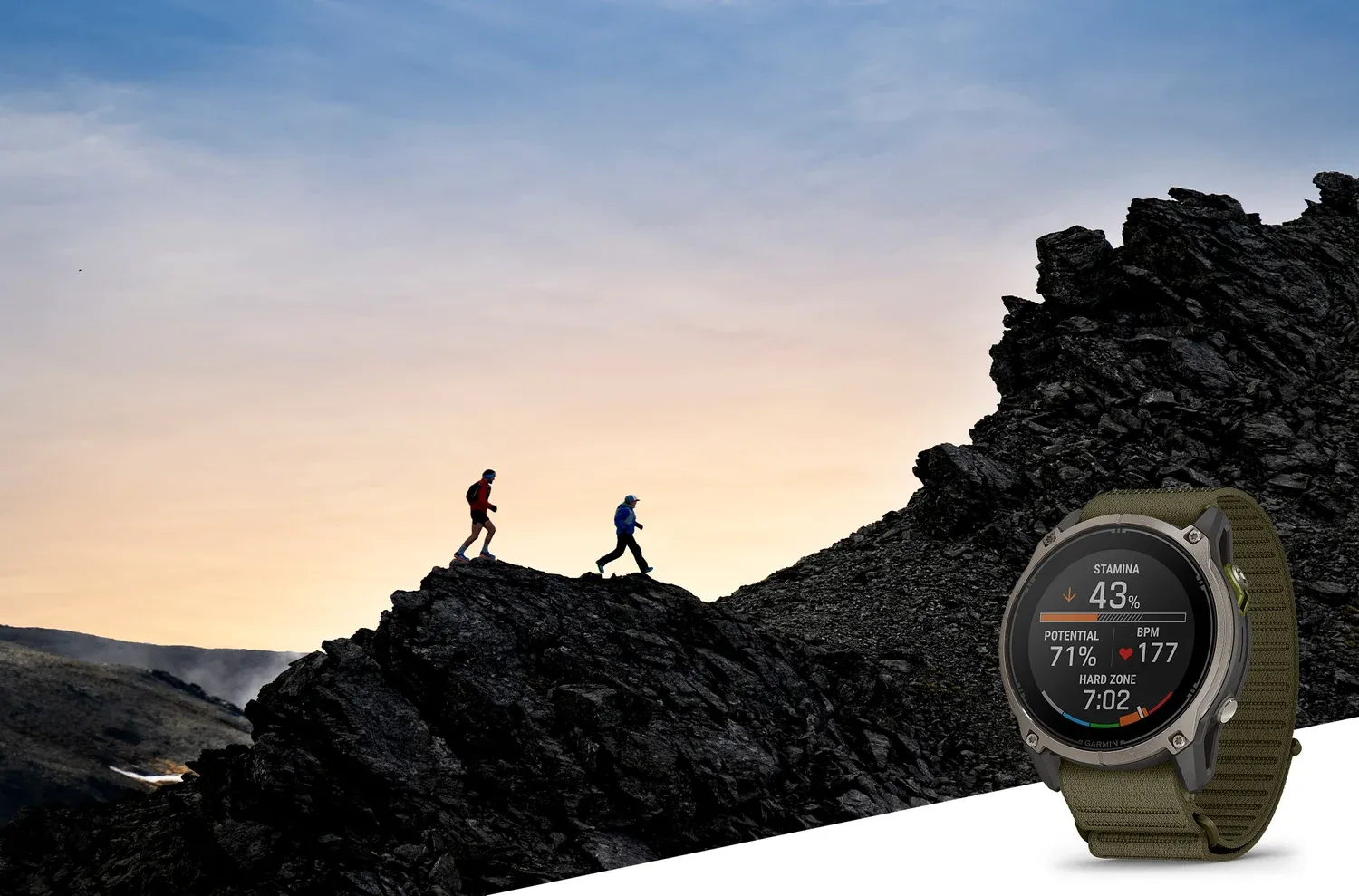
Buy the Enduro 4 if battery life and weight matter most: it's rated at 36 days as a smartwatch without sun against 29 for the 51mm Fenix 9, weighs 66 g against 91 g, and costs $899.99, $200.00 less. Buy the Fenix 9 for its far sharper AMOLED screen, calls from the wrist, diving and smaller sizes.
Enduro 4 vs Fenix 9: which should you buy?
The Enduro 4 for ultrarunners and multi-day hikers: longer battery in every mode, 25 g lighter and $200.00 cheaper than the 51mm Fenix 9. The Fenix 9 for everyone who wants an AMOLED screen, a speaker and microphone, a dive computer or a 43mm or 47mm size.
Enduro 4: battery and weight win.
Fenix 9: AMOLED vs MIP.
Fenix 9 in 43 or 47mm.
Keep it: same screen and battery.
Enduro 3 on sale at $699.99.
What's New: Enduro 4 Arrives Six Weeks After the Fenix 9
Garmin launched the Enduro 4 on October 6, 2026 at $899.99, six weeks after the Fenix 9. It keeps a memory-in-pixel screen and a solar lens for battery life, while the Fenix 9 uses a brighter AMOLED screen.
Garmin announced the Enduro 4 on October 6, 2026 in its press release. On garmin.com it costs $899.99 and comes in one size, 51mm. The Fenix 9 arrived on August 25 and costs $999.99 in 47mm and $1,099.99 in 51mm, with the Fenix 9 Pro Solar at $1,199.99 in 51mm.
So the Enduro 4 vs Fenix 9 choice, or Fenix 9 vs Enduro 4 if you started from the Fenix, is really a choice of screen and priorities. The Enduro 4 is built for the longest events: a 1.4-inch memory-in-pixel (MIP) display under a solar-charging sapphire lens, a fibre-reinforced polymer case and a titanium bezel, at 66 g. The Fenix 9 swaps battery for a sharper, brighter AMOLED screen, a speaker and microphone, dive features and more sizes.
How to read this comparison. Health Perk hasn't tested either watch. We use Garmin's specifications and prices, checked on November 16, 2026, plus spec tables and reviews we attribute by name: the5krunner, Notebookcheck and RunningXpert on the Enduro 4, and TechRadar and Tom's Guide, who tested the Fenix 9 Pro.
Garmin Enduro 4 vs Fenix 9: Specs Side by Side
Same 51mm footprint and 64GB storage. The Enduro 4 is $200.00 cheaper and 25 g lighter and lasts longer; the Fenix 9 has the AMOLED screen, speaker, mic and dive tools.
| Feature | Enduro 4 | Fenix 9 (51mm) |
|---|---|---|
| Price on garmin.com, Nov 16 | $899.99 | $1,099.99 |
| Sizes | 51mm only | 43, 47 and 51mm |
| Display | 1.4-inch MIP, 280 × 280, solar lens | 1.4-inch AMOLED, 454 × 454 |
| Smartwatch battery | Up to 36 days, 90 with solar | Up to 29 days |
| Weight with band | 66 g | 91 g |
| Case | Fibre-reinforced polymer, titanium bezel | 51 × 51 × 14.7 mm |
| Thickness | 15.7 mm | 14.7 mm |
| Storage | 64GB | 64GB |
| Speaker and microphone | Beeper only | Yes, for calls and voice commands |
| Dive computer | No | Yes, to 40 m |
| LED flashlight | White and red | Yes |
| Satellite messaging | No inReach version | Fenix 9 Pro inReach models |
Enduro 4 figures from Garmin's press release and the5krunner's spec table; Fenix 9 figures from the5krunner's Fenix 9 spec table and garmin.com. Both are rated 10 ATM water-resistant.
Enduro 4 vs Fenix 9 Battery Life
The Enduro 4 outlasts even the 51mm Fenix 9 Pro Solar in every mode the5krunner compared. It's rated at 36 days as a smartwatch without sun, against 29 for the 51mm Fenix 9, and up to 320 hours of GPS in Extended mode with solar.
Battery is the Enduro 4's reason to exist, and Notebookcheck calls it the watch's primary differentiator. the5krunner's Enduro 4 vs Fenix 9 Pro Solar comparison puts the two flagship batteries side by side and finds the Enduro 4 ahead in every mode Garmin publishes, even against the most expensive 51mm Fenix 9 Pro Solar.
| GPS mode, hours (no sun / with solar) | Enduro 4 | Fenix 9 Pro Solar 51mm |
|---|---|---|
| Normal GPS | 80 / 144 | 75 / 124 |
| Max Accuracy | 60 / 90 | 54 / 75 |
| Extended Battery | 120 / 320 | 100 / 211 |
| Max Battery | 210 / unlimited | 186 / 1000 |
The gap is smallest in Normal GPS, 80 hours against 75 without sun, and biggest where the Enduro's larger solar ring helps: 320 hours against 211 in Extended mode with solar. Solar figures assume strong direct light, so RunningXpert advises judging by the no-sun numbers, which still favour the Enduro.
Real use is always shorter than the rating. Tom's Guide's Nick Harris-Fry got 10 to 11 days per charge from the 51mm Fenix 9 Pro with the screen always on and near-daily runs in the most accurate GPS setting, in his Fenix 9 Pro review. Nobody has yet published a comparable long-term Enduro 4 battery test that we could find.
MIP vs AMOLED: The Screen Is the Real Trade
The Enduro 4's MIP screen sips power and is easy to read in direct sun, but it's less sharp and dimmer indoors. The Fenix 9's AMOLED is far sharper and brighter, which costs battery.
Both screens measure 1.4 inches. The Enduro 4's memory-in-pixel display has 280 × 280 pixels and reflects ambient light, which is why it needs so little power and reads well outdoors. The Fenix 9's AMOLED has 454 × 454 pixels, and Garmin says it is more than twice as bright as the Fenix 8's, with the Fenix 9 Pro reaching up to 3,000 nits.
Notebookcheck notes that MIP is becoming rare in Garmin's line-up and still has a loyal following. RunningXpert's Jeppe Platz Schmidt describes the Enduro 4's screen as easy to read in sunlight but less sharp than AMOLED. If you mostly look at your watch outside, MIP is no handicap; if you read maps and notifications indoors or at night, the Fenix 9's screen is the more pleasant one.
Weight, Size and Comfort
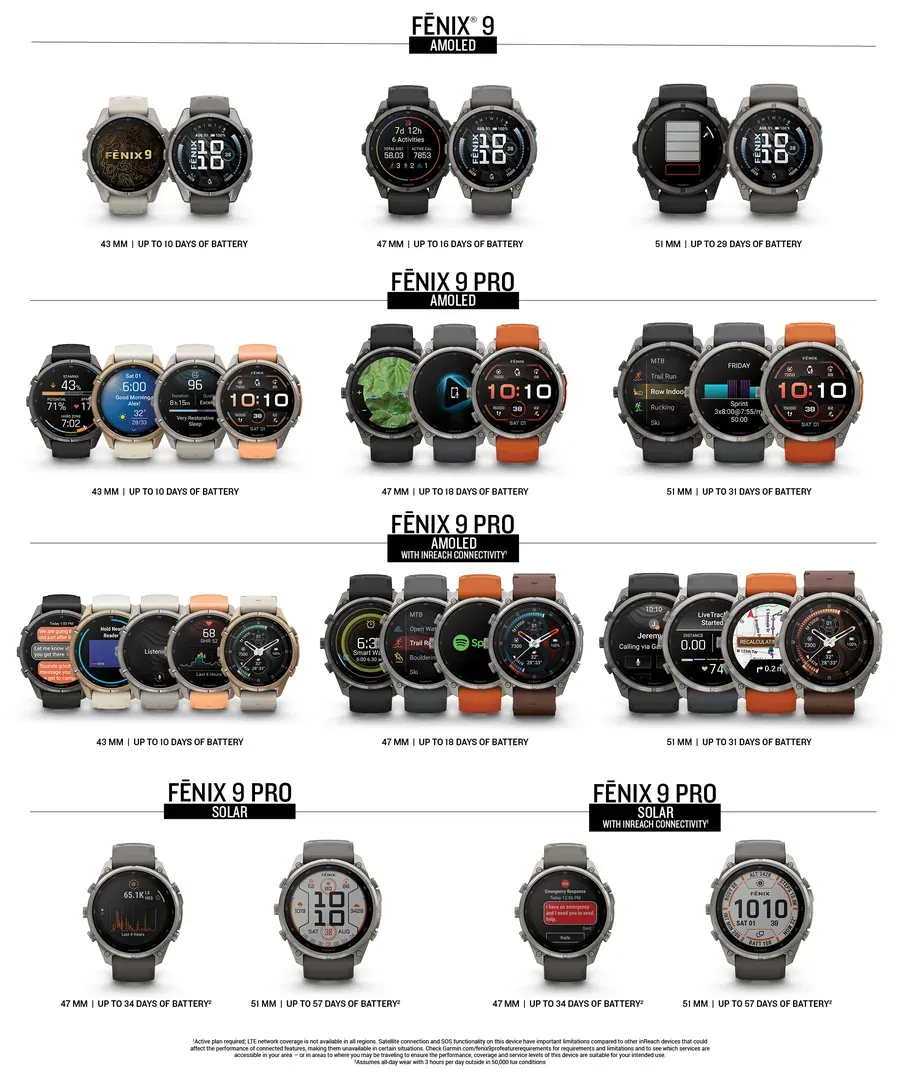
The Enduro 4 weighs 66 g with its fabric band, against 91 g for the 51mm Fenix 9 and 102 g for the 51mm Fenix 9 Pro Solar. But it only comes in 51mm.
Garmin keeps the Enduro light with a fibre-reinforced polymer case, a titanium bezel and its new ComfortFit fabric band, which fits wrists from 145 to 220 mm. RunningXpert says the lower weight really shows on the wrist. The Fenix 9 Pro uses titanium throughout and weighs 102 g in 51mm and 84 g in 47mm, according to the5krunner.
The catch is size. The Enduro 4 is 51 × 51 × 15.7 mm and there is no smaller version, so on a slim wrist it will look and feel big, however light it is. The Fenix 9 comes in 43, 47 and 51mm, and Notebookcheck counts that choice as a reason the Enduro 4 isn't for everyone.
Features: What Each Watch Has That the Other Doesn't
Most training software is shared, including Garmin Epic, Stamina Zones and maps. The Fenix 9 adds a speaker, microphone, dive computer and inReach options; the Enduro 4 adds grade-adjusted rolling pace.
Both watches run Garmin's latest outdoor software. Both get multicontinent TopoActive maps with 30% faster panning than their predecessors, Garmin Epic for multi-day trips, Stamina Zones and Stamina Curves for pacing, rowing and rucking tools, Garmin Pay, an LED flashlight and Garmin's ECG app, which is available in some regions.
- Only on the Fenix 9: a speaker and microphone for calls and voice commands, a dive computer for scuba and freediving to 40 m, and, on the Pro models, a green flashlight mode plus Red Shift and Colour Shift display modes.
- Only on the Fenix 9 Pro inReach models: LTE calls and texts without a phone, two-way satellite messaging and interactive SOS. These need an active plan.
- Only on the Enduro 4: grade-adjusted rolling pace, which averages your pace over the last kilometre adjusted for climbs, and a larger solar ring. RunningXpert says grade-adjusted pace targets helped during hill intervals.
For off-grid safety, the5krunner points out that the Enduro 4 has no inReach version, so the like-for-like comparison is an Enduro 4 plus a separate satellite messenger against a Fenix 9 Pro inReach. garmin.com listed the 51mm Fenix 9 Pro with inReach at $1,299.99. Garmin's optional Connect+ subscription works on both; our look at whether Garmin Connect+ is worth it covers what it adds.
Enduro 4 vs Enduro 3: Worth the Upgrade?
Not for most owners. The body, screen and battery are the same; the Enduro 4 adds 64GB storage, 50% more RAM and faster maps. On garmin.com the Enduro 3 was on sale at $699.99, $200.00 less.
Garmin's press release says the Enduro 4 has 50% more RAM than the Enduro 3, a faster map engine and 64GB of storage instead of 32GB. According to the5krunner's spec table, the case, 1.4-inch MIP display and battery ratings are unchanged, and the Enduro 4 is 3 g heavier at 66 g.
Notebookcheck expects the speed gains to show mostly in benchmarks and edge cases, so it finds an upgrade hard to justify for current owners. If you're buying new, the Enduro 3 on sale at $699.99 (list $799.99) on garmin.com on November 16 is the budget route to the same battery life, while RunningXpert recommends the Enduro 4 for new buyers who want the newest software.
Enduro 4 or Fenix 9: Which Should You Buy?
Buy the Enduro 4 if battery life and weight come first. Buy the Fenix 9 if you want an AMOLED screen, calls from the wrist, diving or a smaller size. The Enduro 4 costs $200.00 less than the 51mm Fenix 9.
Enduro 4. It outlasts even the 51mm Fenix 9 Pro Solar in every mode the5krunner compared, and costs $300.00 less than the 51mm Fenix 9 Pro Solar.
Fenix 9. Its 454 × 454 AMOLED is far sharper than the Enduro's MIP, and much brighter.
Fenix 9 in 43mm or 47mm. The Enduro 4 only comes in 51mm. The 47mm Fenix 9 costs $100.00 more than the Enduro 4.
Fenix 9. The Enduro 4 has no microphone and no dive computer.
Enduro 3 on sale at $699.99: same battery and screen as the Enduro 4, less storage and RAM.
Comparing the Fenix 9 with its predecessor instead? Our Fenix 9 vs Fenix 8 guide covers that, and our Apple Watch vs Garmin comparison helps if you're still choosing a platform.
Enduro 4 or Fenix 9: Which Fits You?
You race 100 km or longer.
Enduro 4. the5krunner names ultra runners as its audience, and its light weight and battery suit long races.
You're away from a charger for days.
Enduro 4, possibly paired with a separate satellite messenger. With solar it's rated at 320 hours in Extended GPS mode.
You train most days and want a smartwatch too.
Fenix 9. Calls, voice commands and a sharper screen matter more day to day than weeks of battery.
You scuba or freedive.
Fenix 9. It has a dive computer to 40 m; the Enduro 4 doesn't.
Big watches feel bulky on you.
Fenix 9 in 43mm or 47mm. The Enduro 4 is 51mm only, though it's light.
How to Choose Without Overpaying
Judge battery by the no-sun figures.
Solar ratings assume 3 hours a day at 50,000 lux. Without sun the Enduro 4 is still rated 36 days against 29 for the 51mm Fenix 9.
Try the size before you buy.
The Enduro 4 is 51 × 51 × 15.7 mm with no smaller version.
Check the Enduro 3 sale price.
On November 16 garmin.com had the Enduro 3 at $699.99, $100.00 off, with the same screen and battery ratings.
Price satellite safety separately.
The Enduro 4 has no inReach model. Compare a Fenix 9 Pro inReach with the Enduro 4 plus a separate messenger, and include the plan.
Consider the MIP Fenix 8 Solar.
If you want a Fenix with a MIP screen, garmin.com had the 51mm Fenix 8 Solar on sale at $849.99 on November 16.
True or Not? 4 Myths About the Enduro 4 and Fenix 9
The Fenix 9 Pro Solar matches the Enduro 4 on battery.
True or not? Tap to find outHere's what the sources say
No. the5krunner's comparison shows the Enduro 4 ahead in every mode Garmin publishes, from 36 vs 30 days as a smartwatch to 320 vs 211 hours in Extended GPS with solar.
The Enduro 4 is a cut-down Fenix.
True or not? Tap to find outHere's what the sources say
Not on training software. Both get Garmin Epic, Stamina Zones, the faster map engine and 64GB storage. The Enduro lacks the speaker, microphone, dive computer and inReach options.
The Enduro 4 has an AMOLED screen like the Fenix 9.
True or not? Tap to find outHere's what the sources say
No. It keeps a 1.4-inch memory-in-pixel screen, which is what gives it the longer battery life.
Solar means you never need to charge.
True or not? Tap to find outHere's what the sources say
Only in some modes and in strong sun. Garmin's solar ratings assume 50,000 lux; in normal GPS use the Enduro 4 is rated at 144 hours with solar.
What This Data Can't Tell You
This comparison uses Garmin's battery ratings and specifications, which describe set test conditions, plus reviewers' spec analysis and early impressions. Your battery life depends on screen settings, GPS mode, sunlight and how much you train. Heart rate, ECG, sleep and recovery figures from either watch are estimates and recordings for tracking, not diagnoses, and nothing here judges how accurate they are for you.