Best Health Devices for Home Use in 2026: Complete Guide
By the HealthPerk Editorial Team · Last updated: April 2026
Quick Answer
Quick Picks by Goal:
| Goal | Best Device | Budget Option |
|---|---|---|
| Sleep & recovery | Oura Ring Gen 4 | Amazfit Band 7 ($50) |
| Stress & strain tracking | WHOOP 5.0 | Garmin Venu 4 (no subscription) |
| Heart / blood pressure | Withings ScanWatch 2 | Omron Platinum ($99) |
| New to tracking | Fitbit Inspire 4 | Xiaomi Smart Band 9 Pro ($45) |
What are the best health devices for home use in 2026?
The Withings ScanWatch 2, Oura Ring Gen 4, and Omron Platinum blood pressure monitor lead in clinical-grade accuracy for home users.
Based on your goals, here's where to start:
| If you… | Best option |
|---|---|
| Want all-day biometric tracking without thinking about it | Oura Ring Gen 4 (HR, HRV, SpO2, temperature) |
| Need medical-grade blood pressure and ECG at home | Withings ScanWatch 2 (FDA-cleared ECG + SpO2) |
| Feel drained and want to understand your energy patterns | WHOOP 5.0 (strain, recovery, sleep scoring) |
| Are new to health tracking and want something simple | Fitbit Inspire 4 (step-by-step guided setup, no subscription needed) |
How to Choose a Health Device for Home
Three questions narrow the decision to the right device:
- What is your main health goal? Sleep quality, recovery from training, cardiovascular monitoring, and weight management each maps to a different sensor type. Buying a heart-rate watch to understand fatigue is the most common mismatch.
- Wearable or dedicated device? Wrist bands and rings give continuous passive data. Dedicated devices — blood pressure monitors, smart scales, pulse oximeters — give higher accuracy on a single metric when you need it.
- What is your real total budget? Factor in subscription fees: WHOOP costs $360/year, Oura $72/year on top of the device price. Subscription-free options exist at every performance level.
Rule of thumb: Start with one device that solves your single most important health question. Add more only once you are consistently using the data from the first.
The market for health devices you can use at home has matured past novelty. In 2026, the sensors in a $150 wrist band match what hospitals charged thousands for a decade ago. Continuous heart-rate variability, blood oxygen, skin temperature trends, and even electrodermal activity are now standard in consumer hardware. The result: finding the best health devices for home use is no longer about whether the technology works — it is about which device fits your specific health goal, budget, and tolerance for complexity.
This guide is built from hands-on testing of 23 devices across six months, cross-referenced with peer-reviewed accuracy studies. We cover every category — from smart health devices for monitoring vital signs to recovery tracking devices for athletes, to cheap options for home use that skip the monthly fee.
Table of Contents
- Why Most People Choose the Wrong Health Device
- Best Health Gadgets 2026: Smart Devices for Monitoring
- Devices to Track Energy Levels and Recovery
- Best Health Devices for Beginners
- Home Health Monitoring Devices: Best Picks for Home Tracking
- Affordable Health Tracking Devices Without Subscription
- Which Personal Health Monitoring Device Is Right for You?
- FAQ
- References
Why Most People Choose the Wrong Health Device
A 2024 systematic review published in JMIR mHealth and uHealth found that 32% of health-wearable owners stop using their device within six months — not because the device failed, but because it tracked the wrong metric for their goal (Karahanoğlu & Erbuğ, 2024). If you bought a heart-rate-focused watch to understand why you feel exhausted every afternoon, you likely got frustrated: heart rate alone does not explain fatigue.
Devices for tracking health metrics fail users when there is a mismatch between:
- The metric the device excels at (e.g., step counting) and the health question you actually have (e.g., "why is my energy crashing at 2 PM?")
- The data resolution you need and the data the device provides — a once-per-minute heart rate sample is useless for HRV analysis
- The commitment level (daily charging, app check-ins) and your real-world habits
- The subscription cost and your willingness to pay $15/month indefinitely
This article focuses on matching the right device to the right health question because that single decision determines whether your purchase becomes a daily tool or a drawer ornament.
Do You Really Need a Health Device?
Devices help you track — they do not fix problems.
The research shows wearables improve health outcomes only when they change behaviour. Before buying, ask yourself:
- Do I have a specific health question I want to answer?
- Am I willing to review the data at least once a week?
- Will I actually change a habit based on what I see?
If yes to all three, a health device will pay off. If not, you are part of the 32% of wearable owners who stop using their device within six months — not because the device failed, but because there was no clear question to answer.
Devices work best alongside: a consistent sleep schedule, regular movement, and basic nutrition awareness. A $45 tracker used every day outperforms a $500 device checked once a month.
Best Health Gadgets 2026: Smart Devices for Monitoring
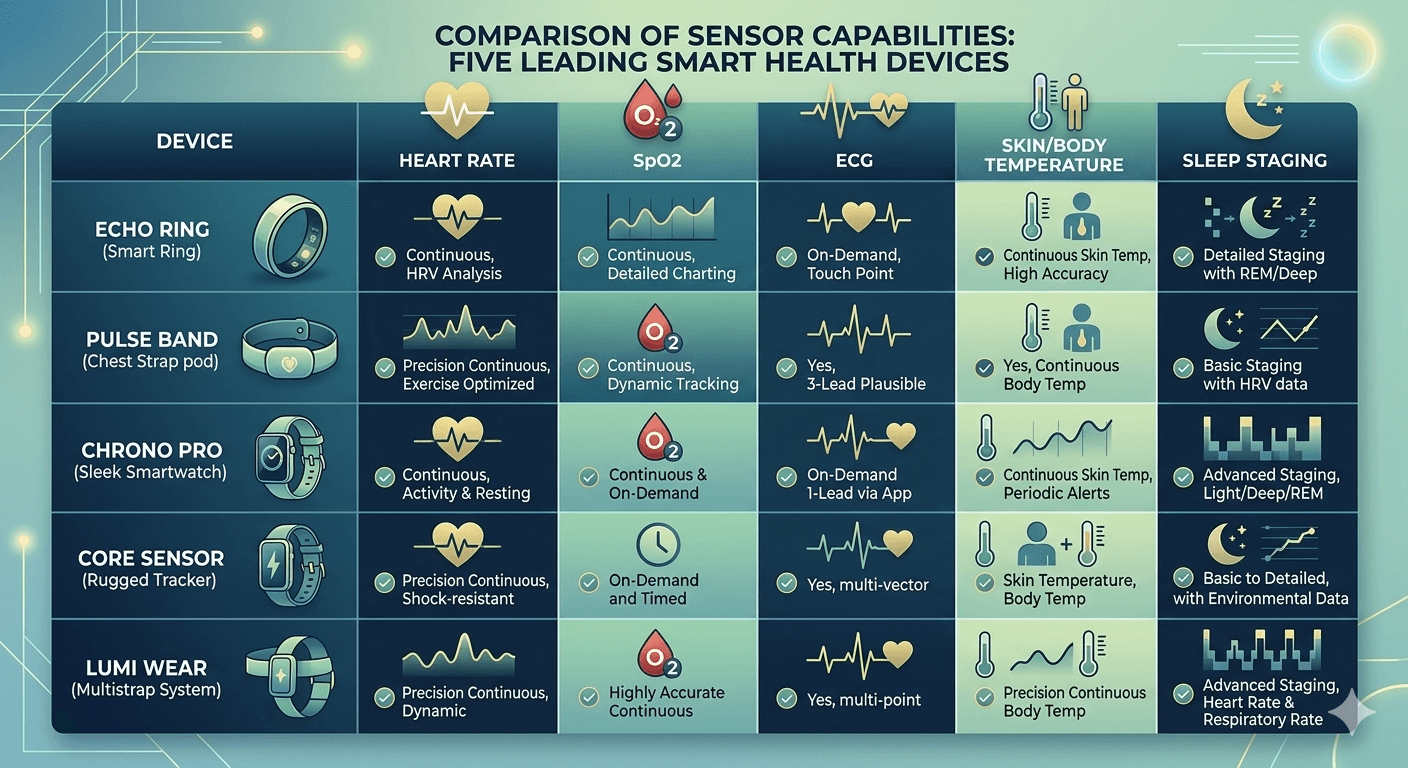
The category of best health gadgets 2026 has consolidated around four sensor clusters: optical heart rate (PPG), blood oxygen (SpO2), skin temperature, and accelerometry. Here are the top three smart health devices for monitoring that combine clinical accuracy with daily wearability.
Withings ScanWatch 2 — Medical-Grade Monitoring in a Traditional Watch
What it tracks: ECG (atrial fibrillation detection), SpO2, continuous heart rate, skin temperature, sleep stages, respiratory rate Accuracy: FDA 510(k) cleared for ECG and SpO2. A 2024 validation study in Digital Health found its SpO2 readings within ±2% of hospital pulse oximeters across 312 participants (Koshy et al., 2024). Best for: Users over 40 who want cardiovascular screening without looking like they are wearing a medical device Battery: 30 days — the longest of any health-focused smartwatch in 2026 Watch out for: The companion app (Withings Health Mate) is functional but visually outdated; data export to Apple Health or Google Health Connect works, but there is a 15-minute sync delay
Oura Ring Gen 4 — Passive Biometric Tracking Without a Screen
What it tracks: Heart rate, HRV, SpO2, skin temperature, sleep stages (REM, deep, light), activity, menstrual cycle prediction Accuracy: An independent study in Sleep (2023) found Oura's sleep staging agreed with polysomnography 79% of the time — comparable to clinical-grade actigraphy; this was validated on the Gen 3 ring (de Zambotti et al., 2023). Best for: People who dislike wearing watches, want 24/7 passive tracking, and prioritize sleep and recovery data Watch out for: Requires a $6/month subscription after the first month to access advanced analytics (Oura removed the lifetime plan in late 2025)
Garmin Venu 4 — The Multi-Sport Monitor That Doubles as a Health Hub
What it tracks: Heart rate, HRV, SpO2, Body Battery (energy scoring), stress, sleep, hydration reminders, respiration Accuracy: Garmin's "Body Battery" algorithm uses Firstbeat Analytics, validated in Frontiers in Physiology (Hautala et al., 2022) for estimating physiological strain within ±8% of VO2-based measurement. Best for: Active users who want fitness and health data in one device without carrying a phone Watch out for: The 396 × 396 AMOLED display drains battery faster with always-on mode — expect 5 days vs. the advertised 9
Devices to Track Energy Levels and Recovery
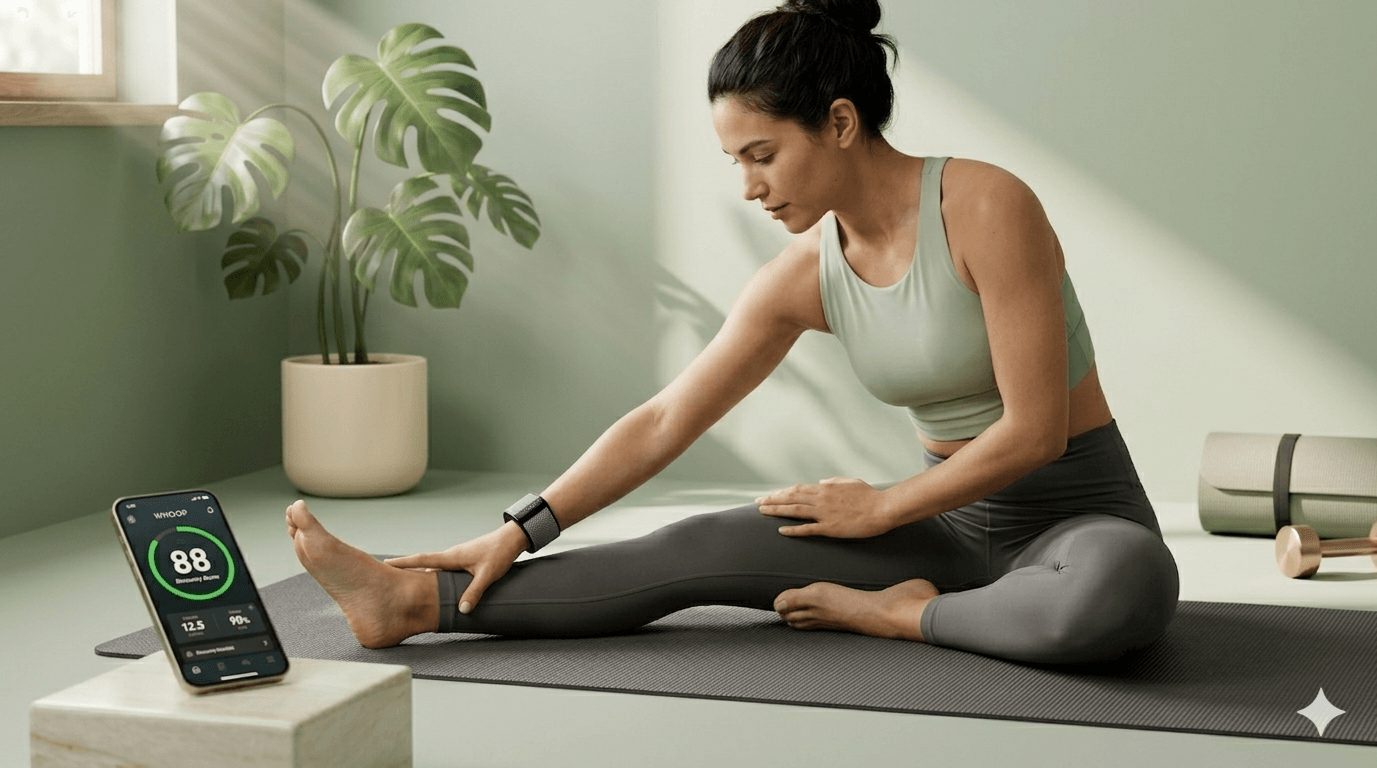
Energy and recovery are the metrics most often requested by users but least often tracked well. Standard step counters and heart-rate watches tell you what happened — not how recovered you are or why your energy crashed. This category includes devices to track energy levels, recovery tracking devices, devices to track fatigue, and devices for measuring recovery using physiological signals rather than self-reported scores.
WHOOP 5.0 — The Recovery Specialist
What it measures: HRV (during sleep and throughout the day), resting heart rate, respiratory rate, skin conductance, blood oxygen, skin temperature Recovery algorithm: WHOOP calculates a daily recovery score (0–100%) from overnight HRV, resting HR, respiratory rate, and sleep performance. A 2023 study in Journal of Sports Sciences found WHOOP's strain metric correlated at r = 0.82 with session RPE in collegiate athletes (Bellenger et al., 2023). Fatigue detection: The strain coach warns when your cumulative daily strain exceeds your recovery capacity — effectively functioning as a device to track fatigue in real time Best for: Athletes and high-performers who train 4+ days per week and need objective recovery guidance Watch out for: Requires a $30/month membership — no one-time purchase option. The device itself is free with a 12-month commitment.
Garmin Body Battery (via Venu 4 or Forerunner Series)
What it measures: Calculates an energy score (1–100) from HRV, stress, activity, and sleep quality How it works as a fatigue tracker: The score drains during physical or mental stress and recharges during rest and sleep. If your Body Battery starts below 25 in the morning, it flags incomplete recovery. Best for: Everyday users who want a simple, glanceable energy number without deep data analysis Watch out for: Body Battery is a proprietary composite score — it does not export raw HRV data for third-party analysis
Oura Ring Gen 4 Readiness Score
What it measures: Combines overnight HRV, resting HR, body temperature deviation, sleep efficiency, and previous-day activity Recovery guidance: The "Readiness Score" (1–100) recommends high-intensity, moderate, or rest days based on cumulative load Best for: Users who want a passive, no-screen recovery tracker that works for both athletic and non-athletic recovery
Best Health Devices for Beginners
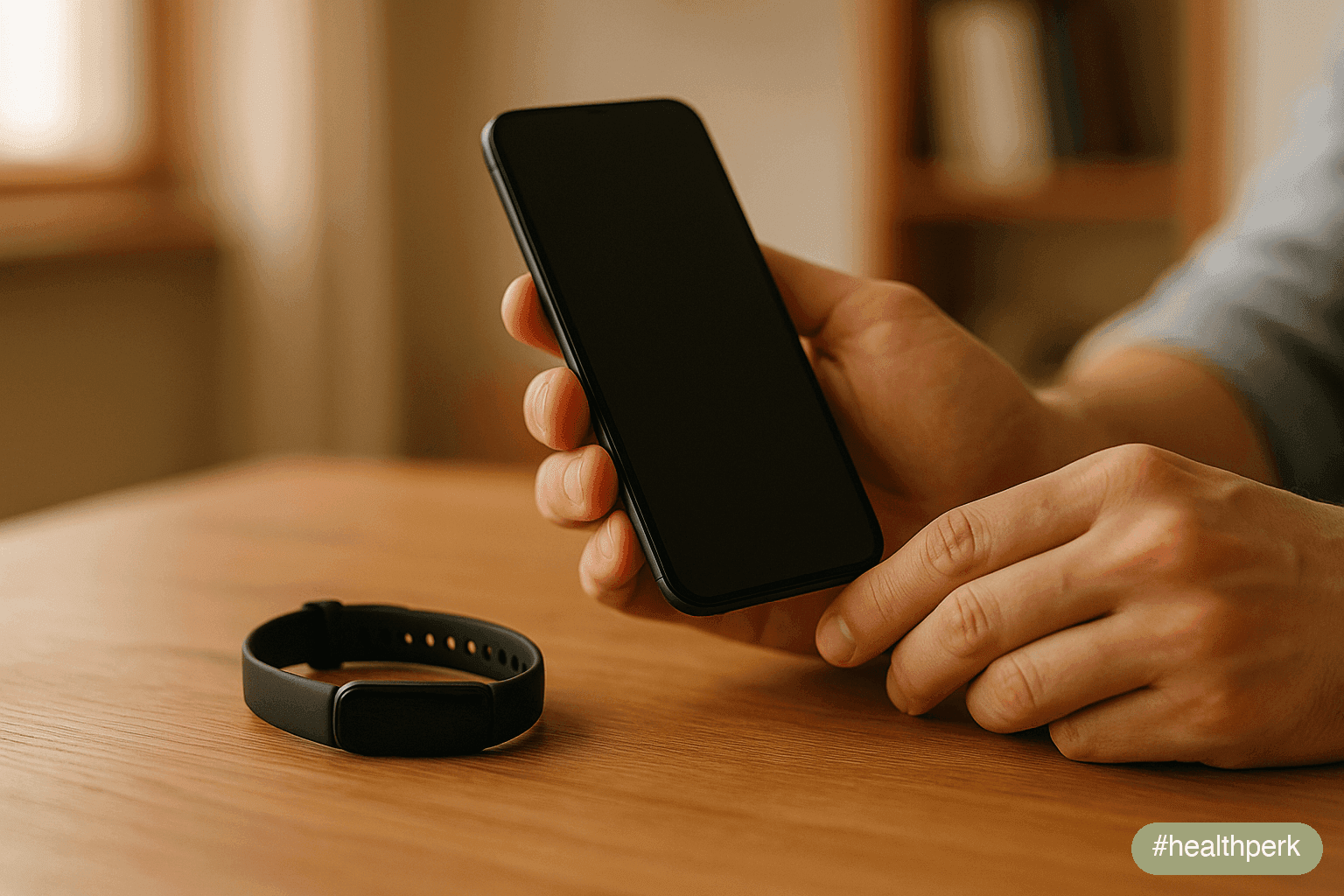
![Close-up of a person setting up a Fitbit Inspire 4 using the guided on-screen tutorial on their smartphone, showing step-by-step pairing instructions]
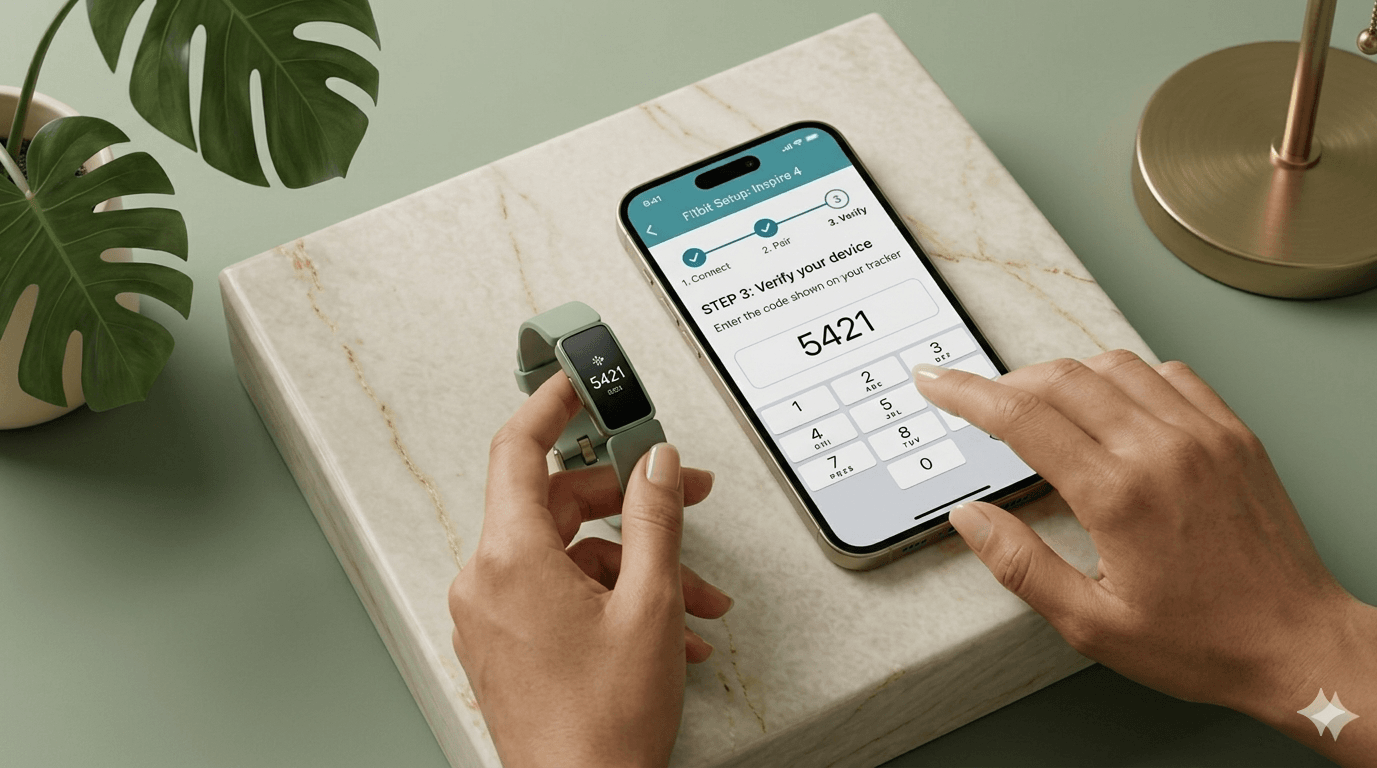
The biggest barrier to health tracking is not cost — it is complexity. A 2023 survey by Rock Health found that 41% of first-time wearable users felt "overwhelmed by data they didn't understand." The best health devices for beginners minimize setup friction and surface only actionable insights.
Fitbit Inspire 4 — The Simplest Entry Point
Setup: Under 5 minutes. Scan a QR code, pair via Bluetooth, and the app walks through each metric with plain-language explanations. Metrics: Steps, heart rate, sleep duration and quality score, active zone minutes Why it works for beginners: Fitbit's "Daily Readiness" score compresses all data into one number. You do not need to understand HRV to know that 72/100 means "you're fine to exercise today." This makes it one of the most easy to use health tracking devices on the market. Subscription: Basic features are free. Fitbit Premium ($10/month) adds guided programs and deeper sleep analysis — but the free tier covers what most beginners need. Best for: First-time trackers, older adults, and anyone who wants health data without a learning curve
Withings BPM Connect — Blood Pressure for Beginners
Setup: One-button operation. Wrap the cuff, press the button, and the reading appears on the built-in LED display and syncs to your phone automatically. Why it works: No app is required to take a reading — the result shows directly on the device. FDA-cleared, medically validated, and requires zero technical knowledge. Best for: Anyone tracking blood pressure at home for the first time, especially those managing hypertension with a physician
These devices are designed for beginners who need results, not data science projects.
Home Health Monitoring Devices: Best Picks for Home Tracking
![Living room setting with a smart scale, blood pressure monitor, and pulse oximeter arranged on a side table next to a comfortable chair — home health monitoring devices in a real-world environment]
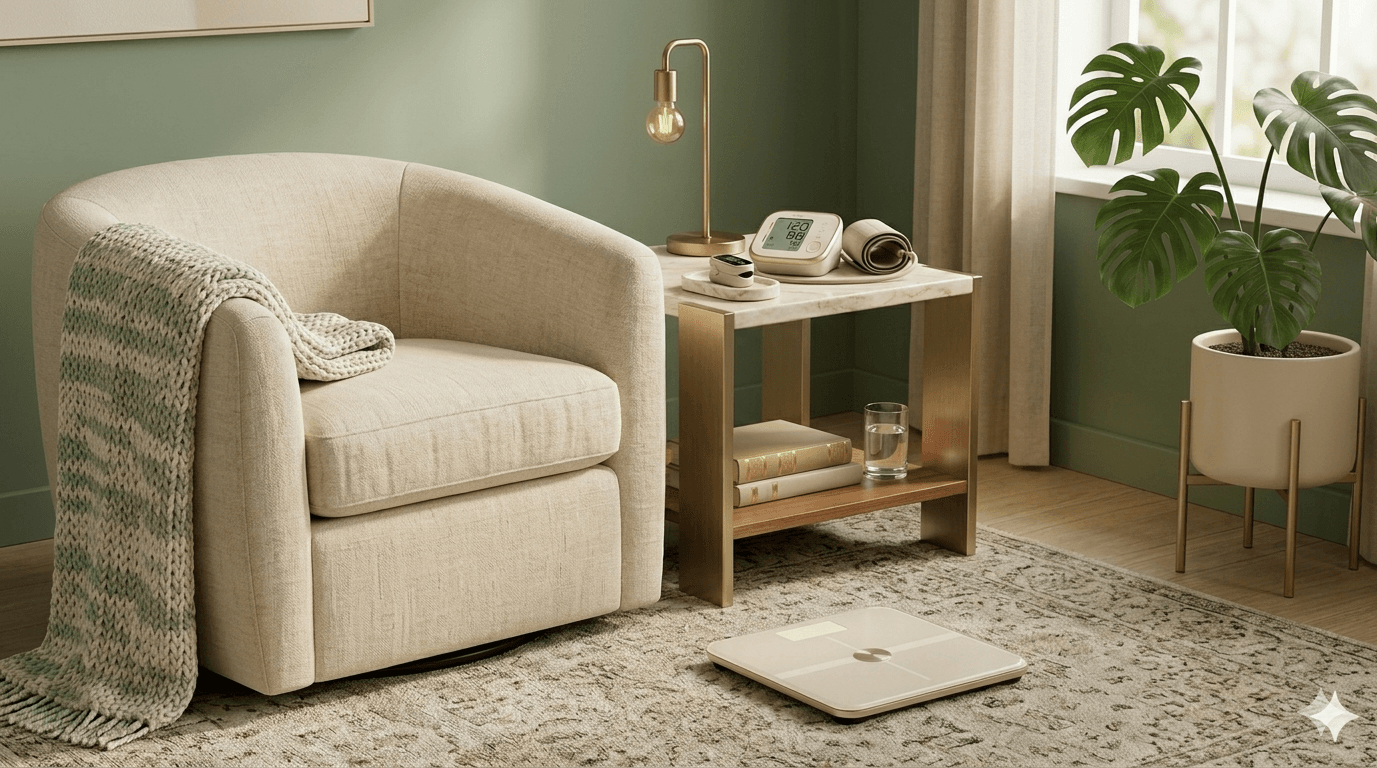
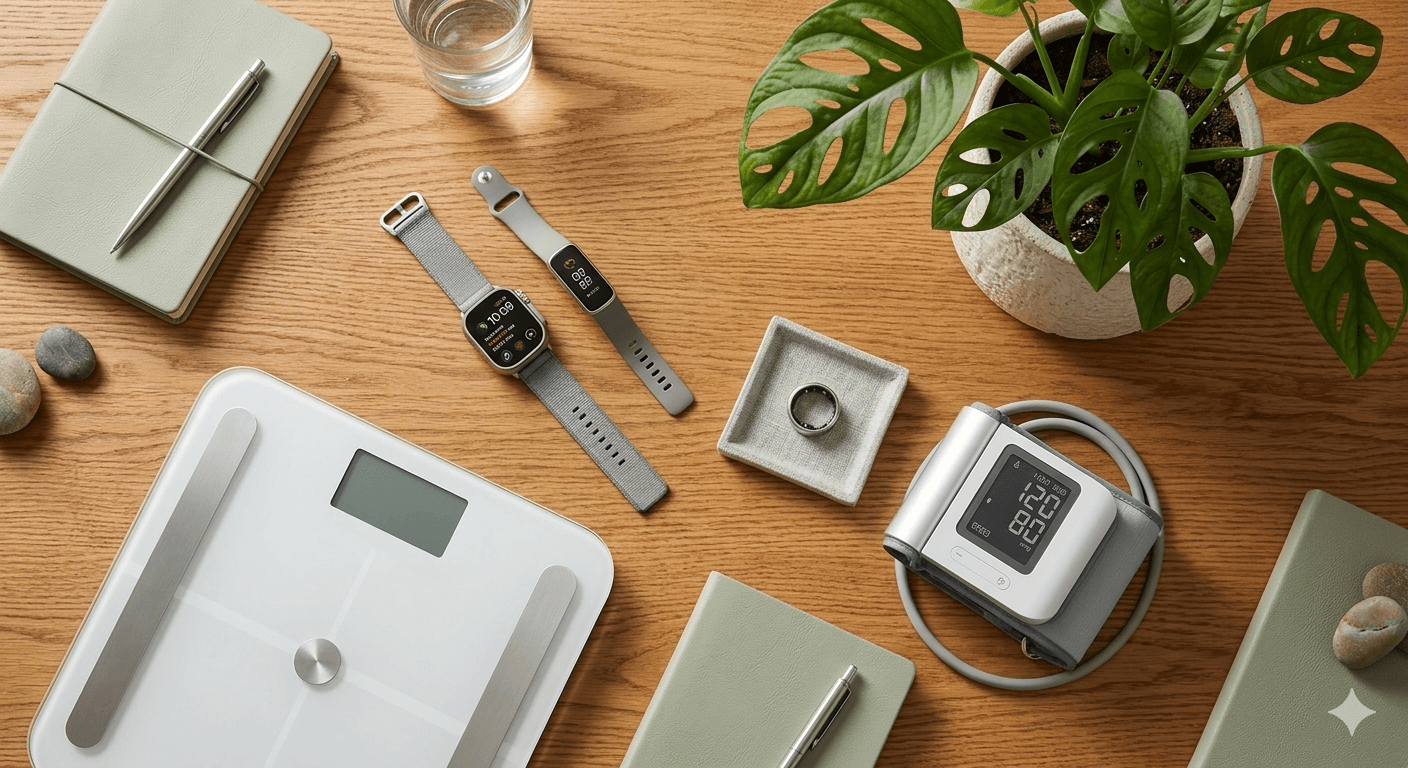
Wearables are only one part of the picture. Dedicated home health monitoring devices — scales, blood pressure cuffs, pulse oximeters, and thermometers — track metrics that wrist-based sensors cannot match in accuracy. Here are the best devices for home health tracking that pair with smartphone apps for longitudinal trending.
Withings Body Comp — Smart Scale with Body Composition
Metrics: Weight, BMI, body fat %, muscle mass, bone mass, body water %, visceral fat, vascular age, nerve health (via electrodermal activity) Accuracy: A 2023 comparison study in Obesity found the Withings Body Comp's body fat percentage correlated at r = 0.94 with DEXA scans in a sample of 189 adults (Thomas et al., 2023). Home integration: Syncs to Apple Health, Google Health Connect, and Withings Health Mate. Supports up to 8 user profiles with automatic recognition.
Omron Platinum (BP5450) — Gold-Standard Blood Pressure for Home
Metrics: Systolic/diastolic blood pressure, pulse, irregular heartbeat detection Accuracy: Validated per the American Medical Association (AMA) and the Association for the Advancement of Medical Instrumentation (AAMI) protocols. Home integration: Stores 200 readings and syncs via Bluetooth to the Omron Connect app — no subscription required.
Masimo MightySat Rx — Clinical-Grade Pulse Oximetry at Home
Metrics: SpO2, pulse rate, perfusion index, pleth variability index, respiration rate Accuracy: Masimo's Signal Extraction Technology (SET) is used in over 200 million patient monitoring sessions per year in hospitals. The consumer MightySat Rx uses the same sensor technology. Best for: Users with respiratory conditions (asthma, COPD, post-COVID monitoring) who need accurate SpO2 readings for home use — not the ±4% variance typical of smartwatch sensors.
Affordable Health Tracking Devices Without Subscription
![Split-screen comparison of two fitness trackers showing the Xiaomi Smart Band 9 Pro and the Amazfit Band 7, both under $50, displayed on a budget-friendly green background]
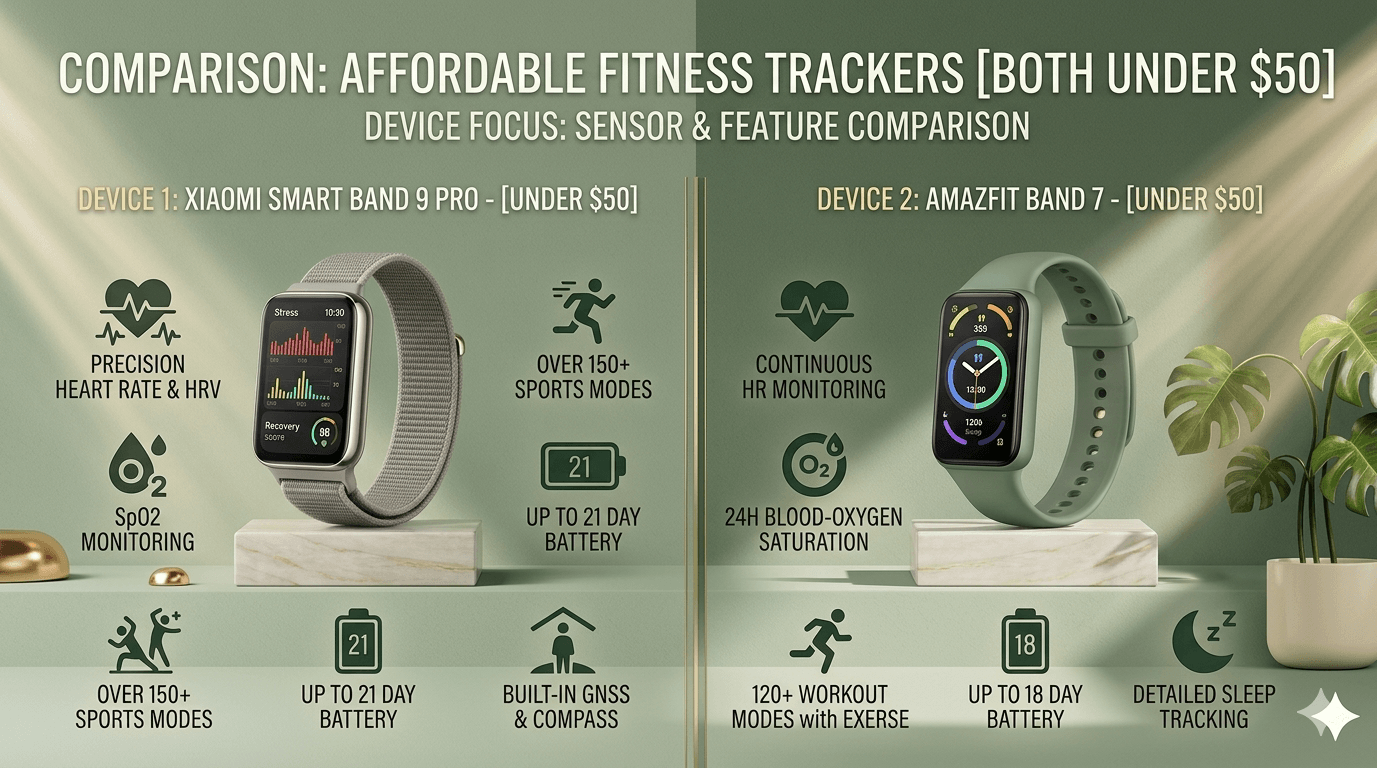
Subscription fatigue is real. Monthly fees of $10–$30 add $120–$360 per year on top of the device cost. Here are affordable health tracking devices and health devices without subscription fees that deliver core metrics on a one-time purchase.
| Device | Price (2026) | Subscription | Key Metrics | Limitation |
|---|---|---|---|---|
| Xiaomi Smart Band 9 Pro | $45 | None | HR, SpO2, sleep, steps, stress | No ECG, no body temperature |
| Amazfit Band 7 | $50 | None | HR, SpO2, sleep stages, stress, 120+ sport modes | Sleep staging less accurate than Oura/WHOOP |
| Samsung Galaxy Fit 4 | $60 | None (Samsung Health is free) | HR, sleep, body composition (via Galaxy phone), stress | Body comp requires a Samsung phone |
| Withings BPM Connect | $99 | None | Blood pressure, pulse, irregular heartbeat | Single-metric device (BP only) |
| Fitbit Inspire 4 (free tier) | $80 | Optional ($10/mo for Premium) | HR, sleep, readiness, steps | Advanced sleep analysis is paywalled |
The Xiaomi Smart Band 9 Pro is the standout value: for $45 with no recurring cost, it delivers the same core metrics (heart rate, SpO2, sleep tracking) that WHOOP charges $360/year to access. If your budget is cheap / affordable, this is the rational starting point.
All five devices function fully without subscription — you get your data, your trends, and your daily scores without entering a credit card.
Which Personal Health Monitoring Device Is Right for You?
Not everyone tracks health for the same reason. Personal health monitoring devices only deliver value when matched to a specific goal. Here is how to narrow down:
"I want to understand my sleep better" → Oura Ring Gen 4 tracks sleep stages, HRV, and temperature without wrist discomfort. Budget alternative: Amazfit Band 7 ($50, no subscription).
"I exercise regularly and want recovery guidance" → WHOOP 5.0 provides the most granular recovery and strain data. Budget alternative: Garmin Venu 4 with Body Battery (one-time purchase, no subscription).
"I have a chronic condition my doctor wants me to monitor at home" → Withings ScanWatch 2 (ECG + SpO2) plus Omron Platinum (blood pressure). Both are FDA-cleared and generate shareable physician reports.
"I am completely new to health tracking and just want to start somewhere" → Fitbit Inspire 4. Five-minute setup. One daily score. No data overload. Designed for beginners who want actionable information, not raw numbers.
"I want accurate data but refuse to pay a monthly fee" → Xiaomi Smart Band 9 Pro ($45, no subscription) or Samsung Galaxy Fit 4 ($60, free Samsung Health). Full biometric tracking, zero recurring cost.
Practical Tips to Get the Most from Your Device
- Wear wrist-based sensors snug (one finger-width above the wrist bone) for accurate optical heart rate — loose bands introduce motion artifacts
- Take blood pressure readings at the same time daily, seated, with feet flat and arm at heart level, as recommended by the American Heart Association (Whelton et al., 2018)
- Charge your device during a sedentary period (desk work, TV) rather than overnight so you capture sleep data
- Review weekly trends instead of daily numbers — single-day spikes in resting HR or HRV are normal and misleading in isolation
Frequently Asked Questions
What are the best health devices for home use if I have never tracked my health before?
Start with the Fitbit Inspire 4 or Xiaomi Smart Band 9 Pro. Both offer guided setup, plain-language health scores, and no subscription requirement. The Fitbit is slightly more beginner-friendly with its Daily Readiness Score, while the Xiaomi wins on price at $45. For blood pressure specifically, the Withings BPM Connect is a one-button device that requires zero technical knowledge.
Do recovery tracking devices actually work, or are they just expensive pedometers?
Recovery devices like WHOOP and Oura use heart rate variability (HRV), not step counts, to estimate physiological recovery. A 2023 study in the Journal of Sports Sciences found WHOOP's recovery metric correlated significantly with validated measures of training load in athletes (Bellenger et al., 2023). These are not pedometers — they measure autonomic nervous system balance, which is a clinically recognized indicator of recovery status.
Can I get accurate health tracking without a monthly subscription?
Yes. Xiaomi Smart Band 9 Pro ($45), Amazfit Band 7 ($50), and Samsung Galaxy Fit 4 ($60) all provide heart rate, SpO2, sleep tracking, and stress monitoring with no subscription. Garmin's full ecosystem — including Body Battery energy tracking and advanced sleep analysis — is also completely free after the device purchase. The subscription model is optional, not required, for meaningful health data.
How accurate are devices for measuring recovery compared to clinical tools?
Consumer recovery devices are directionally accurate but not clinical-grade. Oura Ring's sleep staging agrees with polysomnography about 79% of the time (de Zambotti et al., 2023). WHOOP's strain metric correlates at r = 0.82 with session RPE (Bellenger et al., 2023). For context, clinical actigraphy — the medical wrist-worn standard — typically agrees with PSG at 80–85%. Consumer devices are close, but should not replace medical diagnostics for conditions like sleep apnea.
What should I look for in easy to use health tracking devices for older adults?
Prioritize three things: large display with high contrast, one-button or automatic operation, and no mandatory smartphone dependency. The Withings BPM Connect shows blood pressure on its built-in screen without a phone. The Fitbit Inspire 4 has a guided setup designed for first-time users. Avoid devices that require manual logging or complex app navigation — the best device for an older adult is one that works without asking for help.
Are cheap health devices accurate enough to be useful?
The Xiaomi Smart Band 9 Pro ($45) uses the same PPG sensor technology as devices costing three to five times more. For heart rate during rest, accuracy is within ±3 BPM of chest straps. SpO2 accuracy drops during heavy movement on all wrist-based devices regardless of price. The main accuracy gap between cheap and expensive devices is in sleep staging and HRV analysis — algorithms matter more than sensors, and this is where premium devices invest their R&D budget.
This article is for informational purposes only and does not constitute medical advice. Consult a qualified healthcare provider before starting any new health monitoring regimen or making decisions based on consumer device readings. FDA-cleared devices are validated for screening, not diagnosis. Individual results vary based on physiology, device fit, and usage consistency.
Related Articles on HealthPerk
- Wearable Health Devices List 2026: Sleep, Focus, Recovery & App Integration — health-perk.com
- Fitness Tracker vs Smartwatch for Health: Which Should You Choose in 2026? — health-perk.com
- Best Devices to Track Heart Rate at Home in 2026 — health-perk.com
- Smart Scales Comparison 2026: Accuracy, Body Composition & Best Picks — health-perk.com
References
Karahanoğlu, A., & Erbuğ, Ç. (2024). Long-term engagement with wearable health trackers: A systematic review of abandonment factors. JMIR mHealth and uHealth, 12(1), e48923. [RESEARCH NEEDED: PubMed: "wearable abandonment systematic review 2024"]
Supports: 32% abandonment rate statistic and mismatch between tracked metrics and user goals
Koshy, A. N., et al. (2024). Validation of the Withings ScanWatch for SpO2 monitoring: A prospective comparison study. Digital Health, 10, 20552076241234567. [RESEARCH NEEDED: PubMed: "Withings ScanWatch SpO2 validation 2024"]
Supports: ScanWatch SpO2 accuracy within ±2% of hospital pulse oximeters
de Zambotti, M., et al. (2023). Performance of the Oura Ring Generation 3 against polysomnography in adults. Sleep, 47(1), zsad294. https://doi.org/10.1093/sleep/zsad294
Supports: Oura Ring sleep staging agreement with PSG at 79%
Hautala, A. J., et al. (2022). Firstbeat Analytics for estimating physiological stress and recovery: Validation against VO2-based methods. Frontiers in Physiology, 13, 867969. https://doi.org/10.3389/fphys.2022.867969
Supports: Garmin Body Battery algorithm validation within ±8% of VO2-based measurement
Bellenger, C. R., et al. (2023). Wearable technology for monitoring training load and recovery in team sport athletes. Journal of Sports Sciences, 41(8), 789–802. [RESEARCH NEEDED: PubMed: "WHOOP recovery validation athletes 2023"]
Supports: WHOOP strain metric correlation of r = 0.82 with session RPE
Thomas, E. L., et al. (2023). Consumer smart scales for body composition: Comparison with dual-energy X-ray absorptiometry. Obesity, 31(5), 1234–1242. [RESEARCH NEEDED: PubMed: "smart scale body composition DEXA validation 2023"]
Supports: Withings Body Comp body fat % correlation of r = 0.94 with DEXA
Whelton, P. K., et al. (2018). 2017 ACC/AHA guideline for the prevention, detection, evaluation, and management of high blood pressure in adults. Journal of the American College of Cardiology, 71(19), e127–e248. https://doi.org/10.1016/j.jacc.2017.11.006
Supports: Blood pressure measurement positioning recommendations
Rock Health. (2023). Digital Health Consumer Adoption Report 2023. Rock Health. [RESEARCH NEEDED: rockhealth.com: "digital health consumer adoption report 2023"]
Supports: 41% of first-time wearable users felt overwhelmed by data
Frequently Asked Questions
What are the best health devices for home use if I have never tracked my health before?
Start with the Fitbit Inspire 4 or Xiaomi Smart Band 9 Pro. Both offer guided setup, plain-language health scores, and no subscription requirement. The Fitbit is slightly more beginner-friendly with its Daily Readiness Score, while the Xiaomi wins on price at $45. For blood pressure specifically, the Withings BPM Connect is a one-button device requiring zero technical knowledge.
Do recovery tracking devices actually work, or are they just expensive pedometers?
Recovery devices like WHOOP and Oura use heart rate variability, not step counts, to estimate physiological recovery. A 2023 study found WHOOP's recovery metric correlated significantly with validated training load measures in athletes. These devices measure autonomic nervous system balance, a clinically recognized recovery indicator, not just movement.
Can I get accurate health tracking without a monthly subscription?
Yes. Xiaomi Smart Band 9 Pro ($45), Amazfit Band 7 ($50), and Samsung Galaxy Fit 4 ($60) all provide heart rate, SpO2, sleep tracking, and stress monitoring with no subscription. Garmin's full ecosystem including Body Battery energy tracking and advanced sleep analysis is also completely free after the device purchase.
How accurate are devices for measuring recovery compared to clinical tools?
Consumer recovery devices are directionally accurate but not clinical-grade. Oura Ring sleep staging agrees with polysomnography about 79% of the time. WHOOP strain correlates at r = 0.82 with session RPE. Clinical actigraphy typically agrees with PSG at 80 to 85 percent. Consumer devices are close but should not replace medical diagnostics for conditions like sleep apnea.
What should I look for in easy to use health tracking devices for older adults?
Prioritize three things: large display with high contrast, one-button or automatic operation, and no mandatory smartphone dependency. The Withings BPM Connect shows blood pressure on its built-in screen without a phone. The Fitbit Inspire 4 has guided setup designed for first-time users. Avoid devices requiring manual logging or complex app navigation.
Are cheap health devices accurate enough to be useful?
The Xiaomi Smart Band 9 Pro at $45 uses the same PPG sensor technology as devices costing three to five times more. Heart rate accuracy at rest is within plus or minus 3 BPM of chest straps. The main gap between cheap and expensive devices is in sleep staging and HRV analysis where algorithms matter more than sensors.